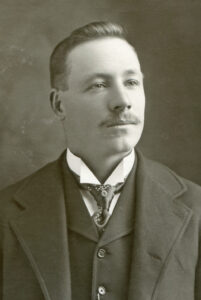
 When Charles Chadwick was born on September 5, 1876, in North Ogden, Utah, his father, Abraham Chadwick Jr., was 32 and his mother, Mary Marinda Garner, was 26. Charles Chadwick was born of a polygamous marriage.
At eight years old his summer job was guarding flocks of sheep on the high, sage desert prairies of northern Utah and southern Idaho. He was left alone in a sheepherder’s wagon with one week’s worth of food, a rifle, and a dog or two. Each
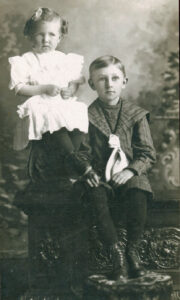
Lydia and Charles Chadwick
week they would bring him more food and check on him. At that age he was, with the help of a dog, expected to keep the predators off the sheep. Later, as a young adult he trained in blacksmithing and oil painting at the Utah Technical school. He went into ranching and proceeded to amass a small fortune in livestock. He’d become a very successful rancher in the community. However, he suffered a major setback losing nearly all his herds to freezing during an exceptionally cold northern Utah winter near Grouse Creek.
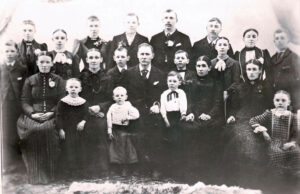
First Row – Eva Chadwick. Henry Loyd Chadwick, George Alonzo Chadwick, Issabell Chadwick
Second Row (sitting) – Emily Chadwick, Mary Marinda Garner, Abraham Chadwick Junior, Olive Ann Cazier, Celestia Chadwick
Last Row (all standing) – John Garner Chadwick, Louisa Jane Chadwick, Lydia Chadwick, Mary Ann Chadwick, David Chadwick, Charles Chadwick, William Abraham Chadwick, Fredrick Richard Chadwick, Hyrum Chadwick, Viola Chadwick, Olive Permilia Chadwick, Benjamin Chadwick.
To continue supporting his family he took the job of town marshal in nearby Oakley, Idaho, where interestingly Elder David B. Haight at the time was a small child. At the same time he also worked for the State of Idaho as a deputy sheriff. While successfully performing his law enforcement duties he was knifed and shot many times. We know this because his young grandson Royce noted decades later the scarring from the wounds on Charles’ body when they took turns bathing in the galvanized iron wash tub in their two-room cabin. The tub was used in the winter when it was too cold to wash up down in the creek. The water was heated on the side of the wood burning stove in the kitchen. Grandma Clara always got first water and privacy.
After Oakley, Charles moved to the cattle ranching town of Wolf Creek, Montana, where he became the town blacksmith, and a placer miner.
When Charles’ married daughter Erma passed away a day after giving birth to her first child, at 57 he and Grandma Clara took baby Royce in and raised him as their own. Years later, when Royce was 60 miles away in high school Grandma fell from the garden stairs and Charles’ sweet partner in life slowly passed away from complications of the fall’s injuries.
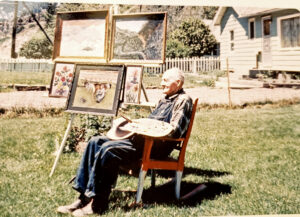
Charles Chadwick’s Oil Paintings
His grandson Royce remembers that at the age of seven he watched Charles Chadwick placer mining in the summers. In Montana the summer days are even longer than here. With light starting at 4 am and continuing until 11 pm it was possible to labor much longer that a mere eight hours. Standing in the ice cold glacier water with a hand shovel Charles would dig a new channel for a promising mountain stream. Once the stream was fully redirected into the new channel he’d go over to the newly empty original stream bed, shovel off the over burden, meaning the rocks and gravel, all the way down to bed rock. Then with a small hand tool he’d pick the sand and gravel out of the cracks of the bedrock. Inspecting the gravel by hand for any larger gold nuggets he eliminated the stones. Then he put the remaining sand a small scoop at a time into a gold miners pan. He’d sluice it around washing the lighter non-gold bearing sand over the pan’s edge until only the heaviest material remained in the bottom of the pan. Then with tweezers he’d pick out any tiny nuggets and gold flakes and put them into a leather poke. Then to get the really tiny pieces of gold he’d drain out any remaining water. Then he’d pull out a small bottle with liquid mercury in it, and pour a large drop of mercury into the heavy sand in the bottom of the pan, and roll it around. Even extremely small pieces of gold would stick to the liquid metal, but the non-metallic sand would not. Carefully he’d pour the gold bearing mercury back into the bottle. It was important to be very careful with the mercury because after many pans there was lots of gold absorbed into the mercury making it very expensive to spill any of it. Later they’d heat the mercury which would evaporate leaving the tiny gold flakes and dust behind. Royce was seven when he first remembers helping his grandfather do this labor. That means Charles was 64 years old and older when he was doing this heavy manual labor the summers of Royce’s childhood.

Clara and Charles Chadwick
Charles Chadwick lived in Wolf Creek the rest of his life laboring into his eighties. Then when his body could no longer continue heavy labor, he oil painted for sale art depicting the scenes of his wilderness life, and he continued gardening because in addition to providing food and beauty it reminded him of his departed bride, Erma. Their garden had not just vegetables, but also myriads of flowers all in row after row.
He had a saying, “There’s a difference between poor and dirty, and poor and clean.” His blacksmith shop, mining cabin, small home and yard were each tidy and organized, free of clutter. Up until a few days before he passed away in 1967 at the age of 91 he lived in the same two-room cabin where he’d lived since the early 1900’s. He was never rich, but he provided for two generations of his family.
While working as summer labor on Frank Thompson’s ranch near Wolf Creek in 1973, Frank told me a story about “Charlie Chadwick”. One summer at the start of harvest a spinning bar on a critical piece of Frank’s harvesting machinery broke due to a manufacturing flaw. In those days it took weeks to get a part in, if there was even one immediately available. Frank’s harvest would be lost that year, but then he remembered the town blacksmith. Charlie was getting older then and was no longer running his smithy, but it was Frank’s only hope. Frank took the broken bar in to Charlie and explained how his family would really be hurting if they lost their year’s crop. Frank asked Charlie if he could do anything to fix the broken rod and save Frank’s harvest. Frank knew that it would be next to impossible to repair a bar that spun that fast without having it warp and break again when reinstalled and brought to a spin, unless it was perfectly rejoined. Still he had to try because there was no other hope. Charlie and Frank went out to his smithy and fired up the long cold furnace. Charlie took the bar, measures, and calipers, and measured it for its original dimensions, and then used a blacksmith’s welding technique to rejoin the pieces of the bar. He added material to the center of the bar and worked it until it was solidly joined and bore the exact same circumference as the original so that it could be slid back into position in the machine. Then Charlie trimmed off the excess length so the bar would fit exactly. Frank reinstalled the rod. Ran the harvesting machine up to full speed, and engaged the mechanism bearing the bar. Against all hope it held together throughout the whole harvest. Frank said that later he ordered in the replacement part from the factory, but he never had to install it. He said the repaired bar outlasted the rest of the harvesting machine.
He died on October 28, 1929, in Payette, Idaho, at the age of 85, and was buried in Morris Hill Cemetery, Boise, Ada, Idaho, United States.