
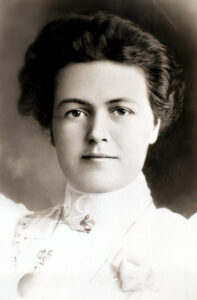
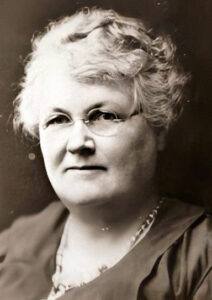
 Eliza Harriet Richins Blackburn was born October 9, 1876 at Henefer, Utah to Albert Francis Richins and Mary Jane Jones.
When Eliza was six months old, her parents, along with three other young couples, decided to settle a section in northwestern Utah, now known as Grouse Creek. They made the trip by ox team and wagon. It took them two weeks.
Their food supply was very low. On their journey to Grouse Creek the wild animals ate all the chickens, except one that they were taking with them. Eliza’s mother would stake this chick out each day, always keeping her eye on it. Eliza said she remembered her mother giving her a dry piece of bread to chew on and she handed it back to have her mother put something on it. She remembered that her mother cried because she had nothing more to give her.
Then she was but two years of age, a chipmunk ran up her clothes. It frightened her and she cried. Her mother didn’t know what had happened so didn’t know what to do. Eliza kept crying so her mother finally took off her clothes and found the chipmunk.
She was expected, even as a very small child, to help out around the place. While still very young she helped pile sagebrush. At night they mad bon fires to burn the brush. They all enjoyed singing around the fires.
In order to send the children to school and to hold church, the residents thought it best to congregate together and make a town. Some moved a mile up the valley. Her first teacher was Sarah Betteridge. They went to the Betteridge home for school where stools were made out of logs. They finally built a log school house with one door and window in it and had slab benches to sit on. Her uncle Phil Paskett was the teacher in the new school.
Eliza knew very little of play. About the only play she remembered was out of doors, riding stick horses and the young calves. The folks didn’t have money to buy dolls or other playthings. She was baptized in Cook’s Dam by William Paskett right after she reached her eighth birthday. The family lived a mile from the meeting house, and even though they had to walk a distance she won a prize of a hymn book for not missing for a year.
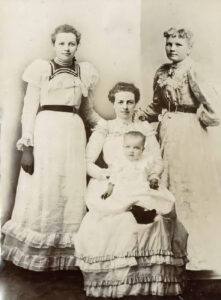
Richins Sisters Annie, Eliza, Orita, and Louisa
The residents of the town were told to live on their claims so they had to leave the town they had made. She had no playmates because of the distance. She helped on the farm with the land clearing and milking cows, milking eight or ten cows every morning at 4:00 AM and then drive them to the foothills before breakfast. She was only nine years old. She also pitched hay and grain. She had to walk a mile to school and was kept out of school for anything they needed her to help with, picking up potatoes, etc. In the winter the snow was up to her knees and after walking the distance to school she would have to sit with wet clothes on all day. She attended school until the 7th grade. Her father wouldn’t let her finish school because she disobeyed and went for a sleigh ride with some chums, but she tried to increase her abilities and talents herself.
Her father owned a general store. The store also housed the Post Office. She helped clerk in the store and was a big help to her father. When she was older, she went to Ogden, Utah a distance of 100 miles to take piano lessons. Her teacher was Mrs. Dott Childs. She studied for one year and enjoyed her lessons, which were later a help and a joy to her in her own home.
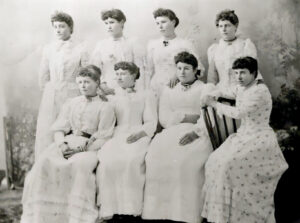
Penn Betteridge, Eliza Richins, Francis Toyn. Clara Cook, Penelope Paskett, Annie Kimber, Sarah Paskett, Mollie Toyn
She was popular among the young folks. She chummed with eight girls, and for amusement they would offer their services to anyone to cut carpet rags, do quilting, cut flocks for beds or anything else they would help with. The families would serve them a dinner and then take them home. They had a hard time to have a good time, having to make their own amusement. Another recreation to her was attending choir practice, especially in the winter when after choir they would go sleigh riding. When she was old enough, she started attending the Ward dances. The dances would last until three or four in the mornings. They would take their lunch with them and at intermission time they would eat.

Funeral of Lillian Paskett Richins Front Row – Melda Morgan, Virginia Richins, Eva Morgan, Myron Richins, Clifton Kimber, Evva Lee, Ora Lee, Larene Richins, Julia Cherry,
Second Row – Robert Leishman, Annie Richins, Eliza Richins, Herold Richins, AF Richins, Mary Jones, Sarah Richins, Orita Richins, Merla Lee, Nola Richins, Della Richins, Lawrence Kimber
Back Row – Oriel Blackburn, Martha Douglas, William George Richins, John Morgan, Newell Richins, Ruby Douglas, Wellington Richins, William Alma Richins, Isaac Lee, Orson Richins, Orva Wilford Richins, Myrtle Richins, Albert Morgan
Thomas Henry Blackburn came to Grouse Creek to teach school, and he rode from Terrace to Grouse Creek on the mail stage. Eliza was taking care of the Post Office. The minute he entered the store she said she knew he was the man she wanted to marry, though she had never seen him before. He was going to board with her uncle Arth and aunt Phoebe over on the west creek. Her aunt Phoebe turned to her and said “There’s one for you Eliza.” He went with her aunt and uncle and she didn’t get to meet him for two weeks. It was after the afternoon meeting that they were introduced. Pen Betteridge introduced them. They were talking and someone asked her what she was going to have for supper and when she said “Potato Soup,” Henry invited himself over for supper. He took her to the evening meeting. However, upon reaching the meeting house her other suitor insisted on taking her home. They left Henry to walk home by himself.
During the winter Eliza’s brother Ether had typhoid fever and Henry used to come and sit up nights with Eliza while she took care of her brother. The following is a poem Henry wrote in memory of those nights.
Just As The Sun Came Up
After the close of a weary day, just as the sun went down,
I mounted my horse and rose away to see Eliza in town,
Thinking quite deeply, I rode along, over the snowy road,
Humming so gaily an old love song, Just as the moon came up.
One thought of Eliza came then to me, filling my heart with joy,
Striking the chords in sweet harmony –pleasue without alloy;
Her sweet face appeared to beckon me, her hand to lead me on,
To drive away tears, make sorrow flee like gloom before the dawn.
As I knocked at the north kitchen door, ‘Twas opened very wide,
Greetings were given me by the score, just as I stepped inside,
The place appeared very dear to me, it seemed so much like home;
Right happy there I felt I’d be, like sea-gulls on the foam.
One bright picture of Heav’n on the wall, I fancied I would see;
One of the time when I came that fall, one of the time when we
Unhampered with friend or with work to do, enjoyed ourselves so well
Visiting with friends and learning to love the place where we should dwell.
And then when the folks had all gone to rest, just as the clock stuck ten,
We talked of the thing that we loved the best, over and over again.
With things to say the time passed away, with refreshments hot to sup,
Bidding each other an Au Revoir, Just as the sun came up.
Trotting so swiftly along the road back to the other side,
I rode on the back of my old bay house, as swiftly as I could ride.
The evening, I thought, was very well spent, the joy quite filled my cup.
I kissed Eliza a sweet goodbye, Just as the Sun came up.
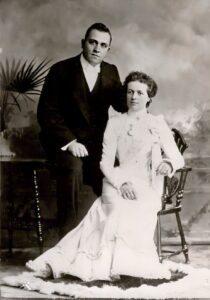
Wedding Day – Thomas Henry and Eliza Harriet Richins
They went together all winter long, going to church, choir practice, dances, and parties. In the last part of May, after the close of school, they went to Brigham City, Utah traveling in a buggy. Their chaperones were John and Em Gilbert. The trip took them two days. Henry stayed in Brigham one week and Eliza went to Ogden and stayed with her uncle and aunt while she had her wedding dress made. On the morning of June 5, 1900, they met again in the depot at Salt Lake City. They stayed that night at the home of President Joseph F. Smith. His wife Edna was Henry’s aunt. At 6:00 AM on the 6th of June they went to the temple, and after going through the Temple and receiving the endowments they were married by President Joseph F. Smith.
They made their home in Grouse Creek, Utah where on May 14, 1901 their first child Oriel Henry was born. In 1903 they were called to Yost, Utah where her husband was made the first Bishop of the Yost Ward. While residing here two more sons were born, namely: Albert Gerald, born August 7, 1904 and George Alva, born February 14, 1906. In 1906 they moved to Ogden, Utah where they made their home for a time. Their 4th son Claudius Elvin was born July 2, 1908 in Grouse Creek, where Eliza went for confinement. They moved to Brigham City for a short time and then back to Ogden, where they lived the remainder of their lives. A daughter, their first, was born in Brigham City on February 11, 1910. She was named Verla Jane.
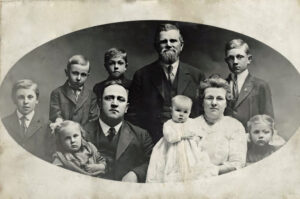
Albert, Elda, George, Henry, Claudius, AF Richins, Amy, Eliza, Oriel, and Verla Blackburn
In Ogden, the husband and father was employed by the Burton Implement Company and later the Ogden Police Department. They bought a home located at 2628 Lafayette Ave., later changed to Eccles Ave. Eliza indeed made this house a home. Her duties were many, for in the next few years three more daughters blessed the home. Elda Lucille, born April 10, 1912, Amy Louise, born July 27, 1914, and Roxie Merle, born February 23, 1915. Henry was a devoted husband and a loving father. He spent a lot of time with his family, taking them on picnics and hikes. They were very proud and happy when they could send their first son on a missing for the church to the Southern States.
On May 11, 1921 her loving husband was taken from her, in death. This was a hard blow for Eliza. She was left with eight children. The youngest being four years of age. Eliza had a strong testimony of the gospel which helped her though this trying time. After her husband’s death, her father spent a good deal of time with her. Helping her with arrangements to remodel the house. Many friends were raised up to help her.
On September 6, 1922 she married Robert Mckee Leishman, for time, in the Salt Lake Temple. He gave to her the companionship and help that was needed in rearing her children.
He home in Ogden was much like a hotel. Her family and friends from Grouse Creek made it their home when they came to Ogden, and she was always a gracious hostess and many times would go without herself in order that those who were visiting might be made comfortable. She loved people. Her home was always clean and tidy, and taught her girls the art of homemaking. Over 30 were born in her home. Eliza took care of them and also the mothers, and more often the rest of the family that would accompany them to Ogden.
She was always a faithful member of the church, doing what she could to help the work along. She was President of the Yount Women’s organization in the Yost Ward and worked continuously in the Ogden 12th Ward in Relief Society and religion class. She and her 2nd husband, worked together in genealogical work, going to the Temple as often as they could. She enjoyed this work very much. She spent many hours doing research work. She always tried to teach her children the gospel and those things that they were expected to do. She taught them that they should be willing to assist in the upbuilding of the Kingdom of God. Nothing pleased her more than when they took an active part.
She did washings and ironings that her girls might have a musical education, and arose earlier than necessary for her to see that they could get their practicing done. She was never too busy to help her children and advise them when they needed her. She was always even-tempered and loving to those who sometimes abused her. When her children married, she welcomed the new members to her family, always making them feel that they were part of the family. No grandmother ever loved their grandchildren as she did. She would plan parties at holiday time and birthdays for those who lived in the same vicinity.
One of her hobbies was cooking. She really enjoyed this part of her housekeeping. Money was always scarce but she always prepared food that would be fit for a king. She made her children’s clothes and tried to teach them to appreciate the things they had.
On August 4, 1940 her 2nd husband died of a heart attack. Again, she was left alone. She had a large house to care for and was not in good health herself, but she wanted to live in her own house and be independent. She took in boarders to help sustain herself. Her health started to fail here in the summer of 1941. From that time on she suffered a great deal. Many times, the only relief she would get would be from the administrations of the Elders. Several times when she was too ill to go to church, she would have the Bishop bring the Sacrament to her. She felt she needed it to help her keep her faith. She said many time that, “She continually prayed for help because she felt that Satan was try to destroy her faith.” Her suffering was almost unbearable at time. She passed away on January 27, 1942 leaving eight children, thirty-four grandchildren and her mother. Her friends were numerous. At the time of her death, hundreds attended the funeral. She is buried in the Ogden City Cemetery.