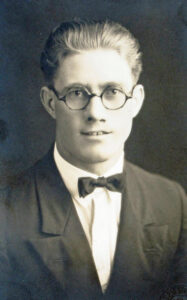
 I was born one cold morning on the 25th of October, 1903 at 3 A.M. in the town of Grouse Creek, Utah, with the birth mark of a harelip. When I was ten months old, Father and Mother took me to Oakley, Idaho in a lumber wagon to Doctor Goodfriend. He sewed my lip up, but advised Mother to stay for a few weeks. We were there for three weeks and I was operated on twice.
William Pope Paskett, father of Melvin, was born March 14, 1855 in Tetbury, Gloucestershire, England. William came to America in November of 1871 and settled in Henefer, Utah along with other members of his family. He married Sarah Ann Hennefer on June 34, 1876 and they moved to Grouse Creek, Utah. To this union were born five daughters and one son: Sarah Patience, Penelope Ann, William James, Louisa Emeline, Cora May, and Lillian. Sarah died December 5, 1889, two weeks after Lillian was born.
Annie Louisa Mecham, mother of Melvin, was born February 13, 1870 in Grantsville, Utah. She went with her parents to Grouse Creek in 1877. They were the parents of ten children: Mary Jane, Stephen Henry, Frederick William, David “M”, Hattie Lavina, Rhoda Annie, Charlotte, Melvin Oscar, Harold Andrew, and John Mecham.
I can remember being baptized by George A. Blanthorn on the 28th of October 1911 at his farm in a hole of the irrigation ditch. I was confirmed on the 29th of October 1911 in Sacrament Meeting by James W. Betteridge.
When the rock meeting house was being built, my brother, Steve drove the team up to the meeting house and I drove them back. Once while coming back, I turned around too short and it was the next thing to tipping the wagon over. Father said I couldn’t drive after that.
During this time, we were building our new house and in November of 1911 we moved in. That was our first Thanksgiving, we were thankful for a better home.
In the spring of 1912 Dave and myself were going out to work in the field when the team was frightened and ran away. I was pulled from the wagon by another horse and I fell on my left arm and broke it. I walked to the house and showed it to the folks. I was frightened and started to cry. A few days later James W. Betteridge, my Father, myself went to Oakley to attend conference because we belonged the Church of Jesus Christ of Latter-day Saints. While there we planned to have my arm set. Doc Oldham put me under with ether and then did his best to pull my arm out at the shoulder. I was laid up with my arm in a sling for a long time.
In March 1916, I was ordained a Deacon in the Aaronic Priesthood by my father. About that time, I joined the Boy Scouts. Godfrey Ballingham was my Scout Master and we took several hikes. One trip the Boy Scouts and Beehive girls took an outing to Cotton Thomas Basin and stayed for three nights.
My brother, Dave, joined the army in February 1918 and went to Florida to train and then to France. He came home in 1919 after the war ended.
In the spring of 1921, when I was 18 years old, I was sent to the Vipont Mine to get one of the saddle horses, which Steven had been using. I did not return home and instead went to work at the mill. A group about my own age spent many happy hours together. One night seven of us, including boys and girls rode to Cotton Thomas Basin. We returned in time for me to go to work at 12, midnight, known as the graveyard shift. I spent five weeks at the mill, then came home to work.
In September, 1923, I went to Oakley, Idaho to find work. Most of the winter was spent in moving houses with Mr. Chas. Briggs.
In the spring of 1925 Dave and I went to Oakley. I worked with A. A. Martindale and Dave went to work for John MacMurry. We spent the summer together and worked for any different people. Our crowd spent many happy hours together, at dances and parties.
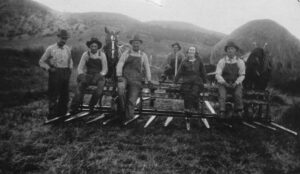
Haying in Grouse Creek – Melvin Pasket on far right
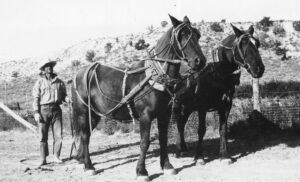
Haying in Grouse Creek – Melvin Pasket
The winter of 1926, was spent in cutting posts. Many a cold trip have I taken along Goose Creek and in the spring, I was out herding sheep for Johnnie Franks. I also helped around the sheds and did the cooking. During that summer Dave and I worked on the Old Hunter place. It was while we were batching that Relia and Verla (Hale) became acquainted with us. They were helping bottle some fruit.
In September 1927, Bishop Wallace A. Hale asked me to go on a mission. My call was for Australia. Parties were given in my honor and the farewell at the ward made me feel like running. I was asked to speak and did so for one minute on two shaking knees.
We took the train to Oakland, California. The trip was very pleasing to us all, as we crossed the Great Salt Lake, and then wound our way through valleys, and up over the snowcapped mountains of Nevada and California. The moon shone serene on the rocks and pines, making them stand out like black ghosts against the white background, as we viewed them from the train windows.
From Oakland, we took the ferry to San Francisco and then boarded the SS. Sonoma.
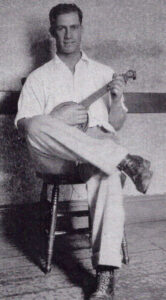
Melvin Pasket with Banjo
On Thursday, December 8, 1927 we landed on the great land of opportunity and our destination, Australia. We were anchored out in the Bay at noon because we had to be examined by a doctor. Each one was supposed to have at least $200 on his person. As we were anchored out at sea, President C.H. Hyde came on board and relieved our minds, as we were without purse or scrip. I could not talk my way off, for I was not well acquainted with the Australian language.
Elder Berrett and I spent a few eventful days at Sydney, and then a long train ride to Brisbane, our destination for a few months.
When my mission was over, we left Australia for the return trip to the USA on February 22, 1930 and landed at San Francisco on March 13, 1930.
I spent the summer at Grouse Creek working with Father and John. It seemed like old times again to be on a farm. It seemed as though I had not been gone a week, but I was actually gone for 29 months.
Grandmother Mecham passed away on September 4, 1930. Most of the children were in Grouse Creek for the funeral. Shortly after going back to work, my brother, Fred, took sick. He held out for a month, most of that time was spent in the Rupert Hospital. Mother and Father were over there with him most of the time. On October 16, 1930 he passed away from Typhoid Fever.
The first of January, 1931 John and I drove some horses to Willow Creek; had new Year’s dinner with Relia and then went to the dance that night.
Harold and I started for Oakley, but got hung up in a snow drift and had to go around the mountain. We were ten hours on the road and traveled 167 miles to get 75. I stayed in Declo for a few days and then went to Oakley and spent about two months. I had a good time in Oakley, but could not find any work. I was called to Burley on April the 26th, 1931 and began working for J.R. Simplot.
Sunday, May 8, 1932, Rhoda (Lee) my sister, and family were out for a car ride. It ended in an accident causing the death of her young daughter Louise. She was buried Tuesday, May 10. I helped dig the grave.
Friday January 20, I took my team and gave the group a sleigh ride up to Emily Kimber’s to a party. I had to take Myrl and several others home. The next week a surprise was given on Emily, her birthday. February 2, Myrl entertained us with a party. Their aim was to take the school teachers and keep them until late in the morning, but it did not work. The parties averaged at least three a week all winter.
I have enjoyed the farm work this spring. Harold and I have made the old place look a lot different. On April 17, 1933 I made a trip to Oakley for a wagon. I have been trying to invent things to help the farm work along. After returning from Oakley, I was working for Lester Carson for a few days helping to get their water on the meadow. The first of June, I was up there again helping with the sheep and helping to repair the pipe line.
Just before Thanksgiving I was trying to become an actor. The play we performed was on December 7. I rather enjoyed the rehearsals. The play was entitled “The Man of Yesterday.”
The school had a track meet and Park Valley Schools were the contestants. A few days later Grouse Creek School went to Yost for the final tryouts. They have some good athletes.
I think at last we are going to have water in Grouse Creek. Mr. Frank Hughes is working on E. M. Dunnis’ well drilling machine and has it at our place. He wants to drill several wells and then get a place to live. I have enjoyed working with him as I am learning a great deal through it. Frank and I are at the blacksmiths while Harold, George, Robert and Archie do the other work. We started to work on the machine last on December 26, 1935 and expect to have it working within a week.
I did not go to the New Year’s dance as I had been working all day and besides it was stormy. We have been working on the well machine the past two weeks. This week may see us move it up to Sid’s to start drilling. I have had the jobs of fixing the motor and helping Frank work out some ideas and thinking up some new ones.
The month of January, 1936 was spent in building drilling machines and hauling hay from Etna. We had the machine going awhile but found that some of the tools would not fit together, so Harold rode over to Oakley and Burley to see if he could get them fixed there. He was gone for a week.
We had one of the worst blizzards that Grouse Creek has known for a long time. It started Friday, February 7, 1936, and did not let up all day. The storm was so bad that the mail man could not get home until late at night. He went down Thursday and only returned to Kimber’s ranch, had to stay there all night. I have enjoyed this winter with the kids as I helped them build a toboggan and they have had a great deal of sport riding down the hill.
School was closed for a while on account of sickness, mumps and scarlet fever. Also Sunday School and meetings have been postponed for a while. All I have been doing the past month is tinkering around trying to build machines. Frank helped us a couple of days to make a heavier bit and Arlin Wakefield let me take his engine so I will have more power and I hope that now we can go down a little way and see what is down under this old hard pan.
The first part of September (1936) we were getting ready to drill wells. The pipe arrived August 25 and the next day Harold and I went with them to get some pipe that was left on the flat. Harold and I did a lot of work to get the machine in place and on September 14, Frank was here and we started to drill. There was a few days work and then a few days rest in between times.
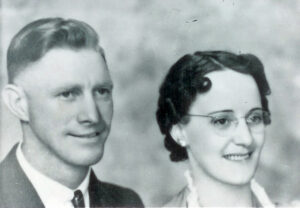
Melvin Paskett and Relia Rachel Hale Wedding 1938
On Saturday, April 2, 1938. Relia and I were married in the Salt Lake Temple. After leaving the temple we went to the Seagull Hotel to stay. That night we went to the Australian Missionary Reunion and met some of my old pals.
On April 7th, 1938 a reception and shower was given for us. Many old-time friends and relatives were present also many new people at Oakley. We received many useful presents and had an enjoyable time visiting. We stayed in Oakley until Sunday.
Alfred Lee brought us over to Grouse Creek. After arriving here and enjoying our supper, the whole town came down and took us for a ride. Drove up and down the street and finally ended up at Godfrey’s.
On the 19th of May. 1939, Relia was taken to the hospital and we became the proud parents of a girl (Mariel) which has been a joy and comfort to us since that time.
On January 28, 1941, I rushed Relia to the hospital and there was another baby girl in the family (Illene).
I worked for Stan (Marchant) and Gerald (Marchant) all summer working the colts and anything they asked of me. We had a heavy snow storm the last part of May just after shearing which broke down a good many trees and laid us off for some time. I did some of the plowing and potato planting and all farm work in general.
I did most of the truck driving at spud picking time and then we made a trip over home in the truck to bring back some wood and a milk can. I spent the winter in doing odd jobs and helping with the sheep again. On January 29th, l943, our first son, Melvin Deloy, was born–how proud and happy we were.
In June of 1943 1 had a chance to buy a Ford Model A for a reasonable sum so invested in the same. Our first trip was made to Grouse Creek to see Harold and John, just home on furlough. John had taken on the responsibility of a wife at the time. We stayed overnight and then came back to work. We have enjoyed the car very much, making several trips to Grouse Creek and a good many to Oakley. Relia learned to drive so as to make trips to town when I could not.
On Friday, September 14, 1945, a baby girl was born to us (Christine). Relia spent 10 days in the hospital at Oakley with her.
In the Spring of 1949, we decided to quit farming and take the job of caretaker of the church buildings. So, in March we left the Stanley Carson farm and moved to the George Clark Place at Marion. While living there I was working for Merrill Robinson until the other job started in June. I had to dispose of my horses. Eldred Bair, my brother-in-law was glad to get them.
We bought us a home and one acre of land from Eliphet Hale (Relia’s brother), located north and east of the Oakley high school building. I was worthy enough to receive a loan from the Church Welfare and I was glad to have the privilege of paying this back at a monthly rate.
Mariel, Illene and Deloy have this memory of a special camping trip in 1950. The people of Oakley celebrated Independence Day or the 4th of July as it is commonly called with a town picnic at Bostetter, a campground in the hills twenty miles west of Oakley. This particular year Grandpa and Grandma Hale decided to go a couple of days early with as many family members as possible and camp out. Uncle David and Aunt Verla Martindale, their children, Uncle Fielding Hale, Relia and children and maybe some other cousins were making the trip. Melvin didn’t go because he had to stay home to milk cows and do other chores. Grandpa’s old white truck was loaded with mattresses and bedding (we didn’t have sleeping bags), boxes of food, clothing and cooking gear and we all piled on top. Twenty miles of gravel and dirt roads uphill and down, alongside canyons and gullies was quite an adventure for all of the youngsters.
About two miles from North Water, the truck stopped and refused to go any farther, no matter what the men did. The decision was made to have Uncle Fielding coast the truck back to town and get Melvin to come up with his Model A car and hay wagon and transport us the rest of the way. Everything was unloaded and placed under a lone cedar tree by the side of the road, the truck turned around and we were left. Uncle David and Grandpa, who were avid fishermen, saw no reason to sit under the tree waiting when there was a fishing stream nearby, so they took all those who wanted to go and headed down the canyon with their fishing poles. The rest of us sat and sat and sat, getting hotter and more tired by the minute. The adults did not want to unpack any of the food because they thought it wouldn’t be long before we were picked up and taken on to the campground. None of us knew that Uncle Fielding was having a hard time locating Daddy in town. Finally Relia and Verla decided to take all the kids who were big enough to walk and hike to North Water where we could at least get a drink and some shade. Grandma stayed with the littlest children under the cedar tree to wait for the car.
Melvin was not happy about making the trip to pick us up but late in the afternoon never was a sight more welcome to our tired hungry bodies than that old car laboring up the hill toward us as we waited at North Water. Another reason for the delay was because they could not find Uncle David and Grandpa and had to wait until they had returned to the cedar tree before they could load up and come to get the rest of us. We got onto the wagon and continued our slow journey to Bostetter. It was a long hard pull for that car with a wagonload of people and supplies. The fanbelt gave out as we were going up the last long hill and everyone who was big enough was pushing the wagon and car to the summit where it was possible ta coast down into the campground. Just as we reached the crest of the hill, a jeep came roaring around the curve in the road. The driver saw our car, slammed on his brakes, turned his steering wheel and the jeep rolled over onto its side, a chain on the jeep flying out and hitting one headlight of the car, breaking it and scattering glass all over the road. Everyone who was standing by the wagon or sitting on the wagon, jumped off and ran either up the mountain or down into the canyon. No one was hurt, but the jeep lost all its radiator water. The Lord must have been with us to prevent a more serious accident, but it was the last straw for Daddy and I am not sure he ever forgave us for that trip. The men tipped the jeep back upright, and we carried all our gear down to the campground to the first campsite we could find because it was starting to get dark and Melvin got the car and wagon turned around and began the long coast back to town. We still had to set up camp and cook something to eat before we could settle down for the night.
It must have been fun for everyone after that first day though, as we all hiked and played on the tree branch that looked like a horse. Other townspeople arrived in a couple of days for the big celebration. Illene remembers the foot races on that day and how she, Mariel, Deloy and Christine participated in them, each one winning first or second in their race. Someone asked Relia what she fed her children to make them such fast runners and she replied, “Just plain bread and milk.” The prizes were a whole package of candy kisses for first place and a whole package of marshmallows for second place. Daddy would not come back to pick us up but he did ride up with someone for the celebration.
David Severe had come up with his big truck and there was room for all of us and our gear to ride home with him. His truck bed did not have sides on it so we had to stay close to the middle so we wouldn’t fall off during that scary ride back home.
During February 1952 we had to take Christine to Salt Lake to have an operation. It was a Wilms Tumor of the kidney and had turned to cancer. The kidney was removed and the kid got along fine for several years.
Christine took sick again in February about a year after she was operated on and Dr. Sutton could not make out what it was, so sent her to Salt Lake again. The x-rays showed that cancer had gone up into her lungs. All the hope the Doctor gave us was one chance out of a hundred. After ten days of x-ray treatments, we brought her home again and then had to take her back for more treatments. She and her mother left again for Salt Lake, April, 1953.
Our fifth daughter, Anell, was born August 25, 1953.
On August 2, 1954, Christine passed away and was relieved of her constant pain and suffering.
Melvin began working for Ray Sager as a carpenter and helped build many of the new homes around Oakley.
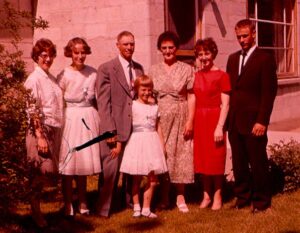
Ileene, Lurice, Melvin, Anell, Relia, Mariel and Melvin Deloy Paskett
Melvin began having bad headaches and would come home from work hurting so badly that all he could do was lie down on the couch. He didn’t say anything to Relia about these headaches and she was unaware of their severity. By the end of December Melvin was unable to eat or take care of himself. Relia took him to the doctor and after tests were performed, she took him to Salt Lake City to a specialist. After the first tests at the hospital, the doctors were prepared to give Melvin radiation treatments as they thought he had a small malignant tumor on the right side of his brain. But there was concern that this tumor on the right side was affecting his speech which is controlled by the left side of the brain. Melvin passed away on January 14, 1968 as the result of a massive brain tumor. An autopsy was performed after his death and it was discovered that the tumor covered almost his entire brain, starting in the front and circling around the right side to the left side and almost meeting itself.
The funeral was held January 17,1968 in Oakley with many family members and friends in attendance and Melvin was buried in the Oakley Cemetery next to his daughter, Christina.
History created from information on Family Search