
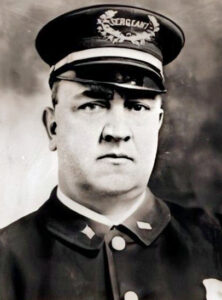
 Thomas Henry Bark Blackburn Jr. was born August 8, 1877 at Brigham City, Utah. He was the 2nd child and the son of Thomas Henry Bark Blackburn and Roxcy Lucina Bigler. Young Thomas or “Henry”, as he was called, spent his boyhood in Brigham City, Utah. He lived in a home where love was in abundance. His father owned and operated a store and Henry received valuable training working in the store.
Henry attended schools in Brigham City, and as a young boy and young man he was faithful in his duties in the Church to which he belonged – The Church of Jesus Christ of Latter-Day Saints. Henry was baptized on August 9, 1885.
When Henry was 18 1/2 years of age he was called to serve as a missionary in the Southern States Mission. He left Brigham City on March 19, 1895.
Henry left his native Utah on March 21, 1896 for the Southern States Mission, a mission which lasted well over two years. From his missionary record we learn that he started his labors in Kentucky on March 29, 1896.
While on his mission Henry enjoyed many wonderful experiences. The following is an example of the feelings of the local residents towards the church.
The following is taken from today’s issue of the Flemmingsburgh Gazette. It was written by H. F. Lewman the correspondent from Wallingford.
“We are sorry to learn that our brother from Johnsonville is so taken with Mormonism, and in the enlightened nineteenth century, and in the face of all that has been done by Brigham Young and his cohorts within the recollection of our school boys. Any man well posted on what Mormons believe and would practice if the laws of the country would allow it, is either a knave or a fool. We think the W.S. Constitution should be revised and made to read that, all but Mormons should have the right to worship God according to the dictates of their own conscience under their own vine and fig tree. What about polygamy, or celestial marriage as it is termed among the religious descendants of Joe Smith? Is it the prejudice that the laws of our country forbid any man having more than one wife? Is it prejudice that makes your blood run cold in your veins when you read the account of Mountain Meadow Massacre? What kind of religion does any man have who can take in cold blood the life of his fellow man, who has never harmed him in thought or action, much less the lives of innocent women and children? Yet such is the case with Brigham Young’s angels. These are historical facts and the brother would do well not to let the Elders of the church of latter-day saints pull wool over his eyes. Now we’ve met with Blackburn and must admit he is a nice gentleman, and we are sorry to see him fooling away his time with such doctrine.
In Wednesday’s (August 18, 1897) Gazette appeared the following from Monroe Pickrell, the Gazettes correspondent from Johnsonville. This is in answer to H.F. Lewman’s effusion of last week.
“The ignorant braggart Wallingford appeared last week in an article intended as a cutting rebuke to an article written by us several weeks ago. How this coconut-headed idiot displays a variety of ignorance so dense that it could be cut with a knife and a malignant stupidity that would have been ridiculous if it had not been pitiful. This re-lipped brute follows up his conclusive evidence of the fact that what he doesn’t know about the Latter-Day Saints would fill a library. We seldom notice such foul mouthed idiots, so in conclusion we will lay this aside by saying for this despicable specimen of degraded humanity to post up on Mormonism. Now to make a long story short, we say you are a liar or simply a jackass.”
Henry received the following letter from his father on November 2, 1897.
My Dear Son Henry;
It is with very peculiar feelings I try to write to you today. President Clawson wrote you a letter the other day to inform you of our trouble and no doubt before this you have heard the sad news, and up to the present time I have not been able to control my feelings and collect my thoughts to write to you. Yesterday I mailed you the papers and the books you sent for. (Clem gave it to me.)
We have had a hard time since September 15, when I took sick and today is my first day in the store since that time and I am still very weak and while I was sick our dear Claudious had full charge of everything and had everything to do. He worked very hard and he would not give up. He felt that it would not do for him to give up while I was sick. He had a cold and did not feel well for some little time. He said all the time, if they got him in bed he was afraid they would keep him awhile, and he felt like the Savior, that he must be up attending to his Father’s business. Oh, Henry! He was a good and observant boy, and did all he could to make my labors light. On Sunday October 10th, he went to bed and Ma worked with him for days and it was thought they could keep him from having Typhoid fever but in about eight days he went into it and got delirious and was that way most of the time. He suffered greatly all the time and Ma stayed with him almost day and night as she had done with me for four weeks before, and the Lord gave her great strength or else she could not have stood it. I can never feel grateful enough to Ma for her faithful labors over us all. On Monday, Oct 25th Claudius commenced to sleep a little – He had not slept before and on Monday night Brother Sorenson and George Ingram sat up with him and he slept as nicely as he ever did and on Tuesday morning, we all felt encouraged that he would soon be better and around again. We expected him to wake and Ma was at the bedside watching for him to wake as he would recognize her and, judge of her surprise when she placed her finger on his lips to find they were cold. She called me and we found a cold sweat over his body and felt he was going. Charlie and I administered to him but he continued to get lower. This was at half past 1:00 and he was dead at2:00 o’clock on Tuesday 26th of Oct. It was so sudden that the blow was almost more than we could bear, besides this our little Leal was laying low with the same disease and she has been low ever since, but we believe she has changed for the better. Gladys has just come up and told me she is better and we hope and trust that the Lord will spare her to us. It was a hard blow to take, Claudius away from us, but no doubt if we knew the purpose of God, we would see that it is all for the best. He was a good boy in every sense of the word and no doubt Gerald and he will be a big work behind the veil while you are doing God’s will in preaching the Gospel of peace to people on the Earth, and you our only boy on Earth – much will be expected of you to help in the ministry of God, and trust you will never be found shirking any responsibility that may be placed on you. I know our boys on the other side will do all they can for you and the rest of us. I want to say to you my boy do not become weary or disheartened but go forth, if possible, with renewed vigor and preach to the people the principles of truth. Be obedient to the authority of God and all will come our right. Leal said to send a kiss to you. Ma and all the rest join in best love to you and we pray that God will bless you and prosper you in all your labors, is our great desire for you. Your loving parents – Thos. H.B. and R.L. Blackburn.
Claudius Blackburn
“An exemplary young man struck down by dreaded typhoid fever.”
Tuesday, October 26 about noon, Claudius Blackburn breathed his last. For several weeks the young man has been ill with typhoid fever. Monday night he apparently rested much easier, and up to within a short time of the crisis his faithful watchers entertained more sanguine hopes of his recovery. His death was a peaceful sleep. Claudius was past fifteen years of age, but in spite of his youth he was trusted even with complete charge of his father’s store during the laters recent illness. He was a fine young fellow, with numerous friends and of whom his parents were justly proud.
It was some three years ago when Mr. and Mrs. Thos. H. Blackburn had the misfortune to lose their son Gerald, he being about fifteen too. The warmest sympathy of the entire community goes out to the relatives in this great affliction. But there must be gladdening satisfaction to the sorrowing family in the belief that in a few short years at best there will be a joyful meeting above with these departed loved ones.
Henry returned from his mission the later part of the year 1898, after having filled an honorable mission.
After returning from his mission, he enrolled at the Brigham Young Academy at Provo, Utah and upon receiving his teachers certificate he was assigned to teach school at Etna, Utah. It was here that he met his future wife. Almost as soon as he arrived in Grouse Creek, he met her in the store where she was working. This girl was Eliza Harriet Richins, one of the most beautiful and popular girls of the town. Henry boarded and roomed with Eliza’s Uncle Arth and Aunt Phoebe Richins.
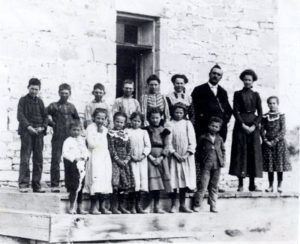
Etna School
Back Row: Warren Jones, Tom Warburton, Valison Tanner, Ralph Tanner, Mary Simpson, Edith Lucas, Henry Blackburn, Amy Warburton, Maude Lucas – Front Row: John (Jack) Jones, Hazel Jones, Emma Lucas, Jennie Douglas, Pauline Warburton, May Douglas, Mark Warburton
Once when they were courting, they went on a sleigh ride. There was a ditch between Grouse Creek and Etna. They were going to a dance. On the way the sleigh turned over and they all got muddy.
He courted Eliza all that winter and after school was dismissed in May he took Eliza to Brigham City to meet his Father and family. His mother had died February 13, 1899. It took them two days to make the trip by buggy so as was the custom and the proper thing to do, they took along John and Es Gilbert as chaperones. Another couple, some of their very best friends went along too as they were to be married on the same day as Henry and Eliza. Eliza went on to Ogden to prepare for her wedding and have her wedding gown made and one week later, on June 5th 1900 they met in Salt Lake City. They spent the night at the home of President Joseph F. Smith. Two of Presidents Smith’s wives were great aunts of Henry’s.
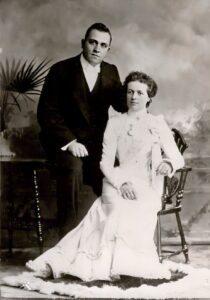
Wedding Day – Thomas Henry and Eliza Harriet Richins
The handsome and lovely couple were married on June 6, 1900 in the Salt Lake Temple for time and all eternity. The ceremony was performed by President Joseph F. Smith. They were honored on June 11, 1900 at a reception in Brigham City and then again at Grouse Creek upon their arrival there.
Their first home was the old house across the lane in Grouse Creek. The first cow they had was earned as wages for working.
Henry continued his profession as school teacher in Grouse Creek. Almost one year later their joy was complete when their first child, a son, was born on May 14, 1901. He was name Oriet Henry.
They were happy living in Grouse Creek and when a call came to move to Yost, Utah they were sad to leave. This call came to them in August 1903. Henry was called by the First Presidency of the Church to be the first Bishop of the Yost Ward.
They lived in two different homes in Yost, but because of some unhappy experiences they were very unhappy while living there. Some of the people in Yost who were not members of the Church resented a Bishop of the Mormon Church teaching their children. This caused quite a bit of dissension.
While living in Yost two more sons were born: Albert Gerald and George Alva. Gerald was born 7 August 1904 (Henry’s birthday present). Alva was their Valentine baby, born on February 14, 1906.
When Gerald was born two of Henry’s sisters, Leal and Genevieve spent the summer with them to help Eliza out. Aunt Leal tells how they would gather in mushrooms and how they all enjoyed them. Henry delighted in teasing his little sisters but they loved him and seemed to know that he would play jokes on them as long as he lived. They would go into the hills to pick pine nuts which they all loved to eat. Henry was happy when he could go on such an excursion, and especially when he could take someone with him to share the joy.
Because of their unhappiness in this place Henry applied for a job at the W.W. & M. Co., and in April of 1907 moved with his family to Ogden, Weber, Co., Utah. They made their first home in Ogden at 661 27th St.
Things were not easy for Henry and Eliza their first year in Ogden, but they were happy to be there. They made many new friends.
After school was out in May 1908, Eliza took the three boys and made a trip to Grouse Creek. The purpose being Eliza and Henry were expecting a new baby the latter part of June. After they arrived there, they found an epidemic of whooping cough which all of the boys contracted. Henry desired to be with them when the baby arrived so he made a trip to Grouse Creek and when the time arrived for him to return to work, he left reluctantly because the baby had not arrived. Finally, in fact the first day after he left for home, their 4th son arrived.
Henry decided that maybe farm life was the life for him and he tried to purchase land in the area of Grouse Creek, a place he held very dear. However, upon learning that the land he desired was bought by someone else, he gave up the idea for the time being.
While living in Brigham City they enjoyed their new purchase of a horse and buggy, and also a cutter which they used in the winter. They were very proud and enjoyed riding together in them.
Henry was desirous of bettering his working conditions so he went back to Ogden to secure better employment. When the baby was one month old, they moved back. They purchased a home at 2628 Lafayette Ave. (later changed to Eccles Ave.) This was to be their permanent home. It was a large place which would accommodate their growing family. It was on the outskirts of the town at that time.
He went to work for the Burton Implement Co. and because he was such a jovial and well-mannered man he was well liked by the customers and fellow workers.
After their return to Ogden, they did a little better financially, but Henry worked hard to keep the wolf away from the door. He was handy at many things. He was the family shoe repairer. He fashioned a small cupboard for Verla out of a wooden box. All the girls enjoyed this “little cupboard”.
On April 10, 1912 another baby girl was born. She was the first to be born in the family home. They named her Elda Lucille. Albert F. Richins (her grandfather) blessed her on April 25, 1912.
While employed at the Burton Implement Co., he was appointed as a special policeman by T.S. Browning, Ogden Police Chief. Later he was made a patrolman on the Ogden Police Force. His many experiences here were interesting and many times dangerous. Henry was a large man just 1/4 inch of being 6ft tall.
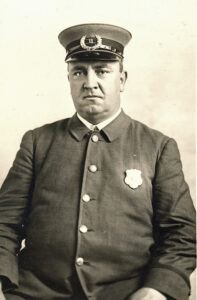 During the years he acted as a special officer, Police Officer, and Deputy Sheriff he had many opportunities to show his ability with his fists.
In spite of his stature, he was very athletic. He liked all forms. Baseball was his favorite sport. He was a catcher and an excellent hitter. Oriel says: “He could blast that ball a mile.” He used to enjoy playing baseball with all the older boys in the neighborhood and was welcomed by all as one of the bunch.
Henry was loved by all the young people in the neighborhood. He would take his boys and all the other boys who wanted to go (and they all did) and hike up to Mt. Ogden or Malans’ Heights. Oriel tells us that Father would arrive home from his afternoon shift on the police force at 11:00 PM and we would start out about midnight so as to be on the peak at sunrise. This was always a pleasant trip, and he would always have his Kodak along for the sights he enjoyed most.
Henry didn’t forget the younger members of the family either because he was always taking the whole family on picnics up to Malans’ Heights. How they loved it.
Henry truly loved his children. We find from numerous letters how concerned he was for them, and how he enjoyed their childish pranks and ways:
On July 27, 1914 at 8:45 AM the third daughter, Amy Louisa was born. She also was born at the family home.
Henry loved and respected Eliza’s family almost as he did his own and her family in turn loved him. Henry’s and Eliza’s home in Ogden was a second home for them as well as many of the people of Grouse Creek. Henry loved to spend time in Grouse Creek on the farm. When it was possible for him to have a vacation, he always went to Grouse Creek and his first act would be to go to the wood pile, chop every ceder stick on the pile into stove lengths. He would then get one of the teams of horses, hook them to a wagon and go to the hills for more dead ceder trees. Whatever children were around at the time made the trip too and when they would come in with the wood, kids would be hanging on all over the load like ornaments on a Christmas tree. Everyone had fun, and two or three loads a day would be the result. Henry would continue this routine for three or four days until he felt that Grandma Richins would have enough wood to last for a couple months. This pleased Grandma very much and she would always say “When Henry comes out, I always know there will be stove wood ready for a long time.”
It was always one of his greatest joys to get the family into a wagon and made a two or three day trip up to the “Field”, (this place was 10 miles to the north of Grandpa’s house) where wild meadow grass was cut each summer for winter feed for the stock. A small stream ran through the meadows and several small streams were located directly in front of the cabin. In this area would be countless numbers of sage hens with their broods of young. It is unbelievable now days to day that there were such great numbers of them. You could walk among them without them attempting to fly away. In relating this account Oriel says: “Many times I have killed half grown young chickens with a rock or a stick to take into the cabin where it would be fried at meal time, and believe me, it was the most delicious meat in all the world. Still today, nothing can be compared to those delicious young sage chickens. When father had this pleasure, his joy was full.”
Henry was a great lover of flowers. His garden was always a show place of beauty. “Rise early” was his motto. He did this and worked with the flowers while the dew was still sparkling on them. On the south side of the house he planted beautiful blue morning glories and under the big old apple tree was planted four o’clocks. His favorite flower was the sunflower, many grew in the fields surrounding the Blackburn home. Roses also held a special place in his heart. He planted a rose bush for each of his boys. The white rose was Oriels’. Geralds’ was the large “Pink Cabbage Rose”. Since Alva was the Valentine of the family, a red rose was planted for him and the beautiful yellow wild rose on the north side of the house was Elvin’s.
He loved to improve and beautiful the home and he worked hard when he laid a brick walk from the front to the back yard, matching and angling them to make a design.
Henry also loved music and he used his musical talent to entertain his family. It was a familiar picture to see him, seated in a chair, with one or two children on his knee, singing to them. Often, while he was ill, he would sing and remark that if he could go back to the South, he knew he would get well. He and Eliza passed on their musical talents to their children, always encouraging them to use and improve their talents.
A close relationship always existed between Henry and his father. Many excursions were made to Brigham City to visit the folks. Every fall a gunny sack full of black walnuts would arrive from Brigham City. They were picked off the tree by the home in Brigham.
On January 17, 1916 Henry was elected president of the Police Benefit Association and on November 17, 1916 Henry was promoted to Sergeant.
February 23, 1917 was another happy day in his life when Eliza gave birth to their fourth daughter and eighth child. She was a bouncing roly-poly girl, who always resembled her father. She was named Roxy Merle.
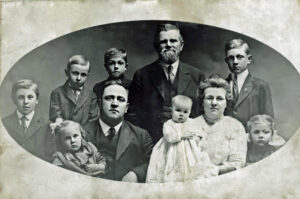
Albert, Elda, George, Henry, Claudius, AF Richins, Amy, Eliza, Oriel, and Verla Blackburn
The following articles are inserted here as a matter of interest to the readers.
August 17, 1913
Prisoners of Day Pinched By One Lone Patrolman
Patrolman Blackburn was practically the whole police department yesterday. He was the busy bird from the time he went on shift at 4 o’clock in the afternoon until an hour before midnight when he went off. Even then he wasn’t through. He answered a call to the police station just as he was leaving the jail and made another arrest.
Of the dozen arrests made yesterday the jolly member of the force made eleven. He came near making the twelfth arrest and making a clean sweep of the police dragnet in one day. The patrol wagon was busy answering another call after he made his last arrest or he might have brought in the twelfth prisoner.
Five of the patrolman’s arrests were made in a bunch. Five drunks were corralled in the alley in the rear of Nicholas’ grocery store on lower 25th Street. The last arrest of the night was a negro named Johnson who was breaking up the furniture during a family row at 165 26th street.
If there is a clean slate on the police blotter today, Blackburn will appear in all of the cases that come before Judge Reeder in the police court tomorrow morning. Who says a policeman don’t have to work? He has nothing to do ’till tomorrow.
After about 6 years working on the Police Department, Henry was suddenly dismissed. This article appeared in the Ogden Examiner, April 30, 1918.
Sergeant Blackburn Is Dismissed From Police Force
Sergeant T.H. Blackburn, who has been connected with the Ogden Police Department for the past six or eight years and who has worked his way from the bottom through honest effort to the position of Sergeant, was summarily discharged from the force early this morning under the plea that it was necessary to cut down the force to save expenses.
At the time of his dismissal from the Ogden Police Force, Chief T.W. Browning, Sergeants Mohlman and Kelliher were all indicted by the Grand Jury, and Henry was dismissed for the reasons he was too well informed as to their activities with the bootleggers.
News travels fast in a small town, and just as soon as word leaked out about Henry’s dismissal, Sheriff H.C. Peterson called him on the phone and requested that he report to him at once. It was then that Sheriff Peterson appointed him, Deputy Sheriff. He didn’t lose a minute’s time in the exchange of jobs. Sheriff Peterson knew of his ability as a peace officer, and many bootleggers remembered too. He worked in this position until his death.
All of the children of Henry will remember their father coming home at noon in the Sheriff’s car. Everyone would pile in for a ride when he went back to work. He would take us to the corner. We were tickled pink to get a ride even though the corner was just one house away.
Early in the year of 1920 Henry was sent to Bailey, Idaho to bring a prisoner back to Weber Co. jail. On this trip he was stricken with influenza, a dreaded disease of that time. He never fully recovered from that illness because high blood pressure followed causing a stroke and partial paralysis resulted. He was never totally paralyzed but remained in a very weakened condition.
Henry was ill for more than a year, and it was necessary that his son Oriel be called home from his mission to help the family.
Henry passed away at 6:30 P.M. on May 11th 1921. I remember Grandpa Blackburn calling us in to see him saying, “Come in children and see your father, he is going.” Not realizing what he meant, Verla said, “Where is he going?” We all realize now that he has gone to a great reward.
He was a very young man just 43 1/2 years old. His passing left Eliza with eight children to care for. The eldest was 20 and the youngest just 4.
Henry is buried in the Ogden City Cemetery.