 Alma Harry Toyn – 27 August 1886
When Alma Harry Toyn was born on August 27, 1886, in Grouse Creek, Utah, his father, David Harry Toyn, was 37 and his mother, Martha Jane Davis, was 39.
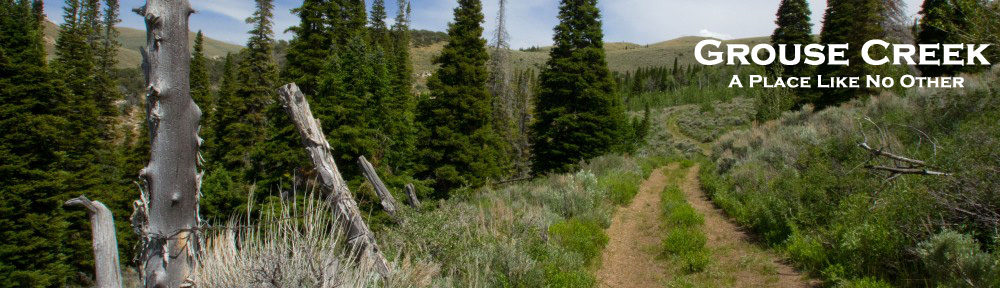
Al Toyn’s early life was spent in Grouse Creek, Utah, a small community located in the Northwest corner of Box Elder County – a few miles from the Idaho border to the North, and the Nevada border to the West.
Alma was baptized in the old rock reservoir in Etna on Sept. 15, 1894 by William Pope Paskett. He was married to Myrtle Alice Hart in a civil ceremony in Pocatello, Idaho on Jan. 31, 1918 and was later sealed to his wife in the Salt Lake Temple on October 12, 1916.
They were the parents of 5 sons and 4 daughters. Myrtle was born on April 5, 1914 in Portland, Oregon. Alma was born on December 31, 1915 in Grouse Creek, Utah. Delbert Wilson was born on July 21, 1917 in Grouse Creek. Martha was born on July 31, 1925 in Ogden and died when she was only 2 ½ years old of pneumonia. Robert was born on April 22, 1927 in Ogden. Richard was born on February 12, 1929 in Ogden. Marjorie was born on July 9, 1932 in Ogden. She died when she was only 1 year old of pneumonia. Harold was born on August 25 1934 in Ogden.
He was a rancher and horse breeder. Al bred horses, and sold them to the U.S. Army for four years preceding WW I, and for the duration of the war. After the war ended, the Army stopped buying his horses.
He later moved with his family to Ogden, Utah and worked for Sperry Mills on West 30th street as a janitor, then went to work for the Globe A-1 Flour Mills in West Ogden, and became a miller. Other jobs he has was a Life Insurance salesman (Al’s brother, Thomas Spencer, was a Life Insurance salesman and tried to interest Al into going into the business), and laborer at the Garland, Utah sugar factory while living in Tremonton.
The Toyn’s used to have sheep and John Hullinger used to help the Toyn boys move the sheep down to the winter range on the Lucin flats along in October. It would take about three days to trail them. As they were going down, they would make the first night camp…not too far from the Douglas ranch on the lower end of Etna, and Mary Douglas would have them come over and have supper with them. After supper they would sit for hours and sing and sing. Mary would play the harmonica accompaniment. They sang many old songs and Jennie Douglas remembers what a good singer Al was. All my life I have really loved to sing and I think it came from those joyful singing sessions. When we were all played out, or sung out, the fellows would go back to camp. Lots of Christmases Jennie’s family spent together with the Toyn’s. The folks would get together and have a big Christmas party. These parties impressed me very much and I have thought a great deal of what wonderful times we used to have. There was always the big supper, spread on the long table which nearly reached the length of our northwest room. It was just loaded with good things to eat. Each family furnished part of the food. There was always plenty of meat and lots of pies and cakes and pudding. Aunt Nell baked the most lovely pies and bread. Martha Jane made delicious butter and the largest, most elegant plum puddings. Jennie remembers working on the flour tiered fruit cakes, which were frosted from bottom to top. They ate but never cleared the table. It was laden until the party was worn out. After dinner they would have a short program. The children would hang up their stockings and Santa Claus would arrive. Somehow David Toyn would come up missing about the time Santa came around. Everyone would sing and dance. Charl and Dave would play harmonicas. Al had his guitar; David would play his banjo or mandolin. Sometimes David Toyn and would be playing and move right out into the middle of the floor and keep singing and playing while he was dancing. When the kiddies would get sleepy, they would spread more quilts on the floor in the next room and they would crawl in to sleep, but the party would go on until 4 o’clock or more in the morning. They were still having the party several times when the sun was coming up over the mountain. They would just push the furniture back against the wall and dance all night. There was only room for one set of quadrilles at a time. David Toyn would call. Those who wouldn’t be dancing would be clapping and marking time with their feet.
Grandpa Toyn was a wonderful man. He was very good to his family and she knew he was good to her mother.
Tom remembers his parents as faithful members of the church and being diligent and obedient in following the prophet. As a family we were blessed by their example and obedience to the law of tithing. That principle was learned not only from scriptures and teachings of the church but also from the example of grandpa and grandma Toyn. It brought stability to our home during the Great Depression. He was blessed with always having a job. While unemployment was about 30% in the U.S. during that time, it caused unnumbered families to go hungry. I never recall not having enough to eat at home or ever going to bed hungry.
As Heber J Grant preached the word of wisdom and tithing, dad and mother spoke to that determination to be obedient and our family was blessed. The older children wrestled with those teachings but I remember dad’s warnings. As I reflect from the child Viewpoint, I suppose the only problem dad had with the word of wisdom was coffee. His shift work at the Globe A- 1 mill brought on drowsy eyes. Coffee served as a wake-up juice to protect him from serious accidents in his somewhat dangerous working conditions.
Once dad invited me to come visit him at his work. One summer day when I was about 12 or 13 years old, I roller skated from their home on Harrison Boulevard over the 24th Street Viaduct to the mill and West Ogden. Dad showed me around the mill; where the grain was stored and how the flower was made. I was amazed at all the machinery. The grain was moved through metal tubes from large grain elevators to machines which grounds of flour into various degrees of fineness. As Bob described, he would test the flower. I also recall dad telling me the bleaching of the flower was a process using chlorine which was not good for us. It is gaseous form chlorine is poisonous and was one of the gases used by the Germans in World War against troops of the allies including the US. Chlorine is still used as a common bleach and soap and water purification system but the levels of concentration are very minimum. Though I never knew what levels of chlorine were used to bleach flour, dad seemed uneasy about the effect that may leave in the human body.
The means of getting from floor to floor in the mill was the one man or two man lift; this was a vertical belt with a horizontal step about two and a half feet x 2 feet sticking out horizontally from the belt. The worker would use his means of going up or down from floor to floor passing through a whole (about 4 feet. Diameter) in the floor ceiling hold grab bars were placed about chest high above the step. To go up to the next floor on the left, the worker will stand near the edge of the opening and while watching the step coming up, he would grasp the hand hold the grab bar at the same time step on the rising step then wait as the lift moved through the opening in the ceiling. Then quickly stepped off on the new floor at the same time releasing the grab bar. As one might guess, this process required good judgment and timing for alighting and existing the lift, going up or down.
He showed me how to ride the lift by having me go with him the first time. We stood side-by-side adjacent to the lift. The lift was continually moving, I guess about 3 or 4 inches per second.
As the step came up, we both simultaneously took hold of the handhold to grab bar and at the same time stepped on to the ascending step. After we pass ceiling floor hole we let loose of the grab bar and just stepped off at the new floor going down was done by approaching the belt on the downside and doing the same procedure as a bell pass down. It required your full attention so that you didn’t miss either the step or the handhold grab bar. I thought the one man lift elevator was quite a Time and Labor saving device. It was a similar in concept to elevators that are so common Office Buildings. But was also more dangerous if one would slip or fall that is one experience with Dad I will never forget. It left me in admiration of his ability to do such work for so many years.
One other personal experience with Dad was a fishing trip. In the summer of either 1940 or 1941, I bought a 1936 Plymouth Coupe. It was this car that Dad, Bob, and I went fishing to Jackson Hole, Wyoming. My most memorable time was trolling on Jackson Lake with a rented motor boat with a guide who operated the boat and took us to what he thought was a good fishing area in the lake. I remember how dad enjoyed showing us his fishing skills. As a recall we did catch a few fish, but not very many. The best was Mackinaw. It was the only time I recall ever spending more than a few hours with Dad. It was good to hear him remanence about his life, but he never was one to talk about himself hardly at all. I believe we stayed two nights in the area sleeping out with just a couple blankets each. The trip was without car trouble either going or returning for which I was thankful.
When I came back from Europe during World War II dad and mother came with Mary Allen and me as we drove to the Salt Lake Temple on January 20th 1944 to be married. I stopped at the gate to the temple and dropped off Mary, Mother and David. While I went to park the car. Mary Mother and Dad started into the temple. Dad took two suitcases, one in each hand. The ground was icy and slick. When I got back into the temple, dad and mother were not there. Mary told me that Dad had fallen and seriously injured himself and had been taken to the emergency room and was not able to go through the temple session or accompany me as an escort. He had slipped on the ice and fallen, landing head-first on his cheek shattering it like a piece of glass hit with a hammer, and bleeding profusely. Mother returned and said that dad wanted us to continue without him. In about 5 days he still had a terrible black eye and a sunken cheek with a bruise on his cheek.

Nora, Thomas, Mary, David, Harry, Frances, Martha, Alma, Joseph, Charles, Ann Toyn
On November 28, 1945, Al Toyn died of Amyotrophic Lateral Sclerosis (ALS), also known as Lou Gehrig’s Disease. Al’s normal weight was 180 pounds when he was 43 years old. At the time of his death, Al Toyn had waisted away and he weighed barely 59 pounds. He is buried in the Ogden City Cemetery.
Information for this history was compiled from information gathered on the Family Search Website.