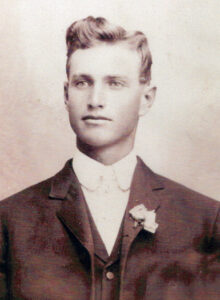
 Frank Paskett was born 25 Jan. 1885 in Grouse Creek Utah to Phillip Andrew Paskett and Emma Richins Paskett. His father, Phillip Paskett, had a small ranch in Grouse creek and raised draft horses for a living. They also raised a few saddle horses for their own use. They pastured their horses in the valley south of Grouse Creek. They sometimes wandered as far south as pilots peak looking for grass.
 Grandfather was a very good and spiritual man and raised all his children to be the same. Father never smoked nor drank alcohol. He and all his brothers and sisters grew up to be good church members. I remember father telling me one time that some of his friends tried to get him to drink with him, when he refused, they threatened to force him to drink with them, so he picked up a large stick and told them to try but they left him alone. He always stood up for what he thought was right.
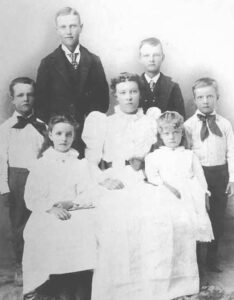
Sidney, Frank, Parley, George – Rosabel, Polly, and Christine Paskett
I know very little about his early childhood except that he went to elementary school in Grouse Creek and then went to Oakley Idaho to a Norman school which was a Junior High of sorts. I am sure that he helped with and other things that needed to be done on the ranch. I know that he and his brother Parley built grandfather a new house which was one of the nicer houses in Grouse Creek. The house was two stories high and is now owned and lived in by Ella Tanner who is my cousin on my mother’s side of the family.
He went on a mission to the southern states mission. I would guess from seeing a picture of him at that time that he was in his early twenties. While on his mission he contacted malaria, but I don’t recall him having much trouble with it after I knew him.
When he returned from his mission, he started dating Jessie Hadfield who had moved to Grouse Creek with her family from Glossop Darby shire England. Dad had a high spirited buggy team of sorrel horses and a fancy surrey which was one of the fastest in Grouse Creek. He was really proud of them. Sam Simpson also had a nice team and he was also trying to court Jessie. Dad finally won out. Sam Simpson later married Jessie’s sister Amy Hadfield.
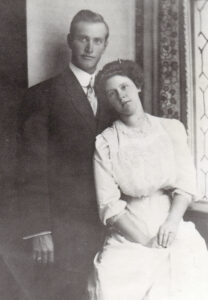
Frank & Jessie Paskett
Dad and Mother got married 26 September 1911. Dad was 26 years old and mother was 18 years old. Their first home was just a short distance down a little hill from grandfather’s home. I don’t know for sure, but I suspect that father built the house. It was built of logs and as I remember it had a kitchen and a living room and two bedrooms. That is where Ivy and myself were born. Just north of the house was a kind of cellar dug in the ground with a dirt roof which was covered with chips from the woodpile to keep it cool. Dad would saw blocks of ice off the Etna reservoir and haul it home in a wagon and store it in this cellar to keep for the summer. He would slide it down into the ice house on a board. I remember a few people coming to get ice in the summertime.
I think that it was about 1917 when he leased a ranch from Tom Thomas. Tom Thomas had a large band of sheep and had married my cousin Mary Shaw and moved to Salt Lake. The ranch consisted of about a thousand acres with only a small part in grain and alfalfa. Only that part of the ranch was under irrigation. It was on the far south end of Grouse Creek. This house was also a log cabin. It had a flat dirt roof and Muslin cloth on the walls inside. The corrals were a few hundred yards northeast of the house, and a country store southeast of the house facing the road which was also owned by Tom Thomas. Dad and mother looked after the store and I suspect that Dad also had charge of the sheep. The men who herded the sheep would come to the store to get their supplies every so often. They were basque, their names were Angelo and Domingo. They always bought chocolates and gave them to mother when they came. She always had a good supply of candy hidden away in her trunk so us children wouldn’t get into them.
About this time uncle John Hadfield was called to the bishopric and dad and Joe Barlow were called as his counselors. Dad started selling off his horses and buying cattle, he was thinking of building a ranch in Tremonton, Utah and raising cattle. In the summer time we would ride to church in w a white top buggy drawn by a team of horses named Queen and Bess. Of course we went everywhere else the same way. In the winter we had to go everywhere in a bob sleigh because the snow would get really deep. They would heat some rocks and put in the sleigh and sit us kids around them and cover us with a quilt to keep us warm.
At that time the stake headquarters was also in Almo, Idaho over a large mountain from Grouse Creek. In 1919 dad went to a stake conference and while he was there, he was informed that he and Joe Barlow were being called as high counsel man and asked to move to Malta Idaho because they were moving the stake headquarters there. As I remember it was apostle Ballard who gave them the call.
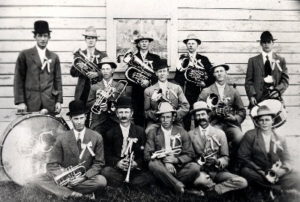
Grouse Creek Band
Back Row: Ted Betteridge, Clarence Richins, Wilford Richins, Newell Richins, Joseph Lee
Middle Row: Art Richins, William C. Betteridge, Stephen Paskett
Front Row: Frank Paskett, James Cook, Alma Toyn, John Ballingham, David Toyn
They both accepted the call and sold everything they had and moved to Malta Idaho. We moved into a small farmhouse owned by Scott Gamble. Later dad bought some land from Scott Gamble and started building a house of his own.
John Elison was the Stake President going into partnership with him to move a gristmill from Almo to Malta and set it back up to make flour and go into business for themselves. Dad worked really hard at the job and finally got it set up and operating. After a short time they had to give it up because it just didn’t make good. We moved into our new house before it was completely finished. The kitchen and main bedroom were finished also, the dining room and living room, but two other bedrooms were not finished. By this time the family was getting pretty large so he put enough boards over the floor for us to put our beds in them and the boys used one room and the girls the other.
After the Gristmill failed President Ellison leased a ranch called the Darby ranch on the northeast side of Malta. They tried raising sugar beets on it, but it was eight miles to the railroad and hauling the beets there to ship them to the factory was too hard and expensive. Dad had about twelve milk cows that helped bring in a living. I think that Dad was also trying to pay back the money that he had borrowed from an Ogden Bank. He finally decided that a partnership was not the way to go. He took a job running a ranch for Bill Jardine in Stanrod, Idaho up near the Clear Creek Mountains about twenty-five miles from home. I failed to say that in 1917 Dad bought a new 1917 Model T Ford which had given up the ghost. However, it had lasted for a long time. He worked for Bill Jordine until about 1928.
In 1928 Mother’s brother Eddie Hadfield and two other men got a contract with the Southern Pacific Railroad to work in the quarry in Lucin, Utah. They were crushing the gravel to make the causeway across the Great Salt Lake for the railroad track. Uncle Eddie invited Dad to go in with them so he decided that it would be a good chance to make some money to help get his debts payed off.
About a week before school let out, Dad and Mother took all the children except Ivy and I and moved to Lucin. Bill Jardine had given Dad a later Model Ford called the B Model. They told Ivy and I to load a few things that they had left for us and then follow them to Lucin in the car. So when school was out we loaded up the old car and went to Lucin. I was driving and Ivy was complaining how I was doing it all the way.
The contract that Uncle Eddie had was to drill holes back into the mountain then load them with dynamite then pack some gravel back into the hole so that the charge would blow up instead of back out of the hole. They would drill about six or eight of these holes about eighty feet back into the mountain and then blow them all at once. It was a solid rock mountain. The side of the mountain would just raise up and then come tumbling down. Then it would be taken to the crusher and then put on the railroad cars and taken out on the lake and dumped on the causeway.
This job ended in 1930 about July, so Dad sent mother home with all of the children except me. He and I went to Grouse Creek and went with two of his younger brothers to Nevada on a hay contract on a large ranch owned by the Utah Construction Company. This was in San Jacinto, Nevada. The ranch hands cut the hay and raked it up in rows and then we scooped it up on buck rakes and hauled it into the stockyard where it was pushed into a net then raised up onto the haystack by a a derrick. Two men with pitchforks would scatter the hay out so that it built a nice straight up stack of hay. This is what Dad did, he was one of the stackers. It was a very hard job to say nothing of the dust they had to breath. Some days we would put up as much as one hundred tons of hay.
We finished this job in the early part of September. We loaded our bedroll into the car and started for home taking a short cut through Nevada on a wagon road. In the afternoon the motor of the car started to knock. We figured it was one of the connecting rods, so we stopped and drained the oil out into a can, took the pan off and found that it was one of the rods. We took it apart and took turns filing on it until we got it just right to fit the way that it should and then Dad put it back together. We decided that it was too late to go on, so we found a field along the side of the road where there was a haystack. We stopped and pulled some hay out of the haystack and rolled out our bedroll on the hay and went to bed. At that time of year in Nevada it is freezing ice at night. After we had been in bed for a few minutes Dad asked me if I was warm enough. I told him that I was fine and said, how about you. He said, “ it doesn’t matter, but you are going to have to finish raising my family.” I was sleepy and tired and it didn’t really sink into my brain what he was saying. He didn’t say anymore and we went to sleep, at least I did. We got up early the next morning and went on home to Malta. In November he became very ill and the old country doctor said that he had pneumonia. He worked real hard with him for the next month or so, but nothing he did seemed to help. Just after Christmas on the 28th of December he passed away with his eyes glued on mother as if he was trying his best to stay. We buried him in the Malta Cemetery.
The Children’s names were, Ivy, Merton, Edwin, Jesse, Cavell, Mary, Darrel, Eldora, Filleta and Frankaline who was born after dad passed away.
Frank Paskett was a very good man and a great example for his children to follow. He accepted the callings that came to him no matter what hardships came to him, he never lost his testimony of the gospel nor his faith in the Lord. We think of home evening as something reasonably new, but I remember him holding it with us back when we were small children. He taught us the gospel and the proper way to live. He was kind and thoughtful and almost never lost his temper. However he wouldn’t allow us to talk back, especially to mother. He loved his wife and his children. We can be very proud to have him for our father and of course if we live the right kind of life, the kind that he lived, we will meet him again. I am sure that he was called to a higher calling.