Life History of Irene Lee Holjeson
January 1, 1995
 “Organize yourselves, prepare every needful thing: and establish a house, even a house of prayer, a house of fasting, a house of faith, a house of learning, a house of glory, a house of order, a house of God.” (Doctrine and Covenants 889:119)
This scripture inspires me to begin to organize my time in 1995. In an attempt to accomplish something fulfilling and hopefully informative for my loved ones, I’m starting this New Year with a strong determination to write my life history up to this date. I’ve started many times, writing brief sketches, only to get discouraged with what I haven’t accomplished in life. I’ll begin each day that I work on this with a prayer that I can do it well. I realize as I step though the door into the year 1995, I become the same age as my mother was when she died. It has made me realize that there are no guaranteed tomorrows to accomplish that which we are counseled to do today.
I’m presently serving as a counselor in Relief Society, and we have extended to the membership of the Twelfth Ward in Clinton an invitation to write their life histories and have it completed before 1995 comes to a close. I’m determined to accomplish just that — to lead out and be one of the first to finish.
Wouldn’t it be interesting to have remembered being on the other side when it was our time for birth into mortality? I can imagine knowing my mom as having morning sickness, being very uncomfortable , and almost dreading the first indication of labor pains because of the lack of professional help at that time in our little community. A sterilized delivery room was something that was unheard of. Apparently in the little community of Grouse Creek, Utah, the mid-wives assumed all the duties and responsibilities of a delivery. Ellen Hadfield’s hands where the first to hold me as I was born on February 2, 1927. She also cared for my mother during her confinement. At the time of my birth, my father, Isaac Franklin Lee, and my mother Orita Ellen Richins, lived in a two room house just west of the church and only a few hundred feet from the schoolhouse. I had three sisters who had preceded my entry into mortality: LaVerne, Evva and Merla. I have often wondered if Dad was disappointed when Sister Hadfield told him it was “another girl .”
Of course I don’t remember those early days. I have been told many things, and because I can’t defend myself I have to accept them as being the truth. I do know there was no lace trimmed bassinet or cradle waiting for my arrival. I know there was no shower or gifts for the new baby, no write-up in the newspaper, or a day-old picture taken of me. My own mother filled out the birth certificate, and I noticed years later that she had put her occupation, housewife, and as Dad’s, laborer. As I looked at this certificate a few days ago, I thought: How blessed I was to be born of a housewife and laborer. I thought, too, that ALL of the marital ills of the world today would disappear if children were as blessed as I was. If only all of them could have a housewife for a mother and a father who labored to provide for them. What a different world it would be.
Divorce and infidelity in marriage were unheard of. I didn’t know we were poor as far as worldly things. I did know we were loved. As Mom rocked my own babies years later, laying them on her bosom and wrapping them close to her with her big front apron, I could feel again the security I felt as a child being rocked as she sang nursery rhymes. As Dad came and went each day to his daily chores and work, still having time to hold us and all us of his early experiences, I know he loved us and wanted to provide as best he could.
One of the things I have been told was that Dad was my regular babysitter. Of course there were the other girls, but I was the baby. Mom wad gone regularly to choir practice, and because she played the piano and organ, she was in demand for more than one Church organization. Dad claims I was the most ornery of the all the kids. When Mom would leave Dad in charge I would cry all the time she was gone. His patience would wear thin: and as he raised his voice to me, I would increase the volume of my howling. He said I would go to the outside door and lay my head on it as I cried and called for Mom.
This story is questionable in my mind, but only because I don’t want to believe it. I don’t have footnotes or references to prove otherwise, but I know I’ve been blessed with that weakness, the ease of crying, to this very day.
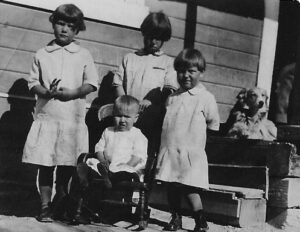
Evva, Irene, LaVerne, and Merla Lee
My uncle, Wilford Richins, blessed and named me. I was glad that my parents chose a short name for me. It was plain and it fits me. As I look at an early picture of the four of us little girls by the two-room house, I laugh at out haircuts. We were all alike: no pony tails, ringlets , or French braids —just straight hair with bangs and shingled on the neckline. I don’t know if Mom or Dad was the barber in those early years, but I know our uncle, Willie Richins, did the honors later on, and the style was the same. In that same photo I faced the camera with a turned up nose and squinty eyes. It was a natural expression of mine. I don’t know if it had any bearing on the nickname that was tacked on me at that very early age or not, but I was called “Winks” as early as I can remember and as long as Mom and Dad lived.
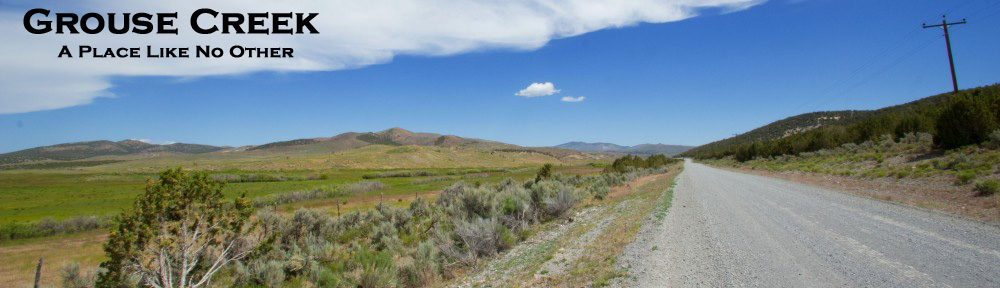
Most of the residents who live in Grouse Creek are LDS, and nearly all the activities there are centered around the Church. When kids get to the age they want to see the bright lights of the city it’s usually the time they are ready to leave for more schooling. The rock schoolhouse provides learning from kindergarten through the tenth grade. From then on, the Juniors and Seniors have to board with friends or relatives in Brigham, Logan, Tremonton, Ogden, or it may even be in the Idaho area.
Grouse Creek has a co-op store where residents buy groceries and gasoline. Its post office is a little one-room building. There is no city government or town hall. There is no police department.
At Christmas time, the Fourth of July, at deer season, and on Memorial Day former residents return to this little spot near Utah’s northwest borders. Some have family still there while others make the trip in one day. There are no motels, hotels, or cafe of any kind.
However, there is a very sacred spot located not too far from the church — the cemetery. In that little spot lay those who helped to make Grouse Creek the place we call HOME.
I’d like to include here some recorded thoughts of our daughter, Eileen, as she pondered the blessing of living in Utah.
WHAT LIVIING IN UTAH MEANS TO ME
“On Memorial Day last year I was standing in the cemetery in Grouse Creek, Utah, a tiny farming community in northwest Box Elder County. It is not a beautiful place. The rocky soil is unyielding and had to be wet down to make it soft enough to dig places for the flower to decorate the graves. My Grandma and Grandpa Lee are buried there.
As I thought of that, I was impressed with what they had made out of their lives and the legacy they have left to their posterity. They didn’t have lots of worldly wealth nor did they have any college diplomas to decorate their walls, but they were people of integrity, thrift, hard work, and perseverance. They were survivors in an environment that was at times quite harsh and unforgiving.
Grouse Creek, even though not particularly scenic is one of my favorite places in Utah. My memories of Grandma and Grandpa Lee and the values they stand for make it so. And on that Memorial Day as I was surveying all the sagebrush and dust I realized why Utah is so important to me.
Because of people like my Grandma and Grandpa Lee and because of places like Grouse Creek, Utah is indeed THE place to live. The pioneer spirit thrives even today because of those great people who gave us such a priceless heritage and also such great promise for the future.
Utah stands for faith, courage, obedience, endurance, and cooperation. Those early values exemplified in the lives of our pioneer ancestors are still in vogue and very much in need today.
I’m grateful we can raise our family in Utah, in an environment that seems to echo with the memories of our pioneer ancestors. In addition to the crops they planted and the cities they erected, they also planted enduring principles and values that can still be harvested even today by those of us left to carry on the legacy.
Utah: The is indeed the place! May it ever be so.”
________________________
I would like to describe Grouse Creek as I remember it. Our early lives were very sheltered and limited to distance. The church, the school, the store, and post office were the center of town and the area where what little activity there was took place.
We had a mailman that drove to Lucin (27 miles south) each weekday. Mail would come on the train from Ogden. The store was one room, the post office another room. The school had three classrooms, a room for gym and lunch and two restrooms. Our church building was adequate for the community. The basement was built for dancing and other activities. Church services were held upstairs.
It was not until the 50’s that electricity came to Grouse Creek. In the winter, we ate our dinner and did our homework by the light of a kerosene lamp. Our baths were taken in a galvanized tub. Water had to be heated on the wood stove and several of us would bathe in the same water, taking turns to be the first in the clean water.
The things I write may not come in sequence as they happened, but I feel I’d like to include them as I remember each incident. Juanita was born two years after I was. I’m so ashamed to admit it now because of her great love for the family and all her endearing qualities, but even as a small child I was envious of her and the attention she got from others.
I remember the time when she had pneumonia. What a worry it must have been for Mom and Dad — so far away from a doctor. It seems like I was told of them having to go to Lucin and catch the train to Ogden to get medical help for her. The thing I remember is that Uncle Bill Lee and Aunt Rhett used to come from Montello for visits. Uncle Bill would always hold Nita while she played with the chains on his pocket watch. One time, after one of her sick spells, he whispered to her and said: “On my next trip to Ogden, I’m going to buy you a doll. I’ll put it in the mail so you watch for it.”
That was music to my ears, and I just knew that he meant to include me, too. I made myself available to accompany anyone who would ask to go get the mail from then on. The day came when the big package arrived. I asked to carry it from the post office to home. I would feel it and shake it, knowing in my heart that there just had to be two dolls in the box. There was only one. I have thought since: Why couldn’t I have been happy for her and not envious?
Juanita had a natural curl to her hair that was pretty. One day several years later Ernest Dunn told me that me and Juanita were two good girls, but she was the prettiest one. That was a blow, too, but of course, he was right.
Mom always told me that I was a sickly child when I was small. I do have a faint memory of when our family had a siege of the smallpox. Dad had gone to Burley, Idaho, and was exposed to it there. It was in May, 1930. Mom had made a trip to Ogden with Juanita who had lobar pneumonia (an after effect of the measles.). While she was there, Dad became very sick. He was our babysitter while Mom was gone. When Dad became deathly ill, Grandpa Richins wrote and asked Grandma, who had gone with Mom, to come home to help Dad. When Mom arrived home a few days later, Dad showed her the strange looking sores all over his body. Mom had them when she was a little girl so she knew smallpox when she saw it. They didn’t want to expose anyone in Grouse Creek, so they loaded the wagon with supplies and took the family to Dad’s homestead which was on the Etna side of the community. It was located about four and one-half miles north of the Kincade place up in the mountains called Straight Fork. He had dug a little spring in the mountain and piped the water to the little one-room cabin. Here our family stayed until each one of us had come down with the smallpox. Mom cared for each of us in our turn, and it was in July when we were over with the disease and able to go back to Grouse Creek. I remember I had them on the bottom of my feet, and once a day Mom and Das would take a needle and open the sores and wrap my feet so I could step down on he them. Of course I thought I was dying for sure when they went for that needle.
Another thing I remember was my craving for root beer. Mom made it often, and she had a taken a bottle of extract with us. She decided to make some for me. I insisted on having a bottle of my own. I was in the fever stage of the smallpox, and Mom filled the little square-shaped bottle that had held the extract with some root beet. She let me hold it while I lay in bed. Mom said my fever caused the root beer to ferment, and it exploded in the bed as I lay there.
Dad’s brother, Len, would periodically check on us and to bring any mail or supplies we might had needed. He would only come as far as the watering trough, because he didn’t want to be exposed.
I remember Dad throwing his shoe at a rat one night. He had a good aim. The rat lay dead. Dad would also point out deer and wild animals, and we would watch them especially in the evening and early morning. We were at the cabin when the yellow sunflowers (Docks) were in full bloom. The hillsides were covered and I still remember the smell of them.
I get a lump in my throat when I think of my parents having the courage to take us by team and wagon to such an isolated place to battle the dreaded disease of smallpox. How I love them for what they went through.
I remember another time when I had cankers all through my mouth. The old standby cure-all at that time was a liquid called Hall’s Canker Medicine. It did nothing for me. Finally in desperation, my parents took me to Montello to the railroad doctor. His name was Dr. Belnap. I had a black furry winter coat, and as we rode to Montello I was in the back seat; and being nervous about seeing the doctor, I chewed on the lapel of that coat. Now I can laugh when I think of what the doctor saw when he looked into my throat. Mom said the sores were covered with little black hairs from my coat that I had chewed.
As kids growing up, we had to make our own fun and entertainment. At one time Merla and I found a dead bird. I can’t remember how it died, but we went into Mom’s spice cupboard and emptied out her baking powder into the pig bucket. We took the empty container and put the bird into it. Going out by our plum tree behind the house, we dug a grave sufficient to hide the can. We sang together what we knew of “I Need Thee Every Hour” and figured we had given him a civilized burial.
In the wintertime we would sit together, Merla and I, behind the cook stove where it was nice and warm. We’d thumb through the catalog. We’d always speak to be or to have the different things on each page. As we turned the pages through the women’s clothing, we saw a pretty woman in a wedding dress. We both spoke at once to be her. It ended up in an argument, and in releasing my anger, I threw the scissors at her. The blade hit her head, and when I saw the drops of blood, I retreated to the bedroom and told Mom I was too sick to eat dinner. I stayed there until Dad came home. I was more afraid of his punishing me, but I can’t remember if I got a tongue lashing or the razor strap.
Another supposedly fun time that ended up in complete frustration was when we played in the rabbit hutches that were up in the corral. Dad had cleaned them out after he quit raising rabbits. As we played, we pretended the different sections were our homes. We’d go in with our dolls and really had fun playing until we accidentally locked them shut. We were where we could view the house but were too far away for our cries of “HELP” to be heard. While we were imprisoned in the hutch, Grandma Lee and Idaho relatives came to visit. We called and called but didn’t get free until Dad came to feed the chickens in the late evening.
I suppose in every family there are. Few shady experiences that would be better unsaid, but I’ve always had to giggle a little when I remember the family’s experience with Ex-lax. I think Mom thought Ex-lax was a cure-all, because Dad had the flu one time, and she gave us all an Ex-lax dose and sent us off to school. It must have been a couple of hours before it started to work. One by one we came home – some running really fast — a couple of us doing the scissor -step and realizing it was too late. In my case we were practicing a play. I was Mary. Keith Tanner was my little lamb. He had his head on my knee when I knew I had to go. I asked permission to leave. It wasn’t granted, so I just walked out. What a disaster!
Our home could brag of no inside plumbing. Our outhouse was to the northwest of the house. It seemed to call when dinner was over and dishes needed to be done. Obsolete catalogs were in abundance and used for a dual purpose. When a visit to the little house was a necessity they made good reading material. About every two years Dad would relocate the little building. There would be occasional summer visits made there by the flies, hornets, bumble bees, and spiders. I remember one day Mom made a rapid exit even before she entered. When she opened the door she found a blow-snake curled up on the floor. In later years the little house could boast of a carpeted floor and seat. Dad took a carpet strip, cut out the two necessary holes, and hammered and tacked it here and there, modernizing our little shanty.
It seemed like we were at the height of our glory when we were playing a trick on someone—at least I’m speaking for myself. There was an old bachelor, Ernest Dunn, who lived in a little one-room hut made out of railroad ties and located just north of Dad’s property. He was ugly, and we thought a bit strange. He would come down to our place to get water and would always talk to himself. When he went to the post office after his mail he’d circle the fence around our corral and stockyard. One day when we were at the store we found a life-like poster of a woman in a bathing suit. It was a “Coke” advertisement. We carried it home. I can’t remember which of my siblings was a part of this, but when we saw Ern Dunn circle the corral on his way to the post office we hurried up to his little hut and nailed the bathing beauty to his front door. We knew about what time he would return so we hid in the trees to watch his performance. He came up the trail talking to himself as usual and didn’t look up until he was about 100 feet from his cabin. He stopped short, swore, backtracked on the trail a few feet, then turned again to look at his new house guest. He repeated this over and over again while we lay under the cedar tree laughing our hearts out.
Dad always seemed to have problems getting his water turns. We were located high enough that if many people used sprinklers to water their lawns we would have no pressure at all. One day Nita and I were coming home from the store and saw Emma Kimber’s sprinkler running full blast. We had hardly any force coming on our place. I guess in our childish minds we thought we’d solve the water problems once and for all. We climbed the fence, took the sprinkler and threw it into the bushes. Emma must have seen us, because she came to our place the next day, and it put Mom right in the middle of an awkward situation.
Dad worked away from home quite a bit. I recall the summers he would work on haying crews. I believe he was in Nevada this particular time. When he would send his laundry home for Mom to do, she would wash and iron his clothes and send them back with the one who delivered them. One day as she was ironing his shirts, she said: “Let’s send a surprise to Daddy. Merla, you and Irene take this nickel and go buy a candy bar and we’ll put it in his shirt pocket.” We hurried to the store to purchase OUR favorite bar. I can still remember which kind it was. It was a three-flavored opera bar. On our way home we stopped and decided we’d each take a tiny taste, rewrap it, and then put it back in the box. We repeated this again by Kimber’s gate and once more by the schoolhouse. When we handed the little box to Mom, she shook the contents to find a piece only the size of a quarter left. She was mad, and we got heck. She sent Evva back down to the stores and gave her another nickel to buy Dad’s treat.
As sisters we were each other’s playmates. Oh I remember Leola and Ivy that I played with, but it seemed we’d end up having disagreements that Grandma Richins would have to settle. Grandma raised Leola, and whenever they ate with us, Grandma would always have to leave early to “shut up her chickens” and Leola wouldn’t have to help with dishes.
One of my best friends (after I started school) was Eileen Warburton. Both she and her cousin Dorothy always seemed to have lot of spending money. At recess and noon they would go to the store and buy candy and treat all of us girls in the same class. One day Dorothy made the remark that I would never be able to treat the girls because I was poor. This really made me mad. I told her I could have money anytime I wanted. She called my bluff and told me I was to treat the next day. I was sick. I had no money, and I knew I had lied when I said I had. When I went home from school that day Mom was at Relief Society. I took a chair to reach her money cup (we called it the “butter cup”) from the cupboard. She kept the money there when she sold butter. Then when we needed kerosene for the lamps, it would be bought with Mom’s butter money. I took a dime and put it in my shoe. I wasn’t too hungry at dinnertime or at breakfast the next morning. Recess time came. I went to the store and bought butterscotch suckers for all the girls. Even though there were enough, I couldn’t even enjoy one for myself. That night at the dinner table about halfway through the meal, Mom said: “Dad. One of the dimes is missing from my butter cup.” I started to cry so Mom knew who the guilty one was. I didn’t get punished then, but I’ll never forget it. It was a hard lesson I learned.

The Middle Room at Grouse Creek School
Front Row: Delma Kimber, Reed Frost, Lemar Toyn, Lela Kimber
Second Row: Dawn Frost, Eilene Warburton, Ivy Kimber, Dorothy Warburton
Third Row: Dwight Warburton, Rex Roberts, Lewis Tanner, David Paskett
Fourth Row: Max Frost, Merlin Tanner, Jack Kimber, Fern Tanner, Irene Lee, Arlene Wakefield
Teacher: Zona Jensen Wakefield
Mom loved to have us perform in church. My first experience was before I started school. Mom had drilled me on a Mother’s Day poem. I can’t even remember anything about it, but I do remember going to the pulpit, standing on a little stool, and as I looked out over that sea of faces I changed my mind. Mom kept trying to bribe me with s penny, but I pushed her aside and sat down. I know she was disappointed in me.
I remember all four of my grandparents. Grandpa Lee was bald like Dad, and I remember him having a fly swatter with him as he sat on their porch.
Grandma Lee was a lady. She had black hair and dark eyes., Her hair was still black when she died, and she said it was because she always rinsed it in sage water. She always had a tired and sad look on her face.
Grandpa Richins had a beard and a cane. He used to walk up and help Mom peel peaches at canning time. One day he called from he gate and told us he had some stick candy for us. We ran to him and gave him the usual kiss to pay for the treat and then he handed us some toothpicks. We didn’t think he was very funny.
I remember Grandma Richins in a long half apron and a bob in her hair, She was short and a busy determined little woman. She always treated Leola as her own.
I loved school. The subjects were easy for me. I especially liked art, spelling and history. When I was in the fifth grade my teacher Zona Jensen challenged the class to try to get 100 percent in every spelling test in the term. She also said a special gift would be given to the girl and boy with the highest score. I won that gift. It was a little cedar chest about 7 x 12 inches, and it was filled with stationery. I loved it and kept it for years. Merlin Tanner was the boy who had the highest score and his gift was a pocket knife.
One phase of school I learned to dislike was sports. We used to practice all spring in various activities, and just before the end of school, we’d have what we called a track meet with the Yost and Park Valley schools. I loved the broad jump, and I was good. I could out jump any in my class. Girls did nor wear slacks in those days, just dresses. On the day we tried out for the finals. I was excited because I knew I would be chosen. As I jumped I anticipated a good mark. What I didn’t plan on was the skirt of my dress went flying high above my shoulders as I landed. My face turned red, and I ran back to the schoolroom. You see, Mom made all of our clothes. Our underpants were made from flour sacks. She would try to bleach out the brand, but it was impossible. As I landed in the jumping pit and my dress went up all the spectators saw B-J Brand on my butt, and they all broke out in a roar of laughter. That was the end of my activity in sports. When I cried to Mom and Dad about it, one of them said: “well, it could have been worse. It could have been a pair that said RED ROSE.” That was another brand of flour we used. I got no sympathy from anyone.
Mom used to work hard to do extra jobs to buy material for our school dresses. One year Annie Pasket came to Mom and asked if she would bring here girls down and clean house for her. They lived in a two-story red house a mile away. I was the one that grumbled. I told Mom to let her own family clean her old house, and we’d do ours. Mom said, “Shame on you. I’m taking the money we get to buy cloth for your school dresses.” That changed the whole picture for me. We went down early in the morning, cleaned windows, scrubbed walls and floors, beat rugs, and washed dishes to be put back on clean shelves. We worked hard and we were all tired. The sun was setting when we finished, but we didn’t mind because we had envisioned the color and kind of dresses we’d have with our earnings. When it got time to go home, Mrs. Pasket said: “Well, Orita, it looks and smells so good. I want to do right by you and the girls, so you can go out in our gooseberry patch and have all the berries you can pick between now and dark.” I glared at Mom. She wouldn’t meet my stares. We picked those little green “buggers” until dark. We walked home, and still had them to clean. They had a stem on one end and a dried blossom on the other. Half way though the job I sat my pan down and told Mom: “I QUIT”. I’ll always remember what she said to me: “Well, you go ahead and quit if you want, but I have my opinion of anyone who quits a job before it’s finished.” I learned a lesson from that experience. It is important to get a description of the job and the amount of the pay settled before accepting any work. Mom’s comment has stayed with me, and I’ve thought of it often as I undertake to do any job.
I think of our wash and iron days often. As I put my laundry through the washer and dryer. The first washer I remember had a plunger under the lid. We’d take turns pushing the handle on the top back and forth 100 times each as the plunger made contact with the batch of clothes inside. Next was the washer with a gasoline motor. Dad started it for Mom, and it could be heard for blocks. It was blessed or cursed according to the willingness to perform. Our clotheslines were filled every Monday. On winter days the clothes would freeze as soon as we hung them out. We’d dampen the clothes and roll them up to be ironed with the flat-iron heated on the kitchen stove. We’d take turns doing five bundles each. We always had beans for dinner on wash days. Mom heated the wash water in a copper boiler on the stove. Homemade soap made for white washes. It took most of the day to do our laundry and another day to do the ironing. We had the scrubbing board for the extra dirty clothes.
Dad drove a Model A Ford he had bought from Grandpa Richins. We always spoke for the seats by the windows. He would never drive it in the winter, He would remove the battery and store it in the cellar. He would catch rain water to put in the battery in the spring.
I’m sure our Grandma Richins meant well, but she always did things that seemed so old fashioned. While we were staying with her one time, she found a pair of long black socks for each of us girls and insisted we wear them to school. We put them on all right, but when we got out of sight, we sat down, took them off, and hid them in Lizzie Cook’s tea trees. Then on our way home from school we’d stop there and put them on again.
One time when I was older and LaVerne was in Ogden going to school, I came down with the mumps. I was the only one in the family to get them. It was Thanksgiving time and LaVerne was due home. My parents talked me into going down to Grandma’s, and I was to stay until LaVerne went back to school. Grandma and Leola went up home for dinner and someone brought a plate down to me at Grandma’s house. I felt like a caged animal. I sure felt rewarded for the inconveniences later when a package came in the mail from LaVerne. She sent me a green dress and a candy cane in gratitude for her being able to come home.
What a difference our Christmases were from what our grandchildren are living through at this time. I’d like to include a letter LaVerne sent to me one Christmas that describes my feelings. I’ve saved this letter because it has meant a lot to me, and I read it every Christmas season:
“Christmas means remembering —
Remembering those childhood Christmases:
– Looking through catalogs as soon as they would come in the mail, trying to make choices that were not too many nor too expensive.
– Reciting in Sunday School.
– Practicing and performing in school programs, drawing names and exchanging small gifts, sometimes feeling our gift to another had been better than the one we received.
– Making little gifts to give our Mom and Dad. Trying to be so secretive and being angry when somebody told our secret.
– Getting more excited as each hour brought the big day nearer and nearer, trying so hard to be good so Santa, peeking in the windows and checking on us, would appreciate and approve —not really caring that we didn’t have room for a Christmas tree.
– Sensing worry and anxiety of parents who at times wanted to do so much but could do so little, yet feeling the depth of their love and concern for our happiness.
– Believing that Santa whose appearance climaxed the kids’ dance each Christmas Eve was the real guy and that he even come early to our house once, crawling through the bedroom window, confronted by our Dad, he left us a bag of peanuts; and yet, being disillusioned that Santa could be so partial, even in a small town such as ours, giving so much to some, so little to others.
– Sleigh-riding on crusted drifts of snow which often covered the fences.
– Hearing sleigh bells as they jingled on the teams of horses pulling sleighs up and down the valley.
– Caroling on a crisp winter night when our breath became foggy as we sang the songs of Christmas.
– Smelling Mom’s mincemeat pie as it baked, listening to the crackling fire early on a snowy morning; feeling warm with thankfulness for food and clothes and shelter.
– Wondering as we’d look through the window from our beds at night how much brighter “ that star” had been than those which sparkled for us.
– Remembering one Christmas time when a little sister was no longer with us and feeling that somehow things could never be the same again.
– And there was always “Silent Night, Holy Night,” and the feeling of reverence at each retelling of the story of the Babe of Bethlehem, and in our hearts we’d resolve each time to let that story be the most important part of Christmas, even while we anticipated other things.
– We were children then.
– Now we are parents confronted with the problems and frustrations, yet the joys and delights of providing Christmases and memories for our own children.
– We lie awake at night doing mental gymnastics with dollars and cents, wishing paper money was made of elastic so it would stretch further.
– We keep saying how frustrated we are, and we really are, as we shop and sew and bake and clean and send packages and Christmas cards — trying to get everything done, hoping everyone will be happy with what circumstances and finances will allow us to do.
– There are still the school plays, the parties, the Santa Clauses, and the secrets; but we participate from a different vantage point now.
– And our memories continue to grow as we recall the first Christmases of our own little ones, and the Christmases that followed, one by one, like the additions to our families, one by one.
– We wait past midnight for all of them to get to sleep.
– We listen to them rise in the wee hours of Christmas morning and hear the whisperings and little shrieks of delight and laughter.
– We tolerate the paper and ribbons and nut shells and orange peelings all over the front room floor, as well as the neighborhood children coming at all hours of the day, beginning at five o’clock in the morning.
– We remember the look of joy of giving that shines through the eyes of our school children as they give to us the gifts they have made in school.
– We experience with a twinge of sadness how children become teenagers and adults and dolls and toy trucks are replaced by clothes and wrists watches.
– And we are keenly mindful of he Christmases, becoming more and more frequent, when some of our children cannot be with us—they are on missions, in the service, or in homes of their own, with special little children of their own.
– They say Christmas is for children, and indeed, we try to make it so. But aren’t we all children at heart? —still enthralled by all that Christmas has meant and still means to us.
– We still sing “Silent Night, Holy Night,” and we still feel reverence in the telling and reading of the story of the Christ Child in Bethlehem. It means more and more to us as we appreciate more fully the significance of His mission to the world and the promise it holds for a future Christmas so glorious that we cannot fully comprehend it — a magic Christmas when generations of children and parents and memories will be welded into one grand event, and the giving and receiving will be almost more that we can bear.”
I would like to write a few thoughts of my Mom and Dad even though they will be mentioned often through my history.
Mom was born on November 12,1899, at Grouse Creek. As I write, my first thoughts and memories go to Mom’s appearance. She’d begin each day by putting on a clean front apron. She always had her hair combed when we got out of bed. Mom was a large woman , about five feet, eight inches. My memory tells me she could do everything — whatever she started, she mastered. I remember the old Wheeler and Wilson treadle sewing machine. She boasted she could sew everything from silk to shingles on it. She made all our clothes except shoes and socks. She even made Dad’s gloves. She made her own soap and played the piano and organ. Her homemade bread could not be duplicated. I remember she bottled fruit, meat, pickles, vegetables and jam. She was so proud of the contents of our outdoor root cellar when the shelves were all filled and the potatoes and carrots were dug for the winter. She quilted and crocheted. At times when Dad was gone we would help her do the chores which would include milking cows and feeding pigs and chickens and sometimes sheep. We had an old milk separator. She would always inspect the dishes that were a part of it to see if we had washed and dried them good enough. She churned cream and butter and quite often sold butter. I remember the old churn, the butter paddle, and the one pound butter mold. Dad loved buttermilk and homemade cottage cheese. She would dry corn in the summertime, putting it in little cloth bags and hanging them outside on the clothesline. Our job was to take turns shaking the little bags several times a day so the corn would dry evenly.
Besides caring for her own family, she would sew for others. I remember times when some women would bring grease that has been rendered or mutton tallow to Mom and want her to make their soap “on shares.” She was called many times when neighbors were sick and help was needed.
She taught us how to wash, iron, mix bread, and do other household tasks, but I hated embroidery work. I remember once when she and Dad went to Burley; she told me if I’d do the chores, she’d bring me a surprise. How disappointed I was when I opened the sack to find a sampler to embroider. She was hurt that I didn’t want to finish it.
I always loved to draw. I wanted to be an artist, and I still yearn to learn to paint. Mom used to tell me that “what is worth doing at all is worth doing well.” She’d say, “Let your artwork be yours— don’t copy.”
At this point I’d like to reinforce her words by recording a true story she told me. She said when she was in grade school the teacher asked all the class to draw turkeys. They were going to decorate the schoolroom at Thanksgiving time. Mom couldn’t draw and hated the assignment. She took her paper home that night and asked her older brother Newell to draw a turkey. He did, and she took it to school the next morning. She was so proud of it as she handed it to her teacher. He was very complimentary, and after the bell rang, he called her to the front of the room and showed the class the beautiful bird that she had drawn. Of course the teacher knew it was not her work, and he said to Mom: “Now Orita, would you draw one exactly like this on the board so the class can see how you did it?” Of course she couldn’t do it and retreated to her desk in tears. She told the to me as an example of what deceit can do for a person. I remember telling this little story to our granddaughter, Michelle, and she has used this in her school assignments. When she was in the sixth grade she was given an assignment in school to compose a poem. She told about the lesson Mom learned. I’m adding her little poem here:
DARE TO DISCOVER AN ANCESTOR: MY GREAT-GRANDMA LEE
One day my great-grandma told a big lie.
She got so embarrassed, she thought she would die.
Her brother had given a picture to her.
She got an idea as her brain started to whir.
The brother was good — quite an artist you see.
He’d spent some time drawing a great good turkey.
My grandma decided to tell her teacher.
That she was the artist of the turkey picture.
The class was impressed with the job she had done.
My grandma was happy — this was quite fun.
But then came the shocker, when the teachers implored.
Please draw another, up on the chalkboard.
Her face got all red, her tummy was sick.
She guessed after all this was not a good trick.
The teacher seemed troubled and even looked stern;
This was one painful lesson for my great-grandma to learn.
Mom was organist in the little Grouse Creek Ward for over forty years. She was honored for that before she died. She also played for over 100 funerals.
I remember Mom teaching the nursery class in Sunday School. We all had little red chairs and we’d sit in a circle around a little wood-burning stove at the church. I wish I had a copy of all those little nursery rhymes and stories she told us.
I could go on and on, but I’d like to say both Mom and Dad were very conservative and wasted nothing. I’ve heard Mom say and I know it to be true that at one time they had 50 cents in a cup in the cupboard. They didn’t want to spend it because that was all the money they had. These are just a few of the things about Mom, and I’ll mention more as I continue my history.
As I begin to write about Dad, I look at the snow coming down outside this morning, and I can’t help but think of stories Dad told us about his sheepherding days and how they worried about the herd getting lost when the blizzards and freezing winds came.
Dad was born on March 22, 1891 at Etna. I would like to take a paragraph from his own history as he related:
“I remember that our home was built by the side of the hill, and the hill was dug out a little ways to become a part of our bedroom. It was warm in the winter and cool in the summer. We had a garden. There was a pretty little meadow with a clear stream of water running through it. We had farm animals. Young as I was I can remember thinking our place was the most perfect spot on earth.”
I always get a lump in my throat when I think of Dad’s youth. He had very little schooling. He was in grade school when my Grandpa Lee would come and pull him out to go to work. Grandma and Grandpa Lee had a large family, and since Dad was one of the older ones, he was required to help support the family. Grandpa Lee would hire him out, then collect his wages.
I know Dad’s life could have been different had he had the opportunities of an education and church activity. But, I was always proud of Dad. He was so tall, and I looked up to him in many ways. He very seldom punished us, but when he did do it, we knew he meant it. I remember one time when Mom was gone somewhere and Dad was in charge that Merla and I began to quarrel. I guess Dad had put up with all he could, so he sat me in one corner of the room and Merla in the other. He gave us the dickens as he paced back and forth. Merla pulled a face at me, and I told her to shut up. Well, Dad thought I was talking to him, and he marched right over, took me by the hand, picked up his razor strap from the wash stand, and he whipped my butt good. He was not in the mood for any explanation of any kind.
Dad was a hard worker and always believed he could get the most done in the forenoon, so he was always up early and went to bed early. He would always be up and have the fires built in the kitchen stove, put the teakettle on, and then call the family. I can still remember the smell of the cedar wood burning in the stove.
I suppose my very happiest years as a child were when we lived on the Hales’ place in Etna. I mentioned that to Dad once years later, and he was surprised because that was the time when it was the hardest, financially, for him and Mom.
Dad loved to hunt and fish. One of the last pictures that was taken of him was at the Etna Reservoir, and he was fishing. As much as he liked the sport, he would never eat venison or fish.
Dad was never what one could call active in the church. He had a fear of being called on to pray and talk. He did have a home teaching route, and he was very faithful and dependable. He was there when the ward needed help on welfare assignments, too.
Other than when he went to church, a social, or to town, Dad wore bib overalls.
He loved peanuts and pine nuts. He loved also the fresh radishes and onions out of the garden. I remember the bread dough dumplings he would cook when Mom mixed bread. He was bald as all he his brothers were, but I thought he was a handsome man, and I was always glad he was my dad.
I never did hear Dad take the name of the Lord in vain, but he did have a few favorite cuss words and knew how to use them when the occasion arose.
When I was older I loved to waltz with Dad. He was so graceful. I remember one time when we danced it was to the tune of “Mexicali Rose.” Even though that’s an old-time piece, I never hear it without thinking of Dad. One favorite song of Mom’s and Dad’s was: “Let the Rest of the World Roll By.” It seems that Dad bought that sheet music for Mom the day they were married.
Dad loved to tease and play tricks on the grandchildren. He would crawl on his hands and knees behind them. When they would discover him, they would look spooked, and Dad would laugh and laugh. His laughing was so contagious. Sometimes he’d take out his false teeth. The kids would jump and scream, and everyone would have a good laugh.
I can remember helping him haul hay. I was the driver of the team out in the field, but when we came in to unload the hay and stack it, LaVerne drove the derrick horse. I’d sit on a log until it was time to return to the field. Dad would caution me about the irrigation ditches and told me to turn the horses before we got to them. I’d always get day dreaming and get to the ditch too late to turn. That’s when Dad would cuss, come and take the reins, and maneuver the horses and the load, getting back on track.
We had a Model A Ford. I recall the time Dad used a crank to start the motor. If it didn’t turn over and start, he’d cuss and swear at it. When Merla and I would get in the car we’d sit in back and giggle while we plugged our ears with our fingers until the motor was running and the cussing had stopped. He had the same problem with Mom’s washing machine. It had a gasoline motor and a pedal to use to start it.

Juanita, Orita, Frank, Marie, Ray, Evva, LaVerne, Irene Lee
Well, Dad was a good man. As I watched him get older and more bent, I wonder if I’d ever measure up to his accomplishments. He was honest and expected all others to treat him honestly, He exercised a lifetime of patience in dealing with those who chose not to honor commitments, and he died without collecting what was rightfully his.
As I try to start this chapter on Merla, I look at her picture and cry. I know how I lean upon and enjoy LaVerne and Nita as sisters now, and I wonder how it would have been to have Merla still here to call her on the phone or to sit and talk about “remember when.” Would she have had a family? Would it have taken long for her to master an artificial Leg?
LaVerne once wrote a poem as a tribute to Merla. I want to use just a part of it as a preface to memories of her:
And we would laugh and play and sing.
We made our childhood playtime ring,
With voices gay and chattering.
We’d dare and do most everything.
But suddenly you went away.
Instead of blue our skies were gray.
We cried for you snd folks would say,
We’d meet again some distant day.
But I —I could not understand.
I longed to feel and grasp your hand.
Kind people said the place was grand,
Where you had gone — a better land.
And I wondered if your playmates there,
Had laughing eyes and golden hair.
I wondered if you’d ever care,
Or think about us while you were there.
Dear Sister, that was long ago.
I’m older now, and now I know,
That life — the life that you loved so,
When once is breathed, must always go.
But tho’ it’s short, I now can see,
That every day may worthy be;
That I, in my own life can leave,
A sweetness like your gave to me.
And if I do live right and true,
Like you dear sister tried to do —
Then when my journey here is through,
God again will give me you.
Merla was my friend and playmate. Being two years older than me, I imagine I was a pest to her at times. We made our own fun. She and I were fishing rivals when we lived at the Hales place. She always caught the biggest trout. She was “Dad’s girl” from the time she was little until she died. I don’t remember, but Mom said she was always good in school and loved her teachers. She was good to me. I remember she and some friends in school planned a party in the Hadfield’s “band wagon” as we called it. It was the school bus. It seems like the girls were the only ones that knew about the party. Merla invited me only if I promised to sing the ABCs as part of the program. Our refreshments were leftover jam sandwiches. I was only five years old. Ray was just a little guy and how she loved him.
I remember vividly the day she stepped on the rusty nail. Dad was preparing for deer hunting. We were going to take him to Grouse Creek to meet his hunting partner. Merla and I raced to the car — to see who sat by the window. On the way to the car she stepped on the nail. It was a day or two later that her leg was swollen and red. Mom and Dad took her to Montello to the doctor and then on to Ogden. These were hard days for the family, too. Grandma Richins had LaVerne, Nita and Ray. Evva and I stayed with Aunt Ella Warburton. I remember my shoes were worn out. Grandma took a pair of her high top shoes (I’m sure a sacrifice on her part), cut off the top, and made me wear them. I hated them and I cried. I don’t believe any other eight-year-old girl would have wore cut off high tops with a two-inch heel. I was so disheartened that I left for school early, went over to our home and found some galoshes. I put them on over Grandma’s shoes and wore them to school. There was no snow on the ground or no rain coming down — no need for boots — but I wore them anyway to hide my embarrassment. I think of how Grandma must have been doing the best she could to meet our needs.
Merla’s condition became critical. Dr. Jensen had her admitted to the hospital. She had developed blood poisoning and gangrene had set in. It was a shock to receive the news that her leg had to be amputated. We wrote letters to her, and I remember her sending some paper dolls to me that some generous friend had given to her, Her one wish was to see Ray, so Dad came home to get him to fulfill that last wish. Some visitors had given her money while she was in the hospital, so she asked Dad to buy Ray a little red wagon with her money. Dad honored her wish and bought the little wagon as a Christmas gift for him from Merla.
One evening when Evva and I were at Aunt Ella’s the phone rang. I listened in. The voice on the other end said Merla was very low. I didn’t know what that meant, but I remember Evva woke me up that night and told me she had just had a dream that was upsetting to her. She dreamed Merla was in a chair and on either side of her were Grandpa Richins and Grandpa Lee (both deceased). She said Merla’s leg was gone, and they were there to carry her. Well, she died on the 16th of November . My school teacher was the one to tell me the next day in school. I ran down to Grandma’s and didn’t want to talk to anyone. The day Mom and Dad arrived with Merla’s body was hard, too. The casket was in Grandma’s living room, and they took us in to see her. I just didn’t understand the whole situation. Life was not the same after that.
I did know that the place in the cemetery became a very sacred spot from that day on. Her very favorite flower was a sego lily, and we tried over and over again to transplant some by her grave, but they never took root. It took a long time to get used to her absence. There was an empty chair at meal time and clothes that had to be sorted through. There were school papers, tickets, and little possessions of her that had now become priceless.
Times were hard financially for Dad and Mom that year. Earlier in the summer a flood had ruined some of Dad’s crops. While they were in Ogden with Merla, coyotes killed turkeys that they were raising.
I remember clearly the night that we were eating supper and a knock came at the door. Tom Warbuton stood on the step and handed Dad a check for $50.00. Dad was proud. He hated to accept it; but he did, and his heart was full of gratitude for Tom’s concern and desire to help us.
A few weeks after Merla’s burial, Dad killed a calf. He sent a part of the beef to Dr. Jensen as payment for his services. For a long time Mom kept the letter from him that said “account paid in full.” It was far from being paid, but my parents felt deep gratitude for the doctor’s kindness to them.
This is the first time that I can remember hearing of an eternal life or a life hereafter; but being only eight years old, I really believed as I still do now, that I’ll see Merla again.
BAPTISM
My baptism date was August 3, 1935. It was just two and one-half months before Merla died. Bishop John Hadfield baptized me and Ted Kimber (Tommy Ted) confirmed me. The customs of performing this ordinance was different out home. Children are done monthly now in the wards and stakes but in Grouse Creek it was done once a year. All those who were eligible were done in the summer months when the water in the creeks or reservoirs were warm. I was baptized under the spout at the Etna Reservoir. I’ll admit, too, that I was nervous and scared. Dad has said it was the best fishing hole on Etna, and I envisioned the trout being a problem to me when I went under. I lived through it though. I went home really mad. One of the girls got a silver dollar for being willing to go through with it. She had been afraid to be under water and was ten tears old and she had to be bribed to do it.
One thing I remember, and I’ve laughed about it many times, is Evva trying to prepare me for life “after baptism .” Being around a haying crew the swear words “damn – it” and “hell” has become part of my vocabulary, too. Evva said, “Now, Irene, after you are baptized you can’t swear any more.” Knowing that she was guilty too, she added: “Well not over ten times. If you do it more than that you’re in trouble.”
HALES’ PLACE
Etna, Utah
At the Hales’ place on Etna there is a hill that overlooks the house, the corral, and the fields and streams of the valley. Halfway up the hill is a ledge of white rocks. Only those of us who have climbed that hill and sat on those rocks know the feeling of peace that can be experienced there. Away from all the noises of the ground, the only thing that can be heard is the whistling sound of the wind in the cedars on the very top of the hill and an occasional screech of a crow or magpie circling in the sky above. The rattlesnakes didn’t seem to keep us from climbing the hill. I often went there when I had a test to study for, a two and one-half minute talk to give, or if I had a problem I didn’t want to share with anyone.
One day I received a bad burn on my hand from the steam of the tea kettle. I wanted to be where I could cry, so I climbed up to the white rocks, lay under a cedar, and covered my hand with the cool dirt in the shade of the tree. I stayed there until it felt better; and when I shook off the dirt before starting back down to the house, the back of my hand was one big blister.
As I sit here today I find myself thinking of dozens of times when pressures seemed too much to handle, wishing I could be back to the Hales’ place, sitting on the white rocks as a release from all the tensions and worries. I can dream that the release of pressures and the feeling of peace must still be found there.
We called our home in Etna, “the Hales’ place,” because the farm really belonged to Willard Hales, who was living in Ogden. Dad leased it from him, and we spent our summers there. We would move over there in the spring when it was time to put crops in and stay there all summer until the crops were harvested. Because we moved over before school was out and back after school had started in the fall, we were obliged to ride in the Warburton school bus. This was just a pickup with the back covered. Benches had been built in it to accommodate all the kids on the Etna side of the valley.
Our nearest neighbor was Tom Warburton, who lived about one mile to the south. Dad’s brother, Len, lived about two miles north of us. I can’t imagine Huckleberry Finn and Tom Sayer having any more of a variety of experiences than we had while living there.
I said before that we were good at playing tricks on each other and also on people who were not in the family. Tom Warburton’s north field bordered our property. He had a hay derrick close to the fence in the lane. He and his boys were up there often. One day while we were fishing in the field north of our house, we found a case of empty beer cans apparently left by a group who had been fishing. Our devilish minds began to work. We took them back to the house, filled all the cans with water, put the cap back on each can, put them in the carton, and carried them over to Tom’s derrick. We knew just about what time they came to work, so we hid in our corn patch. When Tom caught sight of the treasure, he called to his son, Neil, and told him to come and get the carton of beer and take it home and put it in their ice cellar. He said some poor fisherman would be disappointed when he came to retrieve his beer. We laughed for hours imaging their return when they went home that night, tired and hot and looking forward to a cold beer.
We used to go mud crawling. We couldn’t swim and the deepest water in our field was only three and one-half feet deep, so we used that term of mud crawling. The spot we liked the best was the by the bridge in the field. Either side of the ditch was surrounded by cat-tails, and we had barrels of fun during the hot summer days. One day after Mom had complained about the heat, we talked her and Dad into using our swimming hole with a promise that we wouldn’t follow them. We assured them of their privacy because neither of them had suit to wear. About one-half hour after they had left, two men from the Farm Bureau came to see Dad. I told them they were not at the house, but as I opened the big gate so they could drive up to the field, I gave them very detailed instructions on how to find them. When Mom and Dad saw the big black car coming closer, Dad hopped out and ran for his clothes. Mom stayed in a crouched position in the cat-tails until they left. She couldn’t stand up straight for several hours. I really got a tongue lashing.
I remember one time when were moving from Etna back to Grouse Creek, Nita and I were assigned to drive the milk cows. We really didn’t want to because we knew it was the time of day that the Warburton school bus would be on the same road. We didn’t want the kids laughing and jeering at us. We decided to drive them on a shortcut through the hills to Buckskin and then on to Grouse Creek. We started out. Mom and Dad were to load the car and be at Grouse Creek when we got there.
Once on the trail, we hit the cows with the willows and got them going on a run. It was hard to keep up to them. We thought it was funny that we beat the car there. But when our parents arrived, the cows were so exhausted that they were on their sides by the watering trough, with their tongues hanging out. Any person who reads this can draw their own conclusion as to what Dad’s reaction was. The cows gave no milk that night.
During the summer Dad brought the sheep camp in and parked it under the silver leaf trees by the house. We took turns sleeping in it. We thought it was so much fun. It was my and Evva’s turn to sleep there. During the day she had received a call to go out on a date. Mom didn’t want her to go, but only consented by her promising she’d be in by ten o’clock. I took it upon myself to do Mom a great favor by letting her know just what time she came home. I took the alarm clock to the sheep camp, and set it for ten o’clock, put t under my pillow, and went to sleep. When it went off, I jumped up and went and sat by the little door, peering out into the night. As the time passed, I could imagine Mom being really upset. After about an hour, Eva said: “How long are you gong to sit there?” She had come in before her deadline, and I hadn’t heard her come to bed. The trick was reversed, and I never heard the last of it.
We had a good supply of drinking water. Dad dug a little spring down by the middle creek, and we’d carry the water from there for our use the house. More often than not we’d also have bottles of milk and containers of butter down there where they could stay cool. We were all so proud when the state inspectors came to test the Grouse Creek area for the purity of water. Our little spring was rated higher and purer than the surrounding areas.
The Hales’ place was synonymous with work. We were all helpers when it came to the field work, but there were scores of other jobs too. After Dad cut the hay, he would bring the mower knife back to his tool shed to sharpen the blades. He had a stone that would rotate as he sat on a seat and worked a pedal. A tin can hung directly above it and water dripped steadily on the circular stone as it went around. My job was to hold one end of the knife which was about six feet long while he guided the blades against the wet stone to sharpen them.
We also had to herd cows at regular turns in the field by the big bridge. One day I took my doll with me to play with while on duty. I laid it in some wheat grass, and when I picked it up, one of the cows had wandered too close to the spot and the hair had been chewed completely off of the doll.
Another nightly chore was gathering eggs. Because the hens had access to the corral, stockyard, and barn — besides the coop, we’d have to make the rounds. We’d always speak who went to the coop because the most eggs would be there. One night Nita gathered them out of the coop when I thought it was my turn. I ran up behind her and kicked the egg bucket. It was a little harder than I intended. The bucket fell to the ground from her hand and all that was left were the broken shells and runny yolks. I got the Scotch blessing that was due me when I finally mustered up the courage to go to the house.
Dad bought a milk cow from Harold Paskett. When she had her calf, Dad decided to raise the calf from the bucket. It was my job to do it. One night I had the bucket half full of milk and was wandering up to the corral to do my chores. The mother cow saw me coming and started after me. She had horns and I was petrified. When she got too close for comfort, I threw the bucket at her head. Her face got white washed, her horns went through the bucket, and I got heck!
Fishing was our number one sport. We all had our own homemade pole. It would be a willow with a line and hook on it. Dad didn’t care when we went fishing, but he told us our chores had to be done first. Another must was that we had to dig our own worms, bait our own hooks, and clean the fish we caught. There was a limb in the silver leaf tree by the kitchen door that was the place where the poles were to be kept while not in use.
One evening we came from the field after fishing, and as we got closer to the house, the smell of supper was so inviting that I threw my pole on the ground, raced to the wash stand to clean up, and slid my chair up to the table. Halfway through the meal we heard a terrible squawk. Looking outside we saw Dad’s big rooster hopping all over the front lawn with my fishing pole following him. Dad tried to retrieve the hook from his beak, but it was too far down his throat. There was a trip to the woodpile where the axe and chopping block were, and we had chicken and noodles the next day.
I remember one summer there was a huge cloudburst. So much moisture came in such a short time that there was a flood. The bridge in the lane was washed away with the exception of two poles. Earlier that morning Dad had taken Evva and Ray in the wagon with a team of horses up to Len’s place two miles away. The flood hit while they were gone. Their only way home was over the bridge that thad been washed out. We saw them returning, coming down the east side of the field. Mom tried to call to them about the same time some of the Warburton men came to check on us. When Dad reached the washed out bridge, he was devastated. With only two poles left of the bridge and with the muddy churning waters almost touching them, Dad put Ray on his back. He told him to hang on tight. Dad got on his hand and knees and crept cautiously across, just inching his way with Ray’s little arms around his neck. As he neared the other side, one of the Warburton men reached out for Ray. Once on safe ground, they called instructions to Evva (who as about twelve or thirteen years old) to help her as she took her turn crawling across. I remember standing with Mom on he porch of the old log house and hearing her pray out loud for their safety.
Whenever we’d go in the car to Grouse Creek, Dad would always treat us to a nickel candy bar at the store. It’s funny I’d remember that. I’d always buy an “Opera Bar.” Evva seemed to like the “Idaho Spud.” If we wanted our treat to last a long time we’d choose the “Necco’s.”
The last memory I’m going to write about the Hales place is about my little lamb. I’ve related this story to my children and grandchildren and used it in talks I’ve given. I guess the reason I remember it is because it taught me a lesson in obedience.
Dad used to own sheep. In the spring of the year when the little lambs were born, I can remember Dad coming through the lane several times with a little lamb tucked under his arm. Sometimes during the birth of a lamb the mother would die. Sometimes she wouldn’t accept her baby lamb. In such cases Dad would bring them home, and we would raise them on the bottle. One summer I think we all had a lamb to raise. How we loved them. We’d take them up to what we called the “the saddle rock.” We’d rest for awhile and then take off running toward the creek. The lambs would run after us at such a speed that many times they would end up stopping just inches short of the little ditch of water. We’d laugh and laugh. Dad gave us full responsibility of the lambs. We had to feed and water them every day. We had to keep them out of Mom’s vegetable garden, and we had to shut them in the lamb pen at night. We didn’t mind, because he told us that if we worked together to raise the lambs that when the sheep buyers came from Idaho in the fall, we could sell them and use the money for school clothes.
I can still see the little lambs when they sucked the bottles. They would kneel down on their two front legs, and their tails would wag back and forth as they drank. My lamb was the biggest. We used to call him a glutton. He would drink his bottle then bunt the other lambs until they left theirs, then he would finish off what they hadn’t drunk. I used to tell the other kids that he was the biggest because I took better care of him.
One night when we were eating dinner, Dad told us to lock the lambs up early. We were going over to Grouse Creek, because Mom has to play for a choir practice, and it would be dark when we got home. I don’t know what I had to do that was more important then minding Dad, but sitting in the car on our way to the church, I remembered I hadn’t locked up my lamb. I thought to myself, Oh well, I’ll get up early, before Dad gets up. I’ll go out to the lamb pen, and he’ll be there by the gate. I’ll hurry and put him in, and Dad won’t even have to know that I hadn’t obeyed him. I didn’t sleep very well that night. I did get up earlier than Dad. When I heard the first rooster crow, I raced outside in my nightgown. I went to the lamb pen. He wasn’t there. I ran to the corral and barn, calling him. He didn’t come to me. I circled the grainery and even looked by the woodpile where he used to sleep in the shade during the heat of the day. He was not to be found. When I finally found him, he was behind the chicken coop. During the night a coyote had killed him. I still remember how hard it was to tell Dad what had happened and why it had happened.
One might say, “Well, that’s a good lesson in obedience.” True, it was, and I won’t forget it. But I learned another lesson too. If it’s in a family, or church organization, or any other group, if we are to reach a goal and experience success we have to work together. Everyone has to abide by the same rules.
I’m so grateful for he memories of the Hales’ places. I’m glad I was born to the parents I have and into the family that I am a part of.
I’ve been back to the Hales’ place, and it doesn’t look the same. All the familiar spots are gone as is our time to relive the days we spent there.
The years of growing up in Grouse Creek were certainly different than my own children experienced in their early years. We made our own fun. We had a lot of teenage dances. I loved to dance. I was certainly not the most popular girl in my grade. That title was reserved for those who drove cars early and who has a continual flow of new clothes.
When I was in the seventh grade, Whitney Young was our principal and my school teacher. When he came to Grouse Creek, he brought his wife Marvel and a baby Carol Ann with him. They had me babysit regularly, so I was labeled the teacher’s pet. He was there two or three years, and I saved the money I earned to buy some things that other girls had that I didn’t. I bought a wristwatch from the catalog, National Belles Hess. It cost me $2.69. One would laugh now at such an inexpensive timepiece, but when I tended for a dime or quarter a night, it took a long time to get it. Years later when LaVerne went to Washington, D.C. to work she took that little watch with her. I was proud to have it go so far.
We were still living our summers on the Hales’ place when I decided I was old enough to get a little more domestic. I started to make quilt blocks of the ABCs. At that time Leola was spending the summer with her father in Declo, Idaho, so Grandma Richins needed someone to stay with her. Mom had me stay a few weeks. It presented a problem as far as my quilt blocks were concerned. Grandma didn’t have any scrap material like Mom did. I remember going to Annie Barlow, Emma Kimber and Ella Tanner to see if they had some I could use. I almost had my blocks finished when Leola came home, and I could return to the Hales’ place. It was the very first quilt top that I made, and as bad as I detested embroidery work, I was proud of it.
Wintertime brought lots of fun times sleigh riding down Bert Ballingham’s hill. Depending on our ability to maneuver the sled, we could go down the hill and through the lane and almost to our gate. I never did own ice-skates, so I didn’t master that sport. Our family didn’t have a bicycle as long as I lived at home, so I didn’t know how to ride one. I do remember going down to Grandma’s. Virgil Richins, my cousin, had one hanging on hooks in the old outside cellar. One time when they were gone, I went down and tried to ride it from one end of the cellar to another. The entire length of the cellar couldn’t have been more than fifteen feet long. The bike had no tires. Riding the rims was hard, and I soon gave up on the idea of learning.
When my Grandma Lee died it was in the wintertime. She lived in Heyburn, Idaho, so this meant a trip down around Park Valley and on north into Idaho — a long journey especially in the snowy weather. Dad was the custodian of the schoolhouse. In order for him and Mom to attend the funeral someone had to take over that job. Dad asked me to do it. He took me over in the school basement to show me the furnace. He told me how much coal to put in, how to watch the gauge, and how long I’d have to wait for the heat to go through the pipes. I would get up at 3:30 a.am. each morning they were gone, and I’d be dressed and loading the furnace by four o’clock. I’d sit there alone until I heard the clanking of the pipes upstairs — a sign that the steam was going through them — then I’d check the gauge, lock up, and go home to breakfast. I’ve wondered since what would have happened to Dad’s job if the school board in Brigham would have known that he left me — a kid — in charge. But, I feel proud that Dad trusted me enough to ask me.
I remember one summer Newell asked me and Leola to shake grain in two different fields for him. He told us he would pay us. I don’t remember how long it took us to do the job, but I envisioned so many new clothes I would buy with my wages. I only got $5.00 total. I sent away for a two-piece dress with it.
One day when Newell and Jennie had to make a trip to Burley they invited me to go. Mom said I could have my first permanent. It cost $2.50. Because of it being late when we got there we had to stay overnight in the Overland Hotel. I slept on a roll-away bed in their room and got up early to be ready for the new experience. It wasn’t a cold wave. Curlers were clamped all over my head and were attached by wires to a large round machine above the head. The electricity was turned on. The heat went into the curlers and did the job. I had some burns on my head and it seemed to take all day, but I was proud of the results and was anxious to get home so I could show the family.
I almost hesitate in relating a Sunday prank that we’d engage in. There were six or eight of us that were in the same class in Sunday school. When meetings got boring, we would get a hymn book and go through the titles page after page. Our big thing was to say the title and add the phrases , “under the bed.” We wouldn’t have to say a word. All we’d do is point to a page like “Catch the Sunshine” (under the bed), or “Come, Come, Ye Saints,” “Do What is Right,” or “‘Oh Ye Mountains High,” and we’d start to giggle. I avoided Mom’s eyes as much as I could. She would be on the stand because she played the organ. I knew one look from her eyes peering over the organ meant a good scolding for me when we got home. But even so, I am surprised at the patience she has with me as I deal with little pranks of my own grandkids now.
Most of our clothes were homemade, even winter coats. We did have to send away to the catalog for our shoes. So many times there would be several days and even weeks between the time the shoes had given up the ghost and the arrival of some new ones in the mail. I also remember tracing the outside of the shoe on a piece of cardboard, cutting it out, and slipping it inside the shoes to hide a big hole in the sole. Merla and I would have fun using cereal boxes for these reinforcements then showing each other how much of the “Kelloggs Corn Flakes” or “40 Percent Bran Flakes” logos showed through the bottom. It’s good we could laugh at these things. I can imagine how it hurt Mom and Dad when we had to improvise.
I remember one time we sent away for summer dress shoes for me. There was a 4th of July dance coming up, and I wanted and needed them for that. They came the day before the dance. They were just what I dreamed about, white patent leather. I was ecstatic until I tried them on. They were too tight. Mom knew it and said Nita should have them, and they would send for some for me that were a little larger. I insisted on keeping them telling Mom they just fit! I wore them that night and never have my feet hurt and ached as they did then. If anyone bumped me or touched my shoes with their foot during a dance, I’d turn blue. Of course we couldn’t send the shoes back. I had worn them. So Nita got to wear them, and I got two big corns on my feet that I’ve endured as a result of my vain pride and my trying to deceive Mom. They had stayed with me, and I have to suffer with them to this day.
There were some really funny things that centered around the school that I wasn’t a part of – HONEST — like the Halloween night that one boy stayed in the schoolhouse from the time the 3:30 bell ring until it was dark. He was then able to open the door from the inside while someone else led an old milk cow into the building and tied her up to the fountain in the hall. Anyone can imagine the frustrations of the principal as he opened the front door the next morning with the smell and the sounds of the barnyard greeting him.
Then there was the time a treat was given to the principal. It was a bar of soap, dipped in chocolate and rolled in coconut. Another time, the school kids said that Clyde Morris, the principal, was eating cotton cake when in reality it was one of Aunt Ella’s homemade doughnuts she had put in his lunch. Most kids now don’t have any idea what cotton cake was. It was a type of hard pellet that was fed to cattle. It looked like a blown up piece of dog or cat food.
Another trick was played by putting pepper on the steam pipes in each room. It would cause everyone to cough and sneeze a pitifully long time.
As near as I can remember, my school teachers were:
Mae Tingey – first grade (married Ernest Kimber)
Goldie Penrose – second grade
Helen Oldham – third grade
Leda Gull – fourth grade
Zona Jensen – fifth and sixth grade ( married Claude Wakefield)
Whitney Young – seventh, eighth, and ninth grades
Mae Tingey Kimber – tenth grade
I really missed LaVerne and Evva when they headed off to go to Ogden to finish high school. Each in their turn stayed with Aunt Eliza and went to Ogden High.
After LaVerne graduated, she went to California and from there to Washington, D.C. to work in the State Department. War was brewing then, and I knew the folks worried about her being so far away. When she came home for a visit, she got employment at Hill Field near Ogden. While she was gone, Dad added two more rooms onto the house. We were all so proud of the extra space and worked hard to get it finished before LaVerne came home. But I am getting a few years ahead of my history, so I’m going to backtrack a little.
I want to write something about Ray and Russell before I go on. When Ray came into our family, it was a miracle. After five girls, he was so welcomed. I remember getting word that he was born. He weighed ten pounds and three ounces. I didn’t know anything about how many ounces it took for a pound, so I put the two figures together and proudly told everybody we had a thirteen pound brother. We all idolized him, and as he grew up he developed a good singing voice. He went everywhere with Dad and was at his side every Monday morning when Dad would start up the gasoline motor on the washing machine. His favorite toy at least when he was small was the little red wagon Merla gave him. Out in our little community when someone was out of bread — or a start of yeast — they would borrow from a neighbor. One thing I remember about Ray was that he was very particular about knowing whose bread it was when a loaf was returned.
Russell was as welcomed as Ray was. He came in May after Merla had died in November. He soon earned the name of “Happy, “ because that’s exactly what he was. He was easygoing and loved fun and people. Without bathroom facilities as they were, it was not always convenient for the two little boys to go ALL THE WAY to the outhouse. Such was the case with Russell one day as he stood on our back porch to relieve himself. Ernest Dunn had come down to our water tap to fill a bucket and didn’t have a clear view of Russ and what he was doing. He called to him, however, and said “Hello, Happy, what are you doing?” With all the innocence and thoughtfulness of a little three year old, he called back, “Oh, I’m just a pee-in” Dunn grabbed the bucket and headed up the trail to his cabin.
Both the boys were a great help to Dad as they grew up. Mom made little bib overalls for them and lots of my memories of them were at the Hales place when they were small.
At one time Uncle George Richins sent a turtle to Ray. His shell was about eight inches in diameter. He had a hole drilled in the shell so he could be staked out. We all helped name him Toby. He was a cause of jealousy and contention with a couple of our cousins. We didn’t have him long before he chewed the little rope and escaped.
One tender picture I have in my memory about Russell was him on his little tricycle. We had a tame old milk cow named Old Blue. One morning she was laying down in the morning glory patch on the east side of the Hales’ place. Russell had retrieved an empty cocoa can from the garbage, then got on his little trike and rode out into the place where Old Blue was resting as she chewed her cud. He got off his trike and knelt down on the ground and tried to milk her into the cocoa can. She was a very patient animal and would lay still while Russ tugged away at her limp and empty udder.
After Evva and LaVerne left home for more schooling and while the boys were still small, I remember Nita slept with Russ in a bed, and I slept with Ray. I’m sure I was the instigator of pulling the batting out of a worn-out quilt of Mom’s. As Russell and Nita would try to sleep, Ray and I made spit balls out of the cotton and toss them across the room in the dark toward their bed. We could tell when the duds would hit the wall, but we knew when we had hit the target because one of them would always call out for Mom to intervene.
I get so ashamed and feel like such a bully when I recall how I used to treat Juanita. I liked to scare her, and after dark when she would go to the outhouse, more than once I would slip out on the back porch and howl like a coyote because I knew it would scare her. I hope she will have forgiven me by now. She is and has been such an angel to me and my family. We all love her so.
At the Hales’ place she and I played “house” lots of summer days. One crazy thing we did was to dress up our cats in doll clothes. We made a crude buggy for them out of a shoe box. We had to dream up some way of feeding them so we took an empty aspirin bottle, punched a hole in the lid with a hammer and nail, then we’d fill the bottle with milk. As we’d hold the cats they would lick the top of the bottles. Our very favorite pet was Perk, our dog. We spent many happy hours playing with him. In the summer months we would play “Anti-I-Over” with a ball. We’d be on either side of the house and toss the ball up over the roof. As one would throw it one the side, Perk would run around to the other side and catch it in his mouth. He was a confused little pup when wintertime came and the big flake flakes started to fall. He would stand out on the back porch going back and forth snapping at the snowflakes and wondering where they went as they melted in his mouth.
Carol Warburton used to come to Mom once a week to practice the violin as Mom accompanied her. Perk would station himself on the back porch and put his nose in the air and whine and howl like a wolf as Carol played. We would laugh and laugh and look forward to Carol’s weekly visits just to hear Perk howl.
Then came the time when a so-called neighbor who owned sheep poisoned quite a few dogs in the community — I guess in defense of his sheep. Poisoned meat was thrown over our fence one night. Perk didn’t know the difference and gorged himself on what he thought was a great treat. Dad knew what had happened when he saw Perk the next morning and didn’t call us until he had died a few hours later. We put him in the little wagon, took Dad’s short-handled shovel, and went up the hill and buried him.
PIANO
I just wanted to record here some words in Mom’s defense. She always wanted us to take lessons on the piano when we were small, but the folks didn’t have the room or the money to buy a piano. It was my understanding that the piano down at Grandma Richins’s home had been given to Mom. When Mom finally bought a piano, she used it as a trade-in. It was a large piano, a Chickering brand. The men from Glen Brothers couldn’t even get it in their truck so it stayed in the rock house. By the time we got this first one in our home, I thought I was too old to fuss around with those immature tunes and drills so I never did take lessons. I have regretted it to this day. Years after I’d had all my children I took lessons for a year from Mathel Ridges in Ogden, but I broke my arm when I fell one time, we moved, and the lessons stopped. It grieves me now to see opportunities pass when children and grandchildren could be learning what I thought I was too old to grasp. I could have taken from the best teacher in the world. It was a choice of mine, not hers.
Time has its way of erasing memories that probably should be recorded. As I grew older I did sense the feeling of not being so dependent on Mom and Dad, and when I was sixteen and had the chance to work for the summer, I took it. LaRene Richins’ husband, George Napoli, operated the Oak Cafe in Tremonton. I worked the summer for $12.00 a week. I stayed with three other girls in a basement apartment and ate my meals in the cafe. It was then that reality hit me right in the face. Working wasn’t all that glamorous and money didn’t go all that far either. But it was a good experience for me. This is when appreciation became more the just as word in my life. I began to realize a few of the responsibilities and worries Mom and Dad had been feeling for years. I was on my own to clean and iron clothes, buy necessities, to venture out to a new ward, to be consistent in having my prayers, to eat right, and to stay well. I decided it was a critical age to be in a city and a society that was so far away from home and so different from my life with the family in Grouse Creek.
But time waits for no one. I soon realized that this was just the beginning of what we all term as “cutting the apron strings.” I went home for the 4th of July dance, then returned to work, and stayed until school started in the fall.
Both LaVerne and Evva had stayed with Aunt Eliza when they finished their schooling in Ogden. Because I had no one to stay with and I was familiar at least in part with the Tremonton area, I decided to go there to school. I never did feel very secure.
I remember the day I left for school, Mom gave me a $20 bill and told me the was all she had. I didn’t want to take it, but I had no choice. When I got to Tremonton, I decided to share a room with LaRue Hadfield at the John Rueber home. I hated it. There was no room or table to study on . The room itself was just large enough for the bed and a chest of drawers. I remember I paid dues and bought books for school and paid my month’s rent. I wanted to take sewing but didn’t have enough money for cloth and pattern, too, so I just bought enough cloth for a gathered skirt. I still remember the look on the teacher’s face when she told me I’d learn absolutely nothing without a pattern. I walked to school and for several weeks did not have lunch, then LaRene offered to put up a lunch for me for 25 cents a day. I accepted not knowing how I’d pay for it. Then I started to work two hours a night a George’s cafe again.
LaRue always told me I was stick in the mud. I guess I believed her, too. One night she came into the room and invited me to go for a ride with her and some friends. When we got into the car I noticed three boys were there. I didn’t feel good about the situation, and when they stopped for gas a few blocks down the road, I got out and ran back to our place. I wasn’t ashamed or afraid of what she’d say the next day. She didn’t come home all night. The next morning I learned that the car had run into a canal out west of Tremonton. I just had a thankful feeling in any heart that I made the choice I did.
As I would walk to school each morning I would get a feeling of pain in my ankle like it was sprained. I noticed there was a sizable swelling there, at least one ankle was larger than the other. Finally I went to Dr. White in Tremonton , and he x-rayed it. He told me there was a bone growth there that was applying pressure to the joint and that caused the pain. I finally decided to write the folks and tell them, but I wanted them to know I could manage for a few months. Mom came anyway. We got our x-rays from Dr. White and went to Ogden to Dr. Jensen. We were assured that it could be taken care of with surgery, and there was nothing really serious or extensive about the process. It was done, and I was out of school six weeks by the time I had recuperated. I knew I’d be lost in the shorthand and typing classes in school, so I chose to work the rest of the year with intention of returning to school when it started in the next fall.
It hurt my pride to see the ones of my age going on and knowing I’d be a year behind them, but I went back to work this time in the Five and Ten Cent Store. I worked for $2.50 a day. Evva came in to live with me, and she and I rented a basement apartment. I disliked the landlord from the very beginning.

DeLance & Irene Holjeson 1966
This is where a new chapter in my life started. DeLance come into the picture. He asked me to go to a movie with him, but I had heard that he had been married before and was divorced. I had seen him many times off and on because he was working on the police force, but I didn’t think I wanted to date someone who was divorced. My uncle, Willie Richins, who lived in Tremonton told me in all sincerity that he was a good man and not to judge him by what had happened to him. We dated regularly for several months. I knew he was the kind of person Mom and Dad would like. He was not a drinker, nor did he smoke. He was a member of the Church but was inactive. About this time he joined the Navy so he wouldn’t be drafted, but before he left for Farragut, Idaho, he gave me a diamond. I remember the day he bought it. We went to Logan. He spent all the money he had on it. It wasn’t a big diamond, but to this day I still have it and wear it in a different setting.
I remember when he asked me to marry him he told me that he had worked hard all his life, and if I’d marry him, I would never have to worry about being provided for. Just shortly before DeLance left for the Navy, Evva got married and left me alone to find another place to live. Now she and Burt lived in the basement apartment we had shared.
Once again the bottom fell out of my world. After thinking about it for a long time, I decided to go back home until school started in the fall. For the rest of the summer I helped Mom can fruit and vegetables. I even made another quilt. All this time I was writing to DeLance who was then stationed in Farragut, Idaho. Then one day a letter came from him saying he was getting a medical discharge from the Navy. He had quite a few teeth pulled and he had hemorrhaged quite a bit. Anyway it was determined that he should be sent back home. He told me when he would be back and wondered if I could come into Ogden on the train and he would meet me there. I went in and stayed with Evva. DeLance and I spent the hours together that he did not work. Marriage was talked of, but I knew that I wanted a temple one, and the folks expected no less. It also meant not finishing high school. So some very important decisions had to be made. During the next few weeks DeLance made several trips out home to see me. Then one day a letter came from him to Mom. He told Mom that if they would consent to us getting married, he would put his life in order, start going to church, and be ready for a temple marriage in one year. They consented and Mom accompanied me to Ogden (because I was not yet 18) and signed for our marriage license to be issued. We were married civilly in Ogden by Lawrence Malan on the 25th of September, 1944.
I would like to make an important insert here. Mom kept this letter DeLance sent her, and very often she would remind him of his promise. Because of unforeseen circumstances it took five years instead of one to get to the temple. When Mom died, I wanted to find the letter and keep it, but no one had seen it, so I gave up hope of ever having it. When we were on our second mission to the Philippines, LaVerne sent it to me as a birthday gift. She had been going through some of Mom’s and Dad’s papers and had found it. The paper itself is old and deteriorated, but I would like to include the message here as it was written in 1944 with a Mountain States Implement letterhead on it.
Dear Orita:
You will no doubt be very surprised to get this letter from me. I have wanted to write it for some time now. You know Irene and I would like to be married. I know it is my fault that we can’t make it to the temple at this time. I intend to start going to church to make me worthy for a recommend in one year from now. I know Frank is not home at the present time. I know you want Irene to be ready. I guess a girl has a lot of things to do. Would you write and tell me your feelings. I hope Frank will be home soon.
Love,
DeLance
I think I should write a little bit about DeLance’s life here. When he was a little boy his mother died of childbirth complications. He had one living sister (Edris) and one brother (Ferrin) who later was a prisoner of war in the Philippines during World War II. He was killed in action there. After his mother’s death, DeLance’s father remarried but it was an unhappy one and ended up in divorce. So while DeLance was young he went to live with his Uncle George. His brother went to Tremonton from Cache Valley to find work and wanted DeLance to accompany him. So, he left Uncle George’s home after living with him for a few years and went with Ferrin. His father went to Ogden after his divorce and found work there. DeLance went to Bear River High and worked on a farm for his room and board. Later he got married. The marriage did not work out, and when I met DeLance he had just been divorced, had two children, Joy and Bryan, and was working at the Mountain States Implement as s part-time job, he worked on the police force at night.
After the divorce, DeLance’s Aunt Nora took Bryan into their home as her own, even asking at one time to be able to adopt him. She raised him to maturity. Edris, DeLance’s sister took Joy to live with them. They seemed to get along fine, and it was a surprise to us after nineteen days of marriage to get a letter from Edris’s husband, Al, to come and get her because she and their two boys didn’t get along very well. I don’t know if it was having the responsibility of a child so early in our marriage, or my immaturity, or her resentment of me, or a combination of all three, but after the newness of a different home wore off, there were conditions I don’t care to remember or write about, and I certainly recognize that all was not entirely her fault. As the years passed our relationship improved. It was not easy to live in the same town as her grandparents. It always seemed to be a reminder to her that I was not her real mother.
I would like to say that I admire DeLance’s determination to work hard to provide for us. Every person that ever talked to me about him, mentioned what a hard worker he was, an honest employee, always giving more than required in a day’s work. He had learned at a very early age in life what the value of hard honest toil was, and to this day has never altered or changed his ways.
Many years later I asked each of our children to write a tribute to their Dad as a contribution to a Father’s Day gift for him, It was interesting that this honesty and hard work surfaced in every reply I received from the family. I know that if our children learned the value of work in their lives, it was certainly through his example.
Our first home after we were married was the Taylor Motel. We had two small rooms and had to use the public restroom outside our apartment. Mom and I had bottled fruit and made pickles and jam that summer, and I had two quilts of my own to use. It was then that I wished I had made more dresser scarves, doilies, and tablecloths, but as I said before, I hated to embroider.
After about two months of living there, I became deathly sick. I couldn’t imagine why I would have to throw up every single morning, until Evva laughed at me and told me I was pregnant. Several weeks later I went to Dr. Merrill in Brigham, and he confirmed what she had told me.
We found another place to live, a basement apartment owned by Dave Stander. Our rent was $22.50 a month. Our light bill was 77 cents a month because all the electricity we used were the lights and the fridge.
Carolyn was born August 19, 1945. She had a lot of dark hair, especially in the back. I’d have to lift it up to button her little dress, How I loved her. When they brought her to me the first time I checked out all her little toes and fingers. When the nurse took her back to the nursery I remembered I hadn’t kissed her. I had them bring her back. I held her close to my neck and chin and talked sweet to her and just knew that she understood and felt my love for her.
I idolized Carolyn. Mom would send little clothes she had made for her and Evvalene (Evva’s baby) in the mail. I would put them right on her to see how she looked. I would rock her to sleep at night and sing to her.
I was mad and disappointed and disgusted when I found out I was pregnant again and Carolyn was only four and one-half months old. How I regret those feelings now. I’ve felt Heavenly Father had to teach me a lesson in humility and gratitude for the privilege of even being a mother.
Dale was born on September 23, 1946, in Tremonton. A few hours after delivery, Dr. Ficklin came to me and told me he was very sick and suggested taking him to a baby specialist, Dr. Smith, in Ogden. He looked fine to me. He was beautiful with big brown eyes. However, when I held him there was a rattle in his chest that I could feel with my hands. He couldn’t hold food down. DeLance called Evva and they came to the hospital and got him and took him to Ogden. I can’t even remember the diagnosis. The only thing that they said was that he couldn’t digest food — some obstruction seemed to be in his stomach because they gave me a prescription of lactic acid. Each morning I would fix his formula by dropping this into the milk a drop at a time, stirring it a long time. It took an hour to mix it. Before Dale was born, Mom came in and took Carolyn out to Grouse Creek. Edris took Joy, so I had time alone to spend with him. What a little angel he was. I was so sorry for my feelings about expecting him. He didn’t seem to gain weight very fast, he still vomited, and he never did sleep all night through. He slept the best on my stomach. I would lay on my back, and he would lay face down on me. That’s when he slept the soundest.
At deer season we decided to go out home and get Carolyn. She had been there two months, and as far as she was concerned, Mom and Dad were her parents. She wouldn’t come to me. I cried, and so did she. I finally gave her a banana and got close enough to kiss her. I’ll never forget the day we left to go back to Tremonton. She and Mom and I cried as I tried to take her. Her little fists held fast to Mom’s apron and she’d say: No!, No!, No!. When we got home she spent a long time sitting on the floor with her head leaning on the outside door and calling Mom. While we were there Dale was named by Bishop Elmer Kimber.
We just lived a day at a time with Dale’s illness. It was the first of January in 1947 when we both decided the I could take the kids and go home for a week’s visit. That was definitely a wrong decision. After being there for four days, Dale became worse. He was tight and croupy and didn’t sleep. All he did was cry. Dad came to me and said he felt that he needed the help of a doctor so we arranged for Mandy Tanner to take me to Tremonton. Mom came with me. As soon as we got there, DeLance and I took him right to Brigham to Dr. Merrill. He was put in the hospital, and I stayed right there with him. They put him in an oxygen tent and it was hard for me not to hold him. I’d go peer into the tent, and that made it worse because he would put up his little arms and cry for me to get him. It was a long night. The next morning Dr. Merrill came. He told me he wouldn’t last long, and I was to call DeLance and have him come. It took him only thirty minutes to get there, and he brought Mom. The three of us were there by his little bed when they told us he was gone.
My whole world fell apart. I wanted to call to Heavenly Father to send him back and forgive me for not wanting to be pregnant with him and the I’d be the best mother ever if I could have another chance. That night I dreamed I saw Merla sitting in the little rocker of Mom’s. She was holding him and rocking him gently. He wasn’t sick, and he wasn’t crying any more, and they both seemed happy.
Those next few days were so hard, notifying famiiy, planning the funeral, choosing a casket and some little clothes. DeLance and his Dad went to Smithfield to arrange for the grave to be opened. IF ONLY. IF ONLY.
I think of him now and wonder what kind of a life he would have had. Would he have married and had children? Would he have filled a mission? I am so grateful for our religion and our belief in the hereafter. I know a surety that he has inherited the Celestial Kingdom. Whether or not I have a second chance with him is up to me and how I live. I have prayed and always will that I’ll be worthy to see and raise him one day.
There’s a Reason
For every pain that we must bear
For every burden, every care—There’s a reason.
For every grief that bows the heart
For every teardrop that is shed — There’s a reason.
For every hurt, for every plight
For every lonely pain-wracked night — There’s a reason.
But if we trust God as we should
It will work out for our good — He knows the reason.
I still have a lot to learn. I still have a lot to be forgiven for. I still have a great debt to the Lord, and I’ll spend the remainder of my life trying to do my best to help the family I have now.
I do know that the little spot up in the Smithfield Cemetery is a sacred one, and I’ll always treasure my few days I had as the earthly mother of Ferrin Dale Holjeson and strive to be worthy to be his eternal mother.
Before Mom and Dad left for home after the funeral, Mom gave me some good advise that I’ve always appreciated and some I’ll always remember. She said:
“Don’t wait to go to church and other places. The sooner you get out and get involved, the better off you’ll be.” She was right. It was the first time in our lives that we knew that a trip to the temple should be priority, so we started to attend the Tremonton 1st Ward. I had a calling to teach a little Sunday school class. Ed Deakin, Evva’s brother-in-law was our bishop.
Three weeks after Dale died, I had an appendicitis attack. DeLance took me to Dr. Merrill, and he operated on me. He gave me a spinal so I was awake during the whole thing. I could hear him and the nurse talking about Dale dying. I heard Dr. Merrill say: “He was a beautiful baby. He looked like his mother across the forehead and eyes.” It made me feel good that he even remembered enough to notice and that he thought Dale did resemble me a little.
Just after Dale passed away I had a letter from LaVerne asking us if she could stay with us while she waited for Gary to be born. He was born in March and Grandma Richins died the day after he came. LaVerne was a great comfort to me. She used such wisdom in everything she did and said. I looked up to and leaned heavily upon her. I hated to see her go home. She helped me to set new goals and put first things first in my life.
Keith was born June 19, 1948. He was my largest baby. I would look at him in the nursery at the hospital, and I knew for a surety in my heart that Heavenly Father had sent him to us to fill Dale’s vacancy. He soon carried the nickname of “Sonny”.
We set our temple date for June 10, 1949, (DeLance’s birthday). Keith was a year old, snd I thought he’d be ready to stay in the nursery at the temple while we went though the session. I made Carolyn and Joy white dresses. We bought a little white outfit for Keith. Mom and Dad, LaVerne and Myron, and Edris went with us. It was a beautiful, but long day. Jesse Evans Smith was the matron, and I still remember her advice to us as she lectured in the bride’s room. We were the first couple called to be sealed because Keith had cried all the time we were gone. DeLance’s children were sealed, and then Carolyn, Dale and Keith were sealed to us. My heart was so full of gratitude to the Lord for that day. I was so proud of DeLance for the progress he had made to be there.
One thing I want to record is that Grandma Richins’ brother, Uncle Charles Jones, sealed us. Dad and Myron were the witnesses. Keith cried again when they took him from me. Almost everything we heard during the endowment I had forgotten, because I was so nervous: but I do remember how I felt. I can remember going to be bed that night feeling clean. The garments felt so good on my body. I had waited so long for the blessing of wearing them. I remember it made me feel comforted and so grateful that we had kind of “opened the door” so to speak for us being able to have Dale again some day. Of course I knew then, as I know now, that privilege depends on us alone and how we live.
Keith was a joy and a fun little boy to have around. On his first trip to the barber, he asked for a haircut like Grandpa Lee’s (Dad was bald). He loved Grouse Creek. I remember one time that we were leaving there to come home he went with Dad to open the gate so we could drive out. As the car went through the gate, he waved goodbye to us. When we put him in the car against his will, he cried himself to sleep on the floor in the backseat. When he was three years old, he wanted a teddy bear for his birthday. I had saved green stamps and had enough to get one. When I went to pick one up, all they had was an elephant. I got it anyway, and he called it his “teddy with a long nose.” It was in 1948 that we bought a new car. It was a four-door Pontiac. We had bought a little coupe from Hy Paetsch and used it until we got the new one.
We took a vacation to Yellowstone Park. The kids loved the spaciousness of the new car. Keith would stand in the back seat. Each morning I would set a stack of diapers for him on the seat beside him. At one time Carolyn called to me to LOOK”. I turned so I could see in the back, seat and as I did, I could see Keith putting his diapers one at a time out the window of the car. The stack was almost gone.
While we were still in Tremonton, I received my patriarchal blessing. Bishop James Walton was our patriarch at that time. It’s interesting reading it from time to time and gleaning different meaning from the same promises. I know a blessing is sacred and for the individual’s guidance. I know it is something to be kept in one’s mind and heart. I’d like to encourage my grandchildren to receive one and use it for a guide in their lives. I’d like to tell them to listen carefully for the advice given,. The things that are mentioned as warnings are the very areas Satan uses most to weaken us.
When Keith was small, one and one-half years old in fact, we moved from Tremonton to Ogden. DeLance’s dad had visited us and asked if we wanted to buy his home. His intent was to build a larger one for him and Amy. The two of them were married in May before DeLance and me. We first told him no, and then as we thought about it we decided to make the jump and buy it. When I look back on it, I wonder how we dared to do it. DeLance had two jobs in Tremonton and no work in Ogden. But we moved, and for two months DeLance drove back and forth to work. Then he found a job in Ogden working for Solar Company, a battery plant. We loved living on top of the ground. We had lived in Dave Stander’s basement and then in Byington’s home. Now we seemed to have the whole world in our hands even though we had no furniture. The only thing we had in the living room was my sewing machine, but we didn’t mind. The kids soon found friends, and so did we.
I had made up my mind before we moved NEVER to be a nuisance to DeLance’s dad and Amy. We live side by side on 29th Street, and I didn’t want to take advantage of them or make them sorry they sold to us. I tried to keep the kids from bothering them. I can truthfully say that we never had words, but rather built a close relationship. Our children loved Grandpa and the rides in his little work coupe. Amy always had a cookie for Keith. When he thought she’d forgotten him, he’d go out our back door and call: “Amy, I need a cookie.” She spoiled him willingly.
The kids loved having a home of our own where they didn’t have to BE QUIET or BE CAREFUL. They soon made friends in the neighborhood and at school. The people in the 18th Ward were friendly, and we were not a bit sorry we had made the choice to move.
Gayle was born into our family on October 12, 1951. She was a happy baby. The night she was born we were driving to the Brigham hospital and a cop stopped us. He asked DeLance where he thought he was going. He told the policeman; and when he saw me, he escorted us right to the hospital’s front door. I remember the night DeLance came to take me and the baby home. The kids came with him, and Keith was so excited. He looked under the blanket to see the baby and then he looked at me and said: “Do you have any teeth left?” Why he thought my teeth would be affected I don’t know, but we all had a good laugh about it.
The kids went to Lewis School. They had good teachers, and they were all good in school and brought home good report cards. In the spring of the year when Keith was in kindergarten, he had rheumatic fever. We carried him everywhere he went. Other than that, he was confined to bed. I spoiled him. He ate lots of cocoa and toast, had long-acting penicillin shots, and took cortisone which caused him to gain quite a bit of weight that summer. He didn’t have any problems after and recovered by the time school started in the fall.
I should mention at this point that both Ray and Russell stayed with us and went to High School. Both of them graduated from Ogden High.
When Eileen was small, Mom was diagnosed as having cervical cancer. She came in and stayed with us all one summer while she had deep therapy treatments and then radium. I would drive her up to the hospital. She had two treatments a day. One morning when I was helping her bathe, she told me she had prayed asking the Lord for a healing and promising Him she would bear her testimony publicly, something she had never done. She was cured. She went home and shortly after that there was a Ward Conference held. Just before the meeting ended the Stake president stood up and said that he had a strong feeling that she should call “Sister Lee” to the pulpit to share her testimony with the ward. It was one of the hardest things she had done, but she did it, remembering her promise to the Lord.
When Gayle was six months old, I was called to teach Primary. This was the beginning of a 36-year career in that organization. I served in many capacities — even a call as the Stake Primary President.
As all families experience sickness and problems, so did we. We had our share of strep-throats, tonsillectomies, broken bones and such.
When we bought the home from DeLance’s dad at 676 29th Street, we paid $200 down and $50 as a monthly payment. His dad was a carpenter and built homes. DeLance would work all day then come home and lay hardwood floors in the homes Carl built. I would go with him to find and sort out boards. We would apply his wages to our house payments. At one time we were six months ahead in our payments, and we felt like we were the richest people in Ogden.
Another thing we did was to pick cherries in McFarlane’s orchard. It wasn’t an easy job, but I grew close to DeLance as we’d talk about family concerns. We laugh when we say we solved all our problems up a cherry tree. Those were hard days, but they have their rewards. I know one thing. I loved working with DeLance for a goal. We worked hard, but it was worth it.
Amy, Carl’s wife died in 1957. I should add here that it was this time Joy left home. She married Charles White and was making a home and family or her own.
Our greatest blessing we received from moving from Tremonton to Ogden came in DeLance’s activity in the 18th Ward. His very first calling came as the secretary to the Elders’ Quorum. Bud Unck, Owen Rouse, and Blaine Gailey were in the Presidency. Because of the hand of fellowship and love they extended to DeLance, his heart was touched; and we began to experience blessings in our family that up to this time had not been there. He was reluctant to accept this calling. He was a very shy person, he did not like to speak in public, and he was very humble. His reputation soon followed him, and he did more than his share of the manual labor whenever the quorum was assigned to work at the welfare farm or ward projects. Nellie VanDerZee, a little Dutch lady in the ward took a liking to him because of his willingness to get things done, and she was a great support to him in whatever he undertook to do as long as we lived in the ward. She was a great one to be involved in a ward dinner or any money-raising project as long as DeLance was in charge or working for the same thing.
DeLance served first as the secretary, then as a counselor, and then seven years as the president of the Elders’ Quorum. He grew in testimony and confidence. My admiration and love for him grew in leaps and bounds. While he was the president, the quorum supported two full-time missionaries, and they were busy constantly with money-raising projects to keep them in the mission field. Even now when we meet members who were of the old 18th Ward, our conversations always center around, “Remember when ….?” His dad used to chide him and tell him he was burning the candle at both ends, but he was happy and felt satisfaction in what he was doing.
Eileen was born on February 25, 1956. I had been President of the Primary and quit because I was expecting. That’s not an excuse now, but it was then. I remember she was to be born on the 12th of February. Catherine Rouse was also expecting a baby the latter part of February. It ended up with Eileen coming two weeks late and Catherine delivered two weeks early. Eileen and Marcia have been life long friends. Marcia was scrawny and little and looked like she needed more food. Eileen was a healthy baby with curly brown hair. Bishop Melvin James took a liking to her and always had candy for her in the desk drawer in his Bishop’s office. When she had her tonsils out a few years later, he came to see her. She was also an organized child. Even as she played with toys, they were always lined up and organized as if they were on shelves in a toy store.

Jerome Shupla, Carolyn, Irene, Ellen, Keith, DeLance and Gayle – Holjeson Family Early 1960’s
While Eileen was very young, we accepted a call given to the membership of the Ward to take an Indian child into our home to provide an opportunity for education. This was a church-wide effort. We signed up and were interviewed. Jerome Shupla was eight years old when we welcomed him into our home as s member of our family. His home was in Polacca, Arizona. We kept him four winters. He loved to hold Eileen. He was the same age as “Keith but was a year behind him in school. For the first two years they were pals, but different school classes, Keith’s paper route, and other things created different interests, and they were not so close. When I found I was expecting again, we decided to let him go to another family.
I was President of the Primary again when I was pregnant with Marianne. This time I didn’t resign. I had been a counselor to Hazel Crouch in the Stake Primary Presidency for three years and was called to the ward from that position. When the day came for Marianne to be born I kissed all the kids early in the morning and went to the hospital. When I was admitted, an intern came in the labor room to do a preliminary checkup. He took a marking pencil and marked two places on my stomach where he found two heartbeats and announced that I was going to deliver twins. I looked at DeLance and started to cry. I couldn’t have twins with all the other responsibilities I thought I had. I was so upset my pains stopped. When Dr. Alden Harline came in he assured me that yes, there were two heartbeats, but one of them was my own. As Marianne was born, the first thing Dr. Alden said was: “She’s got big blue eyes and dimples.” Both of her grandpas had blue eyes, so I guess she got them from both sides, however only Grandpa Lee had dimples. I remember the day I brought her home, Keith ran all the way from school. He brought two friends with him. David Zundel asked if he could hold her for a minute.
As she grew up, she had her one little circle of friends. She and Bruce Moore were pals until Tad Sorenson moved next door; then they could not be separated. Marianne’s growing-up year reminded me of my own. Things that Marianne couldn’t think of doing either Bruce, Tad, or Sherry Moore did. I hope she writes her own history one day. It would be a best seller.
I worked out of the home during the next few years. I went to work part-time at Sears, working first at the snack bar and then in the candy department. As time went by a lot of changes were made, and I was offered the position of division manager of department 87 (candy). If I took it, I would have had to work full-time. I didn’t start work because I was bored at home. Both Eileen and Marianne needed braces on teeth and I paid for them, a piano, and lessons for Carolyn, Gayle, Keith, and Jerome with my wages. I always took my tithing out first. Because I couldn’t work full-time, I applied at the school board and worked in the lunch room first at Ogden High and then at Lewis School. Both Eileen and Marianne took piano lessons later on.
I had my tonsils out while I still worked at Sears. I had many (too many) sore throat, and so at 35 years of age, out they came.
For about seven years I also worked part-time at the Wedding Arts for Helen Hansen.
It was then that Verna Hale came into our lives. I could write pages about our days and experiences with Verna, but I’ll just say she was a large woman with a heart larger in proportion to her body. She was a GIVER with lots of compassion and love for everyone she knew. Even after her death in 1992, she was still giving, She had left a letter giving her mobile home to someone, her television to a neighbor less fortunate than herself, and many other things that she gave away were mentioned at her funeral.

DeLance and Irene Holjeson
We belonged to the Weber Stake, and after DeLance had served seven years as president of the Elders’ Quorum, our bishopric was reorganized. When we came to Ogden, Grant Lofgreen was the bishop. He was followed by Leland Gibson. After he passed away, enduring a long battle with cancer, Melvin James was in for several years. Now he was released and John Grondel was sustained and ordained as our bishop. This was when our lives picked up momentum. He asked for DeLance to go in as his counselor. This was a high honor, but a scary one. I offered so many silent prayers in his behalf as he shouldered those great responsibilities. It was hard for him, but the family and I supported and loved him for his desire to serve. We were blessed beyond measure. Someone had seen him going into the Stake President’s office that night he received his call and went to his dad, Carl, and told him they thought he should go to our church meeting the following Sunday. He was there to raise his hand and sustain his son in his new calling in the bishopric. Carl was very inactive and didn’t care to attend church, but when he shook hands with DeLance after the meeting, one could see not only tears in his eyes, but also pride in his heart.
He served with Bishop Grondel as s counselor then with Bishop Zundel as his counselor. Our Stake Presidency was reorganized, and President Halverson asked for both Bishop Grondel and Bishop Zundel as his counselors. From that time until the Sunday of our Ward Conference, DeLance presided over the ward alone as one member of the bishopric. The night came when he was called to the Stake President’s office, I put the kids to bed and waited up for him, sitting in the rocking chair by the window. I had all of the lights off. He came in the back door and right over to the rocking chair and knelt down in front of me. “They have called me to be bishop,” he whispered. I knew this would be the greatest challenge he had experienced so far in his life. I took his hands and kissed him, whispering back: “You can do it. I’ll support and help you all the way.”
It was while he was bishop that so many things happened in our family. Of course the kids had grown. Carolyn was graduating from college. Keith was beginning his first year at Weber State, Gayle was in high school.

Carolyn, Marriane, Keith, DeLance, Eileene, Irene and Gayle Holjeson 1977
Carolyn met Richard Starke and was engaged to him about the time Keith put in his papers for a mission. We liked Richard. He was quiet, clean and humble person and so easy to like. On June 9, 1967, they were married in the Logan Temple. Keith came with us and received his endowment that same day, prior to his leaving for Sweden for a two and one-half-year mission.
Everything people said about missions were wonderful snd exciting, but no one told me how I would feel when I saw the plane take off and disappear in the clouds that day. It was hard knowing it would be 30 months before he would be home. I had always felt a special closeness to Keith. As a little boy, he would be the first to say, “I’m sorry” if we had a misunderstanding, and I missed him a lot. Many times when I’d be really homesick for him, I’d wait until everyone was in bed, and I knew DeLance was asleep, then I’d cry. That seemed to help release pressures.
One day after he’d been gone about four months, I came home from work at school and found a tape he had sent in the mail. The note he had enclosed with it said: “Please play this at your next family night.” I was the only one who knew about it, and it was so hard to keep it a secret. We didn’t have a recorder, so I borrowed one from Uncks. I hid it under my bed all week. I’d been telling the family that we were going to have a special visitor at our next family night. I even invited Carolyn and Richard to come from Salt Lake City, where there were living. When it came time that next Monday night to start our meeting everyone asked: “Who is coming?” “Who is our visitor?” I got the tape recorder, turned it on, and the next voice we heard was his: “Hi, Holjesons, this is Keith in Sweden.” We all started to cry. It was so good to hear from him again.
While Keith was gone, the battery plant that DeLance worked at closed doors and moved to Denver. It had changed from Solar Company to Gould National Battery. This was a worry for us. We had a family to support, house payments to make, and a missionary depending on monthly checks. That same time Budd Johnson and Karl MacFarlane opened a little battery shop on 17th and Washington and offered DeLance a job. It was a shaky little business, but at the time, we had no options. He worked long, hard hours and did a lot to build a clientele.
It was while Keith was still in Sweden that I got an alarming letter from Mom. She had been suffering with headaches all winter long. This letter, dated the first part of February was full of mistakes. Mom’s writing went uphill. This was so unlike her penmanship. I knew something was wrong. I went out to DeLance at work and told him of my concerns, He suggested I go out to Grouse Creek and see what was wrong. I called Shirley, Russell’s wife, to see if she would go with me.
As soon as I saw Mom, I thought she had suffered a stroke. The one side of her face was drooped. She went to bed early that night and didn’t visit. This, too, was unlike her.
We brought her back into the doctor. There were examinations, x-rays, and consultations during the next few days, and it was determined that she had a brain tumor. Surgery was set for Tuesday, February 20th. Dad came in, LaVerne came from Grantsville, and we notified Ray and told him he should come. Ray’s plane arrived the day of the operation, but too late for him to talk to Mom before they took her. We were all at the hospital while she was in surgery. Even at this time, as I recall those hours and days 27 years ago, the hurt and worry is the same as if it were yesterday. We waited anxiously for her to come out of the anesthesia, but she didn’t. I called Dr. Schmidt, and they took her back in the operating room and cut a section in her skull to relieve some swelling and pressure.
That night Dad asked that we meet at our home and have family prayer in her behalf. He asked Ray to offer it. I remember he asked for God’s will to be done in her behalf and for a blessing on the family. I felt a certain sense of peace at that time. Ray left and went to the hospital and stayed with Mom until she died on February 23, 1968.
I remember the last thing Mom said to me was, “I have four beautiful daughters.” I told LaVerne, Evva and Nita this the night we had prayer, and LaVerne said, “Yes, and another one is waiting for her.” Mom was buried in the Grouse Creek cemetery next to Merla’s grave.
One thing I’d like to add here is something about Verna. Mom died on the 23rd of February, and Eileen’s birthday was on Sunday, the 25th. Because of all the preparations for the funeral , I had forgotten Eileen’s day. That morning our back doorbell rang and there was Verna with a birthday cake for her and a beautiful ceramic piggy bank. Enough said.
Life was hard from then on for Dad. He insisted on staying in Grouse Creek . He and Mom had moved from the old house by the church to the Jess Barlow home a few years before Mom died. The house was too big for him. He was lonesome.
I had a hysterectomy in June after Mom’s death, and for a week after that I went out home and stayed with Dad. For the first time I remember, Dad cried frequently and openly. He told me he hoped I never would have to go through what he was going through at that time.
EVVA
Evva and her family lived in Ogden for almost as many years as we did. She worked hard all her married life. She had three children, Evvalene, Frank, and Jeanette. They were close to the ages of Carolyn and Keith, and Jeanette was a little older than Gayle. They lived on 21st Street in a home Evva was buying.
I remember one day she called me on the phone. She was crying and said: “I don’t want to die.” She had found a lump in her breast. She eventually had to have a mastectomy. Before that, she had a hysterectomy. It wasn’t long until she had a growth in the other breast and had it surgically removed also. While she was in the hospital with the last surgery, I was visiting with her. There were tubes and bandages all over her chest. The doctor walked in. Without thinking she hurried and pulled the sheets up over her chest. Realizing there was nothing to hide, she started to cry. This was just the beginning of a long hard battle with cancer. She had chemo regularly, her hair fell out and she had such a gray color in her face. Then the cancer hit her back. With her bones affected she could hardly walk. She just shuffled her feet along, scuffing up little throw rugs in her home. I hated to see her like she was. I couldn’t take away her pain, I tried to help by doing her washing and taking some meals to her besides my regular visits. She spent several weeks with me during the summer months before she died in January. LaVerne also had her go to Grantsville so she could help take care of her. I keep thinking how discouraging her days must have been, trying to rise above the sickness she had.
The day she died I had worked at school and had come home to get ready for Primary. I knew I had to go to the hospital to see her first. When I got there, the nurse asked me if I REALLY wanted to go in. I did. Her hands and fingernails were blue. I asked for a blanket to cover her up, but they didn’t bring it. She didn’t know me at all. I had left school around around one o’clock and sat by her bed until quarter to four. There was no movement of her body or any word spoken at the time — just heavy labored breathing. I did my duties at Primary and was going to go right back up there, but before I could, her friend Zona came and told me she had died. I’ve always felt bad that she didn’t have family with her when she went. I called LaVerne. Dad was there when she received my call. It was hard on him. Evva was only 51 when she died. She was buried in the Tremonton cemetery.
Our first granddaughter was born on April 23, just two months after Mom died. When we went to the hospital to see Lisa, Carolyn and Richard didn’t have to point her out. I know as I looked at all the babies in the nursery which one was ours.
Lots of important things happened that should have been mentioned. While DeLance was still a counselor in the bishopric, his father Carl died in his home on 29th Street. He had married Bessie Burnside after Amy’s death. After living in the home about a year, she wanted to sell out her interest in the home. With his sisters out of state, DeLance took the responsibility of borrowing the necessary money to pay her off. The home had previously been deeded to DeLance and I, so we now rented it to pay off the loan. Later, we borrowed again to buy out his sister’s shares in the home. Our renters were the Peysars, Carolyn and Richard, the Ashbys, Verna and then the Blackhams, There was so much work to be done and so many repairs to be made after the Blackhams left, that when we put all new carpet throughout the house and it was painted inside and out, we decided to move into it and sell 676, which had been our home for 26 years.
Up to that point we had good neighbors. One of the best was the Sorensons. Marianne and Tad could play all day and not tire of each other. I could write a whole book about their years as friends — the cardboard play house, green apples and Mr. Allred, Franklin the dog, and many other fun things to remember.
Once again I have to backtrack. Keith came home from his mission, entered college, and married LeAnne Peterson on September 2, 1970. Gayle had corresponded with Garth Reid while he was serving a mission in Canada, so when he came home they planned to be married, too. They were sealed in the Salt Lake Temple on September 16, 1970, two weeks after Keith and LeAnne were. This meant our family had now become much smaller at home, but growing in other ways. Carolyn had David and Debbie, Keith and LeAnne had Christi, Gayle and Garth had Brett. Other grandchildren followed: Melanie, Tanya and Sonja. Ryan came to our family a few years after the Reids had made their home in Alaska.
While we were living at 684 29th Street, Eileen graduated from Weber State College, completing it in three years. While a senior in high school she was had won a Sterling Scholar award. Her goal now was to serve a mission.
DeLance has had the honor of interviewing our three oldest for their temple recommends, but he had been released after seven years of being Bishop of the 18th Ward and before Eileen put in her papers for her mission.
He enjoyed his years s bishop and worked hard. During the time he served, he was called on to raise money for he McKay Dee Hospital, the Ogden tabernacle, the Ogden Temp[e and to remodel the 18th Ward building. With all this he still left a very sizable amount in the ward’s bank account when he was released. No one ever worked as hard as he did. He was loved by the ward members. He conducted many funerals, and this was hard for him.
Eileen’s mission call came while she was at college. I had been given instructions to call her when the letter came. I did. She was home in 5 minutes. She was called to the Australia Adelaide Mission. I thought I’d never have the courage she and Keith had to leave home and family for such a long time. It was hard to leave her at the mission home. We went in helping her to carry her luggage. When they announced which door the missionaries should enter, she turned back and told us, “Go now, it’s better if we say our goodbyes now.” We did snd headed the car back to Ogden, We anxiously awaited for her first letter. It came the day after Bishop Doxey’s home burned down. DeLance and I were down there, and Marianne ran down all out of breath, and told us we had the letter.
Before Eileen left, Keith and LeAnne divorced. This was a very hard thing for me to accept. I had a big lump in my throat that wouldn’t leave. It was a hard thing, too, to sit back and watch as they used their free agency in making that decision. I was so attached to Christi and Sonja. I was afraid this would take them out of our lives. It was at this time I was called to the Stake President’s office and asked to be the Stake Primary President. No one knows how badly I wanted to say NO, but I had made covenants that prevented me from doing that. I remember Presidents Rich’s words when he issued the call. He said: “Sometimes calls come to a person, not just because of what he can do, but because of what the call can do for him.” He was right. My mind and hours were filled weighty responsibility, and I didn’t have time to dwell on the divorce. I served just a few weeks short of four years . My counselors were Joyce Ashcraft and Norma Porter.
A few weeks before Gayle’s and Keith’s marriages, Dad sold the home in Grouse Creek and moved to Grantsville. While Eileen was gone his health had really gone downhill. He had attended her farewell, but I was afraid he wouldn’t be around for her homecoming. LaVerne called Russell and me when he went into the hospital with a nose bleed, and at that time I had such a depressing feeling that he wouldn’t be with us long. It was so hard on him to have Mom gone. LaVerne and Myron and family had become his own, and they were so good to him. He’d get homesick for Grouse Creek, and they would take him out there only to have him want to return to Grantsville. Nothing was the same out to Grouse Creek. He went on trips with them to Alaska and to Denver to see Nita. I loved having him with us in Ogden, but it hurt to see him pace the floor like a caged animal. I knew he didn’t like the city, and he wasn’t shy about telling me that. At one time he lived with Ken Kimber in a little apartment not very far from us.
Eileen retuned from Australia on January 29, 1979. One of the first things we did was to take her out to see Dad. He had become much weaker now. On February 11, we drove our after church, and as we turned on Race Street and saw all the cars around LaVerne’s home I had a sick feeling that we were too late. Gary answered our knock and said: “Grandpa just died.” He was buried by Mom and Merla in Grouse Creek. Dad was a good man, honest in his dealings, and a hard worker; and he died not collecting many things that were rightfully his. He owed no one. I am proud to belong to him.
Up to now we had loved living in Ogden. Our home was adequate, we loved the ward, but the neighborhood had drastically changed. There had been robberies and even shootings next door to us. One night there were cops and drunks on the lawn and porch. We felt unsafe.
After DeLance’s release as Bishop, he was called to the High Council. Lester Stettler was also a member of it. One day Lee was telling him about the homes he had built in Clinton. There were two that he had not sold. He invited us to ride out to see them. We did, with no intention of buying. Lee approached DeLance with an offer, but NO way would he buy one home, hoping to sell another, and he told Lee that. The next day Lee went to DeLances’s work and said he would take our home on a trade. We moved to Clinton on July 4, 1980. DeLance had asked we what I would want in another home if we moved. I told him three things: a garden spot, which we had never had, a wood-burning stove for emergencies, and a larger place where we could have family if the need ever arose. This place filled all those needs. The only regret we have had is that we didn’t move sooner.
We hadn’t been in Clinton long until our family was gone. Eileen met Dorian Stoker (Garth’s cousin), and they were married November 20, 1981. Marianne and Alan were married one week later on November 27th.
Eileen and Dorian lived in Orem, and Marianne and Alan lived in Ogden. This left us alone in a big home, but the extra rooms were utilized at different times. Marianne had Aaron, and they lived with us for awhile. Dorian went to Korea and was there when Michelle was born. We drove Eileen to the hospital in Provo. I can still remember how big and bright Michelle’s eyes were when they allowed me to go into the delivery room. Eileen stayed with us until Dorian came back.
Looking at the time Marianne and Aaron were with us, I feel like I was possessive and probably bossy. I enjoyed getting up in the night just to rock and feed him. He was a chubby little guy.
After years of hard work and pressure, DeLance decided to retire at the age of 62. He had given the best years of his life to his work. As the business grew it had gone from the little shop on 17th Street, then to 12th Street, and then to Wall Avenue. He had spent hundreds of EXTRA hours buying junk batteries and working overtime. It wasn’t just me being prejudiced, but many customers said it wasn’t the same when he left, and it was his dedication that built the business to where it was.
At one time when the pressures were tight he applied for work at the Ogden Temple. He was accepted but didn’t go because he was offered a partnership in the battery business. I noticed a big change in him after he sold his shares at National Battery Sales and could forget those long hours. His health was much better.
When we moved to Clinton he was asked to be the ward employment specialist, and IK was called as s Relief Society teacher. He was later called to be the High Priest group leader and me the Relief Society President.
One day the phone rang. DeLance answered and we were told to be at the Ogden Temple for an interview. We were set apart as ordinance workers that very day. This calling has brought into our lives some very sacred and special experiences. We were humbled to both be called as supervisors after we had been there for a while. We felt blessed. We knew we were working with the highest caliber of people, and we loved being a part of the work. We served under the Wilcoxes, the Meachams, and the Bairds. As I write this, DeLane serves under President Broadbent.
I’d like to make mention of some of the trips we have taken in our married life. Other than three business trips, they have been made because our married children lived in other areas.
While DeLance still worked at National Battery Sales, we went on three automotive conventions. Our first one was to Hawaii. It was great! We were able to visit the temple and another island. Margaret Kimber Gunnel lived there, and she and Vaughn were really hospitable. We sat on Waikiki beach. When DeLance tells about it he claims we had more clothes on than all the other people put together. We attended a banquet where we were the only two out of 800 that didn’t have wine and coffee with our dinner.
We went to Washington D.C., which is so rich in historical wonders. We also went to Las Vegas, which presented a different view of life.
We’ve made several trips to Alaska since Garth and Gayle have made it their home. They rolled out the red carpet each time and took us to many places we’ll never see again. While Eileen and Dorian were in Germany, we went over there. Here again we were recipients of first-class hospitality. Their little Celebrity put on too many miles as they showed us parts of Europe — places like Austria, Berchtesgaden, Dachau, Nurnberg, Rothenburg, and the Frankfurt Temple. We feel blessed to have enjoyed such a variety of trips, and it has enriched our lives. I once flew to Georgia to visit Eileen and family. I can’t forget our dear friends, Darrell and Evelyn Hill. We spent two vacations with them. They were like us, and we enjoyed their company so much. We had family trips and vacations that will always be a part of our memories — vacations with the Kimbers in Yellowstone, our trips to San Antonio, Fort Carson and El Paso, those we made to Denver to see Nita and Jack. All had a special place in our hearts.
When we moved into our home in Clinton we were in he 8th Ward. Kenneth Mitchell was our Bishop. After we had been there about two years, he called us into his office asking us if we would consider going on a mission, We had talked of it before. DeLance’s blessing even stated that he would serve “at home and abroad,” but we felt that we were not quite ready to make such a commitment. A few years later however, the time was RIGHT and WE KNEW IT. We filled out our papers, had our physicals, and our pictures were taken. We had lots of questions in our minds. What will we do with the house? What about our bills and insurance? Should we sell the car or park it in the garage? Who will take care of the lawn and yard? But the biggest and most important question was: How can we ever leave the grandkids for 18 months? Everything worked out fine. Carolyn took over our finances, Clyde Sharp took care of the yard, we locked up the house, and parked the T-bird in the garage. Our big letter arrived: We were called to serve in the Manila Philippines Temple.
The next few weeks were busy ones. There was shopping to do, physicals and shots to have, and passport papers to fill out. With Thanksgiving behind us, we planned for a big family gathering at Christmas. We had no idea what we would all be doing a year from then. We spent 16 very spiritual and uplifting days at the MTC and then came home for our farewell at church. Gayle came from Alaska, and Eileen came from Georgia. There were 469 people at the church service that day of the farewell. We were humbled.
The day we left to fly the Philippines was one to remember. We had taken both Eileen and Gayle to the airport , and they were on their way home. Carolyn had to work, and Marianne had just gotten out of the hospital after having Tifani, so we asked Brother Sharp if he would drive our T-bird down, deliver us at the airport, then park it back in our garage. I know it was Satan working against us. Our car wouldn’t start, the pickup had a flat. Brother Sharp went to get his car, and it wouldn’t start, so he borrowed his daughter’s car. We loaded our luggage in and started toward Salt Lake City. It began to snow hard and by the time we got to Lagoon there were inches of thick icy slush all over the freeway. It got up under the car and caused it to keep stalling. Minutes ticked by, and we were just creeping. We were told to be at the airport two hours early for an overseas flight. A man stopped to see if he could help, but the back of his car was loaded with boxes and equipment. He couldn’t have taken us on. Well, we inched our way there and arrived just before the plane took off. Richard and Brother Sharp were the only ones there to tell us goodbye.
We had a five-hour layover in San Francisco and then boarded a big DC10 for the longest trip we had ever taken in our lives. President and Sister Andrus met us at the Manila Airport and took us to #13 Young Street where we were to share a home with four other couples. As we drove down Edsa (this was the name of the major freeway that circled Metro Manila), my first impressions gave me a feeling to want to turn around quick and go back home. Manila is a dirty place. There is a lot of pollution from the traffic on Edsa. There were tall business buildings and cars and hundreds of buses, but the thing that caught my eye first and which I’ll always remember were the little children begging at each intersection and along the sidewalks. We were cautioned by the matron not to be alarmed the when we see the men and boys urinate on the walls whenever they had the urge and no matter where they were. I guess that was part of what everyone termed the “culture shock.”
Our little house girl was Lelia Cahuday. She cooked our noon meals and once a week she cleaned our room, The house we lived in was in a large subdivision called Corinthian Gardens. I imagine there were 500 homes there — mostly rich Filipino and Chinese people owned them. Each home was closed in by an eight-foot wall around the yard with large iron gates equipped with locks.
We would walk a mile each day to the temple in the morning and back home at night. One drastic difference I soon noticed was that every home, business, or public place had armed guards at their doors and inside the buildings. Even when going to McDonalds or to Uni-Mart we were obliged to open or purses or packages so they could check them. There were guard houses and at least three guards at each entrance into or subdivision, and every car that drove in or out had to be checked and approved before proceeding.
I’ll never forget the first Sacrament Meeting we attended in the little Guadalope Ward. Bishop Gaviola presided, such a gentle and Christlike person. One of the hymns they sang that day was “Come, Come Ye Saints.” In my mind I thought, “Hey, you don’t even know about that song. It’s our song.” Then it stuck me that with all the poverty and mountains of obstacles they had to hurdle to even become members, it WAS their hymn and applied to their lives and lifted them as much as it ever did our pioneers. “Why should we mourn, or think our lot is hard?” And “Why should we think to earn a great reward if we now shun the fight?” Yes, that was written for them too. I never hear that song without thinking of them.
They apologized that day and told us they had been without electricity for three months. This was because they were too poor to pay the electricity bill. There were no lights, no microphone, or no fans.
As I went to bed that night I thanked Heavenly Father for the blessing of being there. Over 75 percent of the population lives BELOW the poverty level. I could imagine how they could relate better to the life of the Savior than we could. Hundreds of them have been born in the provinces in humble bamboo nipi huts. They knew the life of and lived among the beggars on the street, as He did. I felt ashamed as I compared their little huts and homes to ours at 1027 West 950 North in Clinton. I felt we had been blessed with too much. As I saw the little children begging on the streets and some sleeping in little corners and shady places on the sidewalks I felt like crying. They were the children of God too! My own children and grandchildren were home eating nourishing food. They all had clean beds to sleep in each night. Why had I been given what I have now and why had the Filipino people been so deprived?
The Temple itself is located on White Plains Road. This strip of road was named after the beautiful while building that was erected there. The grounds are graced with tropical plants, flowers, and palm trees. There is a guard house just inside the large front gate. One thing I noticed right away was the pride the Filipinos took in caring for the yard and the temple itself. One day the matron questioned Bong (one of the engineers) and asked whey they were so particular and immaculate in everything they did. He said, “We want this building to look just as beautiful in 100 years as it does now.”
We were already trained in temple work and knew the ordinances, but we did have to learn the denomination of their pesos because we were expected to take our turns in dispensing clothing in both the men’s and women’s areas. The Filipinos were poor. The church not only subsidized the rental of temple clothes but also church literature. I bought a hymnbook once for 75 cents (our money). The whole set of temple clothes could be rented for 35 cents (our money) and then lockers and drawers were provided so they could use them for a whole week if they intended to return during that time. We had to learn to call the lavatories the CR instead of restrooms. I still laugh as I think of that title.
When it came to paint the temple, the workers erected bamboo scaffolds. They looked so unsafe. They would crawl up on them in bare feet to do the work.
The Filipino temple workers soon wound themselves into our hearts and they were so free in expressing their feelings. Filipinos show affection to one another which may seem different from our customs. They form close relationship that last for years. One is their customs of holding hands and walking arm in arm. This is common with two males or to females or even two children of the same sex. When we went into the prayer meeting each morning we were always greeted with a kiss from each Filipino sister.
Another custom was the way the younger people showed respect to older ones. The child takes the hand of the adult in both of his and then touches the back the older person’s hand to his own forehead. This is a token of respect that we were blessed with as the children would line up at the little ward buildings eager to welcome us each Sunday.
I should make note of the public transportation. The buses, at least many of them, had to be fifty years old. A lot of them had rusted floorboards, and as they flew from one bus stop to another you could actually see the road through the holes. Anyone could ride on them. If you had a gunny sack of coconuts, some fighting cocks, or even a pig, you could ride for the usual fare. DeLance and I could ride to the Mandalayong Chapel — about five miles — for three pesos (15 cents our money.)
The taxis were something else. They were all SMALL car sand we imagined they were held together with string and barbed wire. We always felt we should have a “word of prayer” before we climbed in them. Dewayne and Joan Price were with us one time when we waved one down. We climbed in (all four of us BIG Americans) and the taxi driver climbed out. He looked at his rear tires and told us to TRANSFER.
The novelty of the islands were the jeepneys. We had lots of fun and laughs as we’d ride in them. They were like a long pickup. The front section held four Filipinos. The driver would sit in the middle. The back part was equipped with two long benches on either side of the vehicle When we’d ride back there we’d be facing as many riders as were on our side. The top was covered but windows were all open — no glass. They were painted in loud colors. Some had fringe on the windshield. Some had family names written on them, but most of all of them had little metal horses in the front on the engine. They were so unusual that we asked once what they stood for or what they meant. One character said, “Oh, that’s how many wives the driver has or how many pesos he charges for ride.” I think it was just a decoration. No matter how many people boarded a jeepney, there was always room for ONE MORE.
Last but not least there were the tricycles. Only one American plus the driver could ride in one of them, but two or three Filipinos could ride comfortably. This was a bicycle with a side car which had a surried top with a fringe around it to keep the sun off the passenger. DeLance and I rode in one only once.
Dealing with the public transportation was just one of the adjustments we had to make, but it is one of my most vivid memories of Manila. Buses on Edsa would zoom ahead in and out of the traffic only a few inches apart. The taxis would dart out into traffic crossing as many as four lanes without a signal. When the drivers did have the courtesy to signal, it would just be a hand raised in a HALT position.
The first ride on a bus was a memorable one. We had just found a seat when a rooster crowd loudly in the next seat. We just about went out the window. One thing I’ll remember is how courteous the men were. They would always offer a seat to us. I might say that when all the seats were taken in both the buses and jeepneys, the people would stand on the steps and hang out the back of the vehicles. We’d never seen anything like it in our lives.
Shortly after we had arrived Manila, President Andrew informed us that there would be a sunrise service at the American Memorial Cemetery. We had never been there, and this was something new for us. We were picked up an hour before sunrise and all missionary couples, President and Sister Andrus, and Brother Salen were present. The cemetery was east of Makati — a beautiful place. There were thousands of crosses where victims from World War II were buried. There were also large column plate-like walls built ion a circle with 34,000 names written on them. These were carved under this inscriptions: “Those whose graves are known only to God.”
It was cool and quiet that morning as the prayers and testimonies were voiced, the Spirit was strong and all we could hear were the birds in the trees and the water sprinklers rotating back and forth. After the closing hymn we were able to walk round looking at the names of the dead. Since DeLances’s brother Ferrin had been killed in the Philippines during the war we hoped to find his is name there too. We found it, his name, rank and the state he was born in. DeLance and I made several trips back there— one on Memorial Day to take flowers there.
I would like to list some of the other places we were blessed to visit while we were there.
1. The island of Corregidor which reminded us of the horrors of World War II.
2. The Marcos Palace, a reminder of greed and wealth. What was there was evident of what had been stolen from the people of the islands. It was not an exaggeration about Imelda’s shoes and clothes — such a waste.
3. We visited both a pig farm and chicken ranch. President DeRama hosted a barbecue for all the temple missionaries there at the pig farm.
4. Fort Santiago, a place built on the banks of the Pasig River. Dungeons were built below the water level where prisoner where kept by the Japanese. When the tide came in, there were drowned.
5. We went as a group of missionaries to Baguio — a beautiful city higher in elevation than Manila where we actually saw pine trees which reminded us of home.
6. Bane, where the world-famous rice terraces are. These have been there since the Savior’ days, one of the seven wonders of the world.
7. Hidden Valley and Pagsonjan Falls — when we went to the falls, we rode up the river in a “bonka,” a canoe for two.
8. Bamboo Organ — this was in a large church in Cavite. We went to a concert there. It didn’t hold a candle to our tabernacle organ.
9. We made many trips to Clark Air Force Base, 60 miles north of Manila near Angeles City. We made friends with the Leflers and stayed overnight with them several times.
10. We visited the Taal Volcano and city of Lagaspi.
11. We went dozens of times to Pistqng to buy souvenirs.
There were just some of the places we went to, but lest anyone should get the idea that our mission was a VACATION, I would like to say it was an education and not at anytime since have I regretted the time we were there.
Early in September of 1987, DeLance received a memo from Floyd Hogan who had just two weeks before that replaced Garth Andrus as President of the Manila Temple. The memo was an announcement to him that DeLance had been called to be a sealer in the temple, We were both to be at the temple Monday, September 14, at which time Elder Dallin Oaks of the Quorum of the Twelve would bestow the sealing powers on him. This really humbled DeLance. It was a great honor for him, but he was afraid he couldn’t pronounce all the names or learn the ordinance. No one worked harder or prayed more than he did. Every day before an assignment he would find an empty room where he could have prayer by himself. The Lord has really blessed him. Elder Oaks told him his authority was for the Manila Temple only, but if he had family members that requested him to perform their marriage ceremony that he could, with a letter of permission from the First Presidency, officiate in that capacity in another temple. Months later after we had returned home, he was able to do this for our granddaughter Lisa and James Stratton in the Salt Lake Temple. A second blessing came to him in having the privilege to do the same for another granddaughter a few years later when Melanie and Keith Erickson were sealed in the Manti Temple.
While we were on our mission, George I. Cannon was the Area President assigned to the Philippines and outlying areas. I was impressed with him. He told us that EVERY morning when he got up he repeated the 4th section of the Doctrine and Covenants and would then repeat this little verse, written by Elder LeGrand Richards:
For every worry under the sun
There is a remedy — or there is none.
If there is a remedy — hurry and find it.
If there is none — never mind it.
He was a very pleasant person and such a good example to all of us.
The most common language in the Philippines is Tagalong, and the question most asked of us in returning home was: “Did you learn the native language?” The temple itself is an English speaking temple, so we had little time to try to master the Tagalong language. However, being around the native temple workers, there were phrases that we did pick up.
Magundung umaga means good morning, but the phrase we used most was Mahal kita, which means: I love you. When we said it we meant it as did the sincere and affectionate people we worked with. We had many beautiful and spiritual experiences, and I would like to put some together near the end of my history.
One of the very special couples that we became very close to was Brother and Sister Garcia. We were invited to their home and one time they took us to Pomponga, where Brother Garcia’s extended family lived. It was 60 miles away. Sister Garcia made a beaded necklace for every American sister. I received more than my share of her handiwork. The morning we left to come home Brother Garcia came to our room two hours early to help DeLance pack. It was raining. He had fastened an umbrella to the handlebars of his bike to keep out the rain. When the van came to get us, he stood on the curb with his head bowed and tears running down his cheeks. They are special people. We left Manila on July 4th and flew to Tokyo, Japan. From there we went to Alaska to spend a few days with Gayle and Garth before flying home. The family was at the airport in Salt Lake City when we got there. I wanted to get out and kiss the ground. Even the barren salt flats looked good to me. As the plane came in and passed over Clinton and Clearfield my heart almost stopped. We hadn’t loaded our luggage and started home before I started to contrast people sad places. It would be hard to erase the memory of those brown-skinned, dark eyed people and get used to a new life.
So many new and different things awaited us at home. Marianne informed us that she was expecting again. Brother Sharp had been taking care of our place, and he had planted a garden. The string beans were ready to CAN! There were big Welcome Home signs on the fence on 1000 West and on our garage door. We had been home two days when Clyde and Clarice knocked on or door. They had planted, picked, and frozen a pea crop and had come to put them in our freezer. The date was set in church for our homecoming. The temple called, and we went back to work on Group II. Our whole lifestyle was changing. Keith flew home from Boston to see us. David and Malisa had a little great-grand son for us. The world moved fast those first few weeks.
While we were gone Eileen and Dorian had been sent to Germany. We had seen all the rest of the family, and even though we talked with Eileen a few days after our arrival home, we ached to see them too. She had Bradly in August and we hadn’t seen him, so before too many months passed we bought tickets to Frankfurt, Germany.
After several attempts to replenish our wood supply , the Blue Goose, our old pickup, gave up the ghost. We sold it for $90. We traded in the T-bird for a red Celebrity car. We were proud of our new wheels.
The weeks and months rolled by, and as we got the house and yard in shape we seemed to have time on our hands. After having such a rigid schedule on our mission we felt that we were, as DeLance put it, “spinning out wheels.” We talked of another mission but we were really not serious about it until we attended the funeral of Owen Rouse, an old friend. As we rode home from Ogden that day we decided if we were ever going to go on another one it would have to be NOW while we still had good health. Owen’s sudden death had been a grim reminder that life was short and the length of our stay here unpredictable. We knew we owed the Lord more than we had given so we went to talk to Bishop Robinson. The next few weeks were a whirlwind of activities. We had our physicals and shots, went to the dentist, had pictures taken, and filled out our papers once more. We didn’t want to leave the house vacant again, so we asked Lisa and Jim if they would consider living in it. We both knew they would take good care of it, and we would have no worries. Carolyn consented to take over our finances again, and we waited for our call to come.
We were not surprised, nor disappointed, when we opened the letter and read the we would be going back to the Philippines under the leadership of Brit McConkie. We were excited to see all our friends again.
By this time Eileen and Dorian were back in the states, stationed in Oklahoma. Again both she had Gayle came for another farewell meeting in church. We were not required to go to the MTC the second time, rather a two-day training in Salt Lake City.
While in this meeting Elder Bueche told us we would be the couriers for some very sacred temple material and we were to guard it with our lives. We had all the luggage and carry-ons that were permitted and worried about the large brown canvas bag that we were to deliver to the temple. Before we boarded in San Francisco, a large burly man came into the waiting area with some scales and a measuring stand. He yelled that any luggage the was too heavy or too large could be fined as much as $200. I was sick, this extra bundle and added both weight and size to our carry-ons. I voiced my concerns to DeLance. He had more faith than I did and said things would be all right. But as I watched the man measure and weigh other luggage, I knew we were in trouble. We waited until the last of the line and then went to be weighed. The man looked at our luggage, then at our missionary badges, waved his hand and said, “Mabuhay,” which means greetings. He told us to go ahead and board. They didn’t lift, weigh, or measure our load. The Lord had answered by prayers.
Once we were on the plane, I could sit back, recall our last days at home, and our goodbyes, and feel again the gratitude to and love for the family we had and the opportunity that awaited us in returning back to he temple in Manila.
We were met at the airport by President and Sister McConkie and three of the men we had known previously and who works at the temple. This time we were taken to #9 Young Street and that was to be our home until the missionary apartments were finished. Our first day was exciting. We had so many hugs and kisses and Mahal kita given to us. We were glad to be back.
It was a blessing to work with the McConkies. He was easy and fun to talk to and he was fun, and I felt as close to Sister McConkie as I do my sisters.
We moved into the temple apartments the first of July in 1992. Such a blessing! We could dress in our white clothing , walk up 52 steps, and be at the temple.
I won’t record too much about the people or repeat description of the country but what I want to mention is our friendship with one of the missionary couples. Paul and Marilyn White came from Richfield, Utah. From the very first day we felt a unique closeness to them. We went everywhere with them. We celebrated our birthdays at McDonalds. We rode public transportation to church meetings. We shared Sunday dinners often. We’d play UNO on Saturday nights and learned that it took “skill and ability” to win. That was a favorite saying of Brother White’s. They are such good Christian people and a perfect example for us and others, too. The four of us were considered rebels because we chose to go to the little Filipino wards instead of going to the American branch — but we didn’t mind.
One day Marilyn and I decided to go to Greenhills and get haircuts and a perm. We thought everything was going well. Our heads were washed and ready to curl, and we discovered as the minutes ticked by that we were in a salon run by gay men. We didn’t let them finish. We left, hailed a taxi, and came back home with wet heads. We’ve laughed bout that many times.
One Sunday morning DeLance and I took our usual walk to Edsa to catch a bus to the Mandaluyong Ward where we were teaching temple preparation classes. The classes started at 7:30 a.m. Before we got to Edsa we noticed a lot of people gathered in a spot. As we approached we could see a dead man lying in the dirt, blood from his head on a big rock nearby. His purse was open and empty and flies had started to gather there. I told DeLance to hurry. I wanted to cross the street so I didn’t have to look at it. We did cross — only to find in the island between the lanes of traffic another dead man. We got to the ward, and the bishop advised us to have the Church provide transportation for us from then on. We were surprised because we hadn’t had a chance to tell him what we had seen that morning.
About half way into our mission we got the news that Marianne and Alan were having marital problems. She had requested to move into our home. A lot of things happened that were hard for us to understand, and we worried about the welfare of her and the children continually.
The months flew by and our time was running short. Jim and Lisa had moved into their new home in Layton, and Marianne and the children moved into or house in Clinton.
We started to use up the food we had in the fridge and closet so nothing would be wasted. We went to our circle of wards to say goodbye to the members. We got the luggage lined up so we could pack only the essentials, and we awaited the time for our departure.
I came up with a little different announcement to let the family know we were coming home one week early.
EXODUS MANILA
Now behold, it came to pass in the thirty and third month of the reign of Brit McConkie over the Manila Philippines Temple, it being the 29th day of he 4th month in the year 1993, the same Brit McConkie called into his office the supervisor’s of the Men’s Initiatory and his wife, and he spoke these words unto them.
“Inasmuch as the temple will be closing for vacation and renovation just prior to your release dare, and inasmuch as ye have served well your time here, behold I will release you early to take flight out of this land.”
Now it came to pass that the hearts of the Holjesons were touched and they began to tremble in fear that the President might change his mind. Behold they had taken great joy in serving the Filipino people and this means the time was close at hand when there would be a parting.
But they remembered with love, fondness, and tender hearts their children (who had begat their grandchildren) and their grandchildren (who begat their great-grandchildren) and also all their loved ones at home and they knew that they had been highly favored of the Lord.
Now it came to pass that the Holjesons durst not be boastful about the news or too eager to start packing lest homesickness would overpower them – but they did maintain their happiness as they reckoned with the time on their calendar each day.
Now there was one man among them whose name was Phillips, and he did arrange the flight out of the land to be:
ITINERARY FOR DELANCE AND IRENE HOLJESON
6—07 Leave Manila 9:05 AM Northwest Airlines
Arrive Tokyo 2:05 PM. Flight 2
6—07. Leave Tokyo 3:45 PM Northwest Airlines
Arrive Seattle 8:30 AM. Flight 8
6—07 Leave Seattle 11:15 AM. Delta Flight 857
Arrive Salt Lake City 2:04 PM
And thus we see that the Lord doth bless his missionaries. For I know that this record is true for I have witnessed it and written the same by my own hand.
Even now, my memory fails me when I try to remember names, places, and events. I would like to record the names of all those good Filipino people that we worked with, but I’d surely leave out some very important ones. Things had changed. Brother Garcia was dying with cancer, so they didn’t work with us anymore. The working group at the temple was reduced to four American couples because of the difficulty of getting visas. We usually had 13 couples. Looking back I don’t know how we made it through those long days, especially when the boat people came. I do remember one thing Sister McConkie would say when we’d heard that large groups were coming to the temple and knowing that we were shorthanded. She’d say: “Sisters, it looks like an impossible task but we can do it. It’s the Lord’s work, and if we’ll do our best, He won’t let us fail. She was right, and I knew it.
Our last day at the temple there was a joint prayer meeting with the brothers and sisters. Both DeLance and I had to bear our testimonies. President McConkie spoke and they all sang: “God Be With You.”
A favorite expression of the native members is “I am so much grateful.” I’d like to record here and use their words that I am so much grateful for the blessings of serving two missions with these children of God in the Philippines and the blessing of having DeLance as my companion. My cousin Alden Richins and his wife came to serve as proselyting missionaries. I talked to them at a stake conference once and asked them if they had recovered from the culture shock. She said: “The shock will be when I return home, seeing the things that are taken for granted, feeling the indifference of members at home, noting the lack of appreciation of blessings and conveniences and hurting when there are long lapses of time on fast day in hearing of testimonies.
These Filipino people and their simple and humble ways can teach so much to us. DeLance and I have a deep love for them. The following are experiences from both missions. They are not in order as they happened. There were so many more I could have included but didn’t because of space.
January 20, 1987
To the Temple Workers,
One of the sister temple workers asked me if I would write to you and tell you some of the experiences as we come to Manila with the Palawan Saints on their temple excursion.
We were to leave Puerto Princesa on the boat Saturday evening Jan 3rd and at the beginning of the week typhoon “Bidang” had moved into the area the boat would travel but before departure date there came a report the “Bidang” had weakened and moved away from the area. The Saints and others had also told us that January was a bad time for boat travel because of he rough waters, also we were told that when we reached the area of the China Sea there would be much turbulence for about an hour and half. None of these problems developed, all were amazed at the calm sea.
A description of the boat would also help those who have not experienced that kind of travel appreciated the sacrifice it takes to even think of getting on one. The boat at one time was a luxury liner but is very old, dirty, and is in need of repair. It has a capacity of 1,000 people. All the decks are filled with metal bunk beds two and half feet wide, no springs or mattress, that are pushed together with only a small walking space left. Your bags and whatever you take with you go on the 2 1/2 foot wide bed with you or in the small walking space. There is no limit on what you take on board with you, even pigs and of course the ever present fighting cocks who keep reminding you it is time to get up if they are in dark box, most are not in the box. There are mice and rats as big as cats that run back and forth on the pipes and boat structure a few inches above your head. One even nibbled on Elder Beal’s toe on the trip up. It was amazing how good the children were, because of the conditions on the ship they had to stay on their beds for the 36 hours the trip took. One of the sister temple worker asked me before we left if we had put the Palawan Saints name on the prayer lists. How inspired she was as the trip back was very difficult. They estimate that there were over 4,000 people each with hundreds of pounds of belongings on the boat. They had sold tickets to people without bunks and allowed anyone on the boat who could push his way on, which endangered a few of the saints as they made other way on the boat only to find their bed filled with people and their goods, people most of whom refused to leave. There were far too few C.R.s for that many people and then some were locked closed. The open ones weren’t clean and overflowed out unto the decks. There was also flooding of the decks with sea water because the boat was too low in the water. Because of the over boarding of the boat it would wallow back and forth in its own wake. We arrived home in Puerto Princesa Saturday, Jan. 10th at 9:30 A.M.
The beauty of the Celestial room in the temple as each of the Palawan Saints entered I’m sure will forever remain in their minds and give them strength to strive to keep the covenants they made in the temple. The contrast between conditions on the boat and even some of the conditions some have to live in will always bring to their mind the exceeding joy they felt as then entered the Celestial room.
Pres. Villegas had each of those who had received his endowment take a few minutes in sacrament meeting the next day after they arrived home to bear their testimony. He told them not to dwell on the trip but their feelings about the temple. I wish all of you that worked with them at the temple could have been in attendance and experienced the wonderful spirit of the meeting. President was wise to ask them then because the joy they felt was fresh in their minds and if he had waited time would have dimmed the testimonies.
I will just tell you one of the testimonies that was given because it is one that truly belongs to those of you who so faithfully, with patience and love works with all who come to the temple. Sister Yolanda Ramos in her testimony said the she had doubted the sealing of the dead to the parents. She has two living boys, the older about 5 and the other boy is 3 years old. She had a baby boy who died when 8 months old that would have been four years old now. The Ramos’ room in which they stayed was between the Gavino and Paredes families rooms. During the night after the sealing in the temple, Sis. Ramos said the crying of a strange child awakened her. She lifted her head a little to look at her boys as the cry sounded as though it was from their mat. There was a boy on the mat between her two boys, he was just smaller than her older boy. She said she asked herself why have either the Gavinos or the Paredes brought one of their children here, she then raised up to look and saw the face of her dead child, he vanished and she awakened her husband and together they cried the rest of the night.
Mom inserts —
One on my first assignments in the Ogden Temple after returning home in 1988 was to sit by the mural to direct the patrons. As I watched the new cars, the vans and the motorhomes pull up to the door and the patrons taking just a few steps to enter – a big lump came in my throat and I tried hard not to cry as I made a comparison in not only the mode of travel but the degree of sacrifice it takes to receive the blessings of the Temple.
After the General Conference in April of 1986, President Hogan invited George I Cannon, Area President, to speak at the fireside to the couple missionaries working at the temple. He had asked President Cannon to share some highlights of the conference with them. Elder Cannon told the missionaries that one of his assignments while in Salt Lake City was to meet with the Prophet, President Benson, to report on his area of responsibility. While visiting the prophet, he told him this story.
A couple from one of the southern islands came with their family of five children to the temple to be sealed as an eternal unit. Shortly after returning to their home, a very strong typhoon hit their island. Their home and all of their belongings were destroyed. Their little nipi hut was blown away by the storm. After the winds and rains had ceased, they went back to the spot where their little nipi hut once stood. Nothing was left. They had to sift through the sand with their fingers to see if they could find anything for a remembrance of their home. They found a picture, a photograph of their family taken on the steps of the temple the day they were sealed as an eternal family. President Cannon assured the Prophet that friends and ward members had helped the family to rebuild their home. He also told him that this photo was hanging proudly on the wall of their new little home.
In the spring of 1987, a group of Saints from a ward in Iloilo planned a temple excursion. They spent many hours on a boat, as it docked at Manila North Harbor, they were met by workers on the temple staff who took them by van to the Quirino Chapel. They had saved their pesos for a year to make this trip to the temple and many had sold all their possessions to raise the money for their fare. Besides their clothing, they also brought a sleeping mat, 100 pounds of rice, and some dried fish.
Because there were infants and children in the group, they took turns going to the temple while some stayed behind to care for the little ones. They cooked their rice over a fire and slept on mats in the cultural hall of the chapel.
All week long they came to the temple, doing their own work and then performing the work for the dead. One sister had left Iloilo without having her recommend signed by the proper authority. All week long President Andrew tried to contact her bishop. The last day of the week came and still no contact could be made. The whole group fasted and prayed that the Bishop or Stake President could be reached by phone before the day was over. All day long on the last day, this young sister sat in the lobby of the temple waiting. Just before the last session of the day, the contract was made, and the approval given. As the matron escorted this young sister into the session, the whole group from Iloilo stood up and wept for joy. The Lord had answered the prayers of these faithful saints, and the young sister returned to her home having received her temple blessings. I was the sister that followed the session that night and watched the grateful group of Iloilo Saints enjoy this special occasion.
President Borres was a Stake President in Zamboanga, one of the southern-most islands in the Philippines. Several members from his stake were making plans to come to Manila to receive their temple blessings. Midway through their plans they were informed that the money that was to be given to assist them was no longer available. They met together and decided they could sacrifice even more so they could make the trip. They decided to sacrifice one meal a day from their already meager meals. Some sold their goats, chickens, and pigs and even their pots and pans. The happy day came when they were to leave. They boarded an over-crowded boat for the three-day trip in the hot sun. Their hearts were filled with gratitude to their Heavenly Father to be able to come to the beautiful temple and claim their blessings.
In February 1991, a beautiful family of four came to the Manila Temple from Pampango, a province north of Manila. They had experienced the devastating eruption of Mount Pinatubo. The mother told this story to one of the temple missionaries.
“We were at home that day when the volcano erupted. The ground beneath us began to tremble, and we could hear a great rumble. Our little four-year-old daughter asked if we could say a prayer for our protection. Our family knelt in prayer, and as we asked Heavenly Father to protect us we could hear the rocks and the ash falling from the volcano. The sky became dark and the birds stopped singing. We hurried and took all of the clothes and food we could find and found our way to Grandmother Lola’s home. Out little home was demolished, but we are happy because today we are being sealed as a family in the temple. We know Heavenly Father loves us, and some day we will have another home, but most importantly we are a forever family. I was the temple missionary that the mother related these events to. The matron asked me to take her to the cafeteria for some juice and crackers. She was expecting and felt faint. She related this to me as we sat there that morning.
THE COUP
The Philippines Islands have always been a place of political unrest. As far back as history goes, the islands have experienced uprisings of one kind or another.
We were there when one coup took place. We had been informed of the intentions of the rebels to take possession of Camp Aquinaldo that is locked across the street from the temple and is the largest military camp in Manila. Brother Garcia called us early one morning and told us not to go outside at ALL that day. All day we heard gunfire — it seemed so close. We sat on our beds, looked out our bedroom window, and watched as planes bombed the camp. The temple president called and said we were not to attend any wards that Sunday and that we would hold a Sacrament Meeting in his home. This in itself is something I’ll always remember. To see the Elders kneel at a little end table and to bless the sacrament was a humbling experience. Then we all shared testimonies as the bullets whistled through the air and cannons blasted. We felt safe though, and we knew in our hearts that because we were on the Lord’s errand, that “all was well.” After three days, things settled down, and we were back to work on our normal schedule.
I AM A CHILD OF GOD
There was a couple who came to receive their temple blessing. They had four children and had traveled all day arriving too late for the usual live session. Arrangements were made for them to attend the last session of the day. Most of the workers had gone home when the four little children were brought from the annex to await their parent’s sealing. The matron had them sit on chairs in the hall. They were frightened. The matron knelt down in front of them and whispered questions about their ages. They didn’t answer. Then she asked about school. Their big brown eyes just stared straight ahead. Then she asked if they went to Primary. They smiled and look at each other. “Do you know, I AM A CHILD OF GOD?” She asked. They nodded again. “Would you sing it for us in Tagalog?” She added. They nodded again. With sweet quiet voices the four of them sang the song. I told DeLance later, “We heard angels sing in the temple tonight.” Those beautiful brown-skinned children all dressed in white brought tears to our eyes as they sang:
Lead me, guide me, walk beside me.
Help me find the way.
Teach me all t hat I must do
To live with Him someday.
CHRISTMAS IN THE PHILIPPINES
What will I remember about Christmas in the Philippines?
— I’ll remember the lights on the temple grounds and the groups of singers from the wards and stakes that sang there each night before Christmas.
— I’ll remember little mementos we sent our families in August so they would remember we loved them.
__ I’ll remember the little tree that Dorothy and Ez Bellingham left for us. It was artificial — 12 inches high — with six lights on it. We sat it on our table. We had asked the family not to send presents because the mail was unsafe.
__ I’ll remember the carolers that came to the house from the Passay Ward.
— I’ll remember the decorated homes in Corinthian Gardens.
— I’ll remember the Christmas Eve we spent with Leflers at Clark Air Force Base.
— I’ll remember the spiritual fireside and evening we spent at the Featherstones.
The visitor sadly shook his head
As he watched in the tropical sun.
“Call this Christmas?” to me he said.
“Well, not where I come from.
Christmas needs snow and ice and cold
And the sound of sleigh bells ringing:
And as for me I can’t be sold
On this weather that feels like spring.”
“My poor misguided friend,” I said
“Your lament does not ring true.
You’re mixed up by the things you’ve read.
From a myth you take your clue.
For no snow fell on Bethlehem
On the night the first star shown.
There was no blizzard nor howling gale
That swept with a shrick and a moan.
The breeze was soft, and what was more
The night the Christ Child came
Hibiscus bloomed near the stable door
As Mary murmured his name.
Bougainvillea of violet blue
Arched in a graceful bower.
Poinsettias, wet with midnight dew
Enhanced that scared hour.
The Heavenly Host in the starry sky
Proclaimed the birth of the King.
And rustling palms echoed the cry
As the whole earth seemed to sing.”
So we find here in this sun-drenched land
Untouched by the ice snd snow,
That the spirit of Christmas is near at hand.
And we feel God willed it so.
It’s at this season that the hibiscus and bougainvillea bloom. At Baguio there are miles and miles long the roads where bushes of poinsettias grow, and of course there are the ever present palms on every island, so this poem rang a familiar bell with us.
New Year’s was celebrated in the Chinese tradition. Fireworks were set all night long. The smoke and soot made a dark cloud over the metropolitan area. The wealthier the person was, the more firecrackers he had. Nothing was spared.
We would all sit outside for awhile until the smoke got too thick. Sometimes the booms and blasts were so loud you could imagine big tanks rolling down the road.
PEDRO ANDRUS
We were blessed with the opportunity to teach temple preparation classes. The first series was in the Bonificio Third Ward in Guadalupe. Bishop Papa had interviewed the class members, and we started in April.
Brother and Sister Andrus were one of the couples that attended our class. She was a very attractive woman, and I’m sure at one time in his life Brother Andres was just as handsome. He was tall and very thin because he was sickly. His walking was just short of shuffling movements of the feet. One could quickly tell he was partially paralyzed. His eyes stared straight ahead — his mouth was paralyzed in an open position. He carried a white towel to catch the dipping saliva. He brought a small calculator-type unit to class with him. He could press letters, and his message would appear on the little screen. His first message to DeLance was: “I cannot participate in class because of dystrophy.”
One Sunday we sat behind him and his family in Sacrament Meeting. As the sacrament was passed, I raised my own head from a bowed position as Pedro lifted the water and gently poured it on the white towel and pressed it to his lips. I had a lump in my throat and tears welled up in my eyes.
When our classes were completed there, he typed another question for DeLance: “Will you perform the sealing for me and my family?” Of course DeLance was honored to do so, and on August 8, our last day as sealing supervisors, I walked out to the front desk, and there was Brother Andrus and his family. President Gaviola had accompanied them there. I was so happy I cried. Sister McConkie said: “Sister Holjeson these have to be tears of joy. This is your pay day.” They are beautiful people and we love them dearly.
AN ANGEL IN THE TEMPLE
Each Christmas season seems to bring many stories of giving and sacrificing. It was the week before Christmas, and for the first time I had been feeling pangs of homesickness. My thoughts were with the family back home.
We were informed that a bus full of Saints had arrived from Tocloban. One little sister in that group MADE MY CHRISTMAS. She was about 25 years old and had been crippled from birth. She actually walked on her knees. From the knees down her legs and feet were crippled and very deformed. Her feet were elevated about six inches off the ground, and the weight of her whole body was on her knee bones.
I directed her to a locker, helped her dress as much as she’d let me, then directed her to the restroom. She had such a cheerful and contagious smile all the time saying: “Thank you, sister, thank you sister.” I bent over and kissed her on the cheek and whispered “Mahal kita” ( I love you), and I told her she had made my Christmas because of her example.
As she finished her work at the temple that day she hobbled across the parking lot and the busy street toward patron housing. Her pink dress was flowing behind her. President Vaughn J. Featherstone was at his desk in the PRO building and happened to look up as she crossed White Plains Road. He wept as he watched her from the window. He quickly asked Brother Richards, his executive secretary, to take fast offering funds and buy her a wheelchair. She said: “Two miracles came to me this Christmas: the miracle of receiving my temple blessings and the excitement of waking up to see a new wheelchair by my bed.”
THE HUGUETES FROM CEBU
In the spring of 1992, Eileen sent us an article that had appeared in the Church News section of the Deseret News on January 25, 1992. It told of a family in Cebu who had captured the interest of Elder Featherstone while attending a conference in Cebu. He was startled to see a sister come into the Priesthood session carrying a man on her back. She helped the man sit on a bench in the chapel and then left. After the meeting she returned, helped him on her back, and carried him out of the building. The following day they were back again for the Sunday session.
Elder Featherstone inquired about the couple and found out that they were brother and sister. Anastacio Huguete had suffered a stroke several years before that and was almost totally paralyzed. He had been a well-known singer and entertainer. His speech was also affected. Virginia Huguete, a single sister, began to take care of her brother, not only helping him with therapy but carried him on her back to all his church meetings. He weighed 130 pounds, and she carried him for the distance of two kilometers for each meeting — then two more back home (about one and one-half miles).
DeLance and I read this article with great interest, never dreaming that the day would come when we would meet and serve them in the temple. Cebu was located in the Visias — a long way from Manila.
When the boat people started to arrive, one group was from Cebu. Virginia Anastacio and their aged mother who was nearing 90 years came with them. Their desire was to do the temple work for a deceased father then have the sealing performed for the parents and have seven children (some of them deceased) sealed to the parents. All this they wanted done before the mother passed away.
You would need to know the conditions and accommodations on the boat to realize and appreciate that a tremendous undertaking it was for Virginia to meet the needs of a paralyzed brother and a helpless mother as they traveled threes days and two nights to reach the temple.
Their first morning in Manila, Virginia carried her brother to the temple and returned to patron housing to help her mother across the busy street. We all became so attached to them as they did baptisms and endowments. It was a blessing to serve them.
About four o’clock on their third day in Manila, they came into our little sealing office. We were the supervisors at that time. They announced that they were ready to be sealed as a family. I asked for their papers. They didn’t know what I was talking about, so I invited them to rest in the office while I went to the recorder’s office for their genealogy sheet.
My heart stopped beating when I read the note the temple recorder put on their sheet. He said the sealing could not take place because the father and mother had not been legally married. Years ago this was the custom in the isolated provinces because of their poverty.
The mother just stared ahead as the news was told to them. Virginia smiled and said: “Maybe the Lord wants to test us a little longer.” Anastacio wept openly. He took my hand and looked up at me, and as he sat in his wheelchair he said: “Sister, does this mean that we are forever bastards?” I cried, too, as the three of them left the temple. They were to have one more day before their boat returned to Cebu.
The next morning Sister McConkie found me and said: “Sister Holjeson, did you hear the good news?” I said, “no.” Then she told me a call had been made to Salt Lake City and special permission had been given by the First Presidency to have President McConkie perform the sealings for them. She said, “I think you should be the one to tell them.” I knew Virginia had attended the first session that morning. I waited for her to enter the Celestial Room, and as she entered I motioned for her to come to me. I put my arm around her and whispered the news to her. She hugged me tight and cried, then her whole body went limp. In a few seconds she was running across the street to get her mother and brother from patron housing. President McConkie performed the sealing. DeLance was proxy for one dead brother.
Thanks to the giving hearts of church members in Cebu, Virginia found a new tricad. It is a bicycle with a side car attached, While they were in Manila, the missionaries in Cebu had upgraded their little hut by pouring a cement floor and a patio for the tricad. Now Virginia could transport her brother in style.
Going home would bring big changes. While we were gone Jack (Nita’s husband) had died, as had many of our friends and relatives. Even the ward was different. One neighbor, T.J. Mitchell , had also passed away. He and Cherril were some of the first people to welcome us to Clinton.
We had a group of family at the airport when we arrived in Salt Lake City. Marianne and the kids, Carolyn and family, Melanie and Sonja were there. Lisa and Debbie both had new little great-grandchildren that we hadn’t seen. Another big change were the freeways going to and from the airport. Home looked good! Marianne and the kids had it all tidied up and there was food in the fridge and cupboard. I sat in the rocking chair first just to enjoy the luxury of it while DeLance checked out the car in the garage.
Early the next morning found DeLance out in the yard surveying the garden spot. Andy had plowed it, and it was all ready for planting. We tried to call Edris, DeLance’s sister, and found that she had been put in a rest home several months prior to us coming home.
Our main concern at this point was for Marianne and the children. She had gone through surgery and illness, coupled with the problems of divorce, and life had been hard for her. She was accepted at DATC for added schooling and later found employment at a dentist’s office in Roy. The children enrolled in Clinton Elementary School, with Aaron at Sunset Junior High. They lived with us a year then Marianne decided she wanted to be independent . They moved into an apartment in Clearfield.
Dorian and Eileen had made the decision to leave the military service, and it was good news and a blessing to us to have them return to Utah, Clinton no less, to make their home.
DeLance went back to the Ogden Temple to work while I played second mother to Marianne’s children. DeLance has been appointed a sealer now and is enjoying fulfillment in that sacred responsibility.
On September 25, 1994, we observed our Golden Wedding anniversary — 50 years of marriage. We had told the family we did not want the traditional reception or open house, rather we chose to have just the family celebrate with us. Gayle flew down from Alaska, and Eileen, Carolyn and Marianne planned a special evening for the adults on our anniversary and then a cake and ice-cream affair that included children and grandchildren the next night. Gayle made an anniversary quilt — so beautiful that we show everyone who comes to our home. Eileen put together a large book of good wishes from family, friends and relatives — an heirloom we’ll always treasure. Carolyn and Marianne made the arrangements for the restaurant, where there were special decorations, and also for the cake and ice cream evening for everyone. A special anniversary bell and crystal jewel box and anniversary clock were other gifts. At any rate, it was a special event, and we had a great time.
Time has a way of flying by and taking with it many events that should be recorded. The whole family seems to receive their TEST in the fall of 1994. It started out with Devin becoming very sick. He spent time in both the Davis North and Primary Children’s hospitals. We all worried and prayed for him. While he was down there, Keith, Marianne’s youngest, fell at our home and broke his arm. The rain and stormy weather brought two more accidents. Carolyn and Richard had removed the necessary material from the roof of their home so they could re-shingle. The rains came before they finished and saturated the remaining boards on the roof and came on through the insulation and the ceiling sheet rock. Marianne got in a car wreck. That was an inconvenience and expense she didn’t need at that time. DeLance and I were also in a car wreck in Clearfield. We thought our bad luck would never end — but in every case, it could have been much worse than it was, and we were thankful for that.
At present time I am serving as a counselor to Cheryle Mitchell in the Relief Society. DeLance is the Scout Committee Chairman besides his temple work. We ARE getting old. We have all the characteristics of senior citizens.
– we have our many wrinkles and squeaky bones.
– we forget what we’ve said or done 10 minutes after it happens.
– we creep along in the car at a “school zone” speed.
– we have to have things repeated several times.
– we are too old to go after wood anymore.
– we use coupons when we shop.
– we growl at loud music and teenage dress styles.
– we curse all the dogs in the neighborhood.
– my hair is gray and DeLance’s is white, but we don’t care.
I have earned my gray hair and DeLance prides himself that he still has a lot of hair (white or not).
– we are too tight to have anything but home perms and haircuts.
But with all the symptoms and failings we still have some very positive things going for us:
– we can still care for ourselves, our home, and yard.
– the Lord has blessed his with good health.
– we always have prayer night and morning.
– we enjoy our scripture reading each morning, too.
– we are blessed with special neighbors, friends and family.
– I can still sew and quilt and create patches for big holes in little jeans.
– I can bake cookies for the grandkids and draw pictures to entertain them.
On the more humorous side of things:
– DeLance can still entertain the grandchildren by singing “ “I Shot the Bull,” and “Oh, My Darling.”
– I can say with pride that I still have my own teeth and what is more, I can still squirt water through the front teeth.
– we still enjoy the free samples at the grocery store and R.C. Willey’s.
– we are both what some would describe as being “tight.” We would rather spend money to have a GOOD family dinner than to pay a high price at a nice restaurant for just the two of us.
– we still enjoy the Uno game and insist on family joining us when they visit.
But more important than anything else, we love each other and enjoy working together. we are blessed because we both love the gospel, and we both have testimonies that it is true, and it has been a positive anchor in or lives. So we can still recognize that the Lord has blessed us beyond measure. We have accepted His goodness to us with gratitude. We do want our loves ones to know of our gratitude for each of them being a part of our family. We have been blessed, and we know it!
As I finish my history I’d like to thank LaVerne for my using (without permission) some of her poetry and writings, Nita for sharing memories and printed matter that have helped me write this history, Eileen for typing this for me, Dorian who has proofread it, and to DeLance who has put up with my different moods while trying to put this all together.
Before I finish I would like to add a few words about our family. I hope one day they will all read this and know that if I have ever seemed overbearing, bossy, or critical, it has been because we have walked the path, and we think we know what’s best, and we’ve tried in our clumsy way to pass it on for their good and happiness. We realize at this stage in life that we only have one shot at living. We can’t go back and have another life and live it differently.
To Marianne:
Life has its way of dealing ugly blows. You have had your share, and it pleases me to know and see how strong you are. We watched as you have risen above adversity. I commend you for your love of those little ones of yours. Your efforts and prayers will not go unnoticed by the Lord. We thank you for the months you’ve shared the children with us. We love them as our own. One day, if your goals and ideas remain high, you will have that “special person” come into your life and you’ll experience the happiness and joy that you and the children have prayed for and deserve. Many of our fond memories of 29th Street involve you and your childhood friends. I love you because of your strong determination to do your best and because you are mine.
To Eileen:
How will you ever know how much we appreciate and wait for those morning calls to see how we are and if there is anything we need? Your moving back to Utah has been a blessing to us. Each of those little personalities in your home has added joy to ours. We acknowledge the weekly letters of support on both of our missions. Thanks for the hours of time you have spent at the computer to copy this history, even days when the triaminicin hasn’t kicked in yet. We love you and your high ideals and goals in life. We are glad you are ours. I’ve especially enjoyed those walks around the block we’ve shared. Your testimony is an inspiration to me. You have been a goal setter in your life and have realized the joy and satisfaction of mastering them. I love you.
To Gayle:
You have never let distance keep you from calling and coming to see us. You’ve always been a joking and happy person, and the whole family enjoys your personality. Even when Keith calls you “old fogey” he does it with love. You make us proud to know you are teaching seminary. Your handiwork and projects make my own hide in the shadows, I can’t wait until you are a grandma so you can shower some of those talents and your time on grandchildren. You have had a special closeness with your dad all your life and still look out for him by supplying him with medications. Thanks for adding your four to our group of grandchildren. Alaska isn’t so far but what the heartstrings can reach there. I love you, Gayle.
To Keith:
You bear our family name. I have always felt a special unseen closeness to you. When you have trials in your life, I have felt them, before I have been made aware of them. You have inherited a great quality from your Dad, and that is your ability to drown yourself in your work. You set some high career goals and obtained them. Right after you were born, Dad went on a fishing trip. We were alone. I remember taking you out of the crib and putting you in my bed, cuddling you all night. That may embarrass you now, but I’ve thought of it many times when your’ve been in other parts of the world — Sweden, Los Angeles, or Boston. We’ll always remember our vacation in Alaska and our “bed and breakfast” experience. How we love your daughters and your two little grandchildren. Our hearts are full as we see you experiencing happiness at this time in your life. I hope you will always know that you ARE LOVED.
To Carolyn:
I’ve wondered sometimes if you ever get weary of us LEANING on you. We appreciate so very much you taking care of our affairs while we were overseas. You have always been a stable person. You were given grownup responsibilities with the family while you were still young. Maybe that’s why you were disappointed when I announced I was pregnant the last time. I’ll always hold dear the little birthday note you wrote me when you were small saying you didn’t have any money to buy me a present, but my gift would be a promise that you’d always live the way we’d want you to live. Now you are a mother and grandmother, you can appreciate as I did the value of words like those. I recognize your many talents and covet them. When you see a job ahead — you do it (even if it is shingling a roof). We enjoy your family and little grandchildren. Thanks for letting them be a part of our lives. I love you.
To DeLance:
I remember when we got married and you had $50 to your name. I have always leaned on your wisdom in money matters. You’ve worked hard all of your life, and you’ve given the family and me a good home and a good living. True, as we’ve worked together we’ve done jobs many married couples wouldn’t be caught doing, but it’s had its rewards. Even more important than material earthly things is the spiritual wealth you have acquired in your life. I’ve been blessed to see you rise from a man who didn’t know where his church records were and to someone who didn’t want to pray in meetings or speak in public to a worthy priesthood bearer who was president of an Elders’ Quorum, a. Bishop, a High Councilman, an officiator and sealer in the temple, and as a missionary. You are:
– a man who has the spirit of testimony, one who is completely honest in his payment of tithes and his dealings its others.
– a father who has provided for and love his children, giving to them before for himself.
– a man who loves and worries about his grandchildren, too.
– and a man who is clean living, one who doesn’t indulge in drinking alcohol or smoking, who doesn’t gamble away life-savings, who doesn’t use filthy language in his conversations.
What else could a woman, wife, or mother need? I am a rich person. I realize there are thousands of families who would be blessed to have a patriarch in their life like I have in mine. DeLance, I love you with all my heart.
What would I do if I had my life to live again, knowing what I know now and having lived through it?
I’d have been more obedient to my parents and shown more love and respect to them. I didn’t appreciate them as I should have until the grave closed over them and until I had children of my own.
I would have made the most of my schooling, finishing high school, doing the best I could in every subject.
I would have taken more time to teach my children little truths, to whittle out a whistle or make a doll dress, to bake cookies more often with them, to walk with them, to visit with them as a friend, to tell them more often that I loved them as they grew up, and to compliment them more often.
I would have taken opportunities on the side to develop my talents — some I have always wanted to improve.
I would try harder to be a better mother to Joy and make a closer relationship between us. I have been, in my eyes, a failure in this area.
I would have read the scriptures more faithfully.
If I had another chance I wouldn’t have been as critical of others’ failings as I have been and would not have engaged in any kind of gossip or faultfinding.
I would have gone home to see Mom and Dad more often — especially Dad as he was so alone and lonely after Mom died.
I would have utilized with more effort the missionary hours that were allotted to me. Those months passed so fast.
From this time on I want to take time to enjoy the family and DeLance more, to tell them I love them more often, and to always compliment them on their accomplishments.
As my children and grandchildren and loved ones read this history, I want to tell them with all the sincerity of my heart that I know this Church and the gospel of Christ is true. I’m so grateful to the Savior who was willing die for those things. I did in my lifetime things that were not good or right. I feel great love for Him. I once saw a picture in the “Ensign” of the Savior with His arms around a man with this inscription: “Well done, thou good and faithful servant.” I have a great yearning to feel those arms around me. I love Heavenly Father and for Him giving me the opportunity to come to earth and the blessing of belonging to this Church.
I’m grateful for the truths that are taught in the Book of Mormon, and as I read about the first vision, I have no doubt at all in my heart that the Book of Mormon is God’s word to us of this generation. I know Joseph Smith gave his life that we might have testimony of this.
General Conference is just a few days off, and we will have the opportunity to sustain a new prophet, President Gordon B. Hinckley. How proud I am to be one who can do this. I have absolutely no doubt that he was called by God to be our leader today.
I’m grateful to all who have influenced me for the good in my life. I’m thankful for the trails and adversities I’ve had which I feel have been part of my testing.
I’m so deeply thankful to have been born of goodly parents and to be born in the little place of Grouse Creek, where we were sheltered in our youth from the bright lights and enticements of a city life. I’m thankful that we were taught as children to WORK. I’m grateful for parents who taught me lessons in thrift.
At this time in my life I’m thankful for a good family and for the blessing of having most of them near me.
I’m grateful for DeLance, for a temple marriage, and for the security he has given to me for fifty years now. I’m blessed to have had him for a missionary companion, too, and to have had him to encourage and support me in my church callings and in my calling as a mother.
Today as I finish this history it is March 29, 1995. Each year at this time for as long as I am able, I want to update it and keep it current.
June, 1995
My intentions were that as I closed my history I’d not add to it for a year and then would continue it on an annual basis, BUT I don’t want to forget the least detail of what has happened these past few weeks, so I’m adding a P.S. to 1995.
DeLance and I were working together to clean and paint the old Mitchell home on 1300 North so Marianne and the kids to move into it. We had been working for some 20+ days and were on the downhill slide of the project. We had a mini blind almost in place, each of us on a separate ladder. I don’t know what happened, or why in the world it did, but I felt myself slipping. As I fell, I hit my elbow, then my knee, and as I hit the floor a sharp bolt of pain knifed through my left hip. DeLance was down by me as soon as I hit, really suffering more than I was.
He rushed to Eileen’s, and they called 911. There was no getting up. My whole leg was tingling and numb, my breath was almost gone, and the pain was almost more than I could endure. At my request they did not have the siren on to escort me to the Davis North emergency room in an ambulance a few minutes later.
As I look back on the whole thing, it being a month later, it seems like a black nightmare. I remember trying to raise up a little while I was in the ambulance and seeing DeLance following in the truck. When I think about it, I can hear the attendant radio the hospital as he sat by me: “We are en route to the E.R. with a 68-year-old female with possible broken hip and head injuries.” I kept telling myself — “This isn’t me!” Then the pain would be a sharp reminder that it was me. A couple of weeks later a $269 bill from the Sheriff’s Ambulance Service was another grim reminder the it was not a nightmare, and I was a part of it.
The remaining hours of that day are blurry in my mind. I do remember some nurse cutting off my painting clothes, the doctor pointing out the break as he reviewed the x-rays with us, the shot of medication to deaden the pain, looking up and seeing DeLance, Eileen, and Marianne, and me being gratefuI that I had family, and then the peaceful feeling I experienced when DeLance and Ken Mitchell gave me a blessing before they wheeled myeto the operating room.
I had 12 days of hospital care, of shots, bedpans and therapy. Then I was able to come home with orders NOT to put any weight on my left foot for six weeks. The doctor inserted four pins to help the hip become usable again. Our hospital bill was an eye-opener to the fact that each of those five-inch pieces of metal cost $487. Time will tell us what it cost to put them there.
Home for my first weeks was at Eileen’s. No one could ask for better care than I got there. Others could envy me. Family prayer was always said around my bed, the same with home evening and scripture reading. The family room was converted to a bedroom to accommodate me. Bradly placed a little silver bell on the stand by my bed to ring when I needed help. I could hear the three children practice the piano and could hum their pieces to myself. All of them were quick to help serve meals. Eileen went more than the second mile in seeing my every need was met. I welcomed the darkness when Dorian came to tell me good night because of the tears of gratitude and the big lump in my throat when he’d tell me they were glad to have me in their home and hoped I’d have a good night’s rest. A son-in-law like that is hare to find.
DeLance was faithful in spending what hours he could with me. He had such a load with the house and yard, the temple, and other commitments. He looked so tired each time he came.
I was not lacking for attention, Each day Marianne came with the kids, and I’d enjoy the kisses from them. Carolyn, Lisa and Jim and family, Debbie and Malisa and their kids, ward members, and friends all came too. Sonja and Russ were also regular visitors.
On the 22nd of June Keith and Jeanette flew here from Boston. We hadn’t seen Keith for over three years and had never met Jeanette, so it was a great time for all the family. It was when they came that I wished I could be up and healthy so I could entertain them the way I’d planned. Ryan visited us from Alaska and was here at the same time so it was a good family reunion.
Special spiritual experiences were mine each time the sacrament was brought into the home for me. I have a special feeling about the sacramental covenants that I didn’t have before. Doug Coghill brought the Aaronic Priesthood boys after Sacrament Meeting each Sunday.
When the therapist told me some of the treatments had to be in our own home, I made the decision to come home. How I appreciated all Eileen had done for me, and I knew I’d miss our talks we had together. Home looked good to me. DeLance had kept it clean. Maneuvering the stairs and getting in the shower were the hardest for me. The extended toilet was a great help. I’ll always remember the breakfasts DeLance would bring upstairs, and we’d eat together, sharing a tray.
As I write this I’m still carrying crutches, hoping my next visit will be an okay to graduate to a cane, I asked to be released from my Relief Society calling as a fair gesture to me, Cheryle Mitchell, and the organization.
Gayle came for a visit on the 11th of August and stayed for a week. It was good to see her again. Tanya will be going to college in Orem this year. Sonja and Russ are planning to get married on September 9th, with DeLance officiating. I am hoping I can attend.
As of this day, and as far as I know, everyone in the family is well. Who knows what another year will bring.
May 2005
As each year passes and I add another year to my age, I am reminded of something my Dad used to day about the passing of time. He would tell us how one birthday to another or one Christmas to another seemed like an eternity to him when he was a child. He then would say getting older could be compared to someone standing by a railroad track as a speeding freight train passed. To him counting the years seemed to be like trying to count the cars as they flew down the tracks and disappeared. As Skyler, Michelle, and Devin left on their missions, it was a quick awakening to the fact that when they return home I will be nearing my 80th birthday. Mom was 68 years old when she died. As I write this I am 78.
I have found that each year brings some of the same concerns and worries but also some of the same pleasures. Time also brings new challenges. More than ever I feel the vacancy of what I could have accomplished and didn’t. It also brings to me the realization that what time I have left is short to say the least. I find that the enthusiasm and energy I used to have to tackle a job or assignment has gone down hill fast.
My whole lifestyle has changed since DeLance died. I have always loved to cook. I now have little desire to try a new recipe unless I know someone will be here to help me eat it. If I go ahead and do it anyway, I have to give it away and hope it looks good enough to others so they will want to try it. Now I fix my meals, put them on a tray and retreat to the living room to eat them. I remember after DeLance died and all the company had left, I sat down to my first meal alone. I bowed my heads and started to ask the blessing — I choked and started to cry. Not too much of what was on the plate was eaten that night. As the days, months and years have passed, I have many more reminders that even though this was my first test of being alone, like it or not, it would be my lifestyle from now on. There would be times of:
– kneeling alone by the bed side to say night and morning prayers,
– going to Church, ward parties, wedding receptions, shopping and visiting alone,
– spending long Sunday afternoons without someone to visit with,
– facing little emergencies with the house or the car without DeLance’s input,
– buying new things like a much needed lawn mower and trying to decide on my own which would be the best buy,
– reading scriptures alone,
– taking care of the bills and finances,
THESE ARE JUST A FEW OF THE CHANGES THAT I HAVE EXPERIENCED.
With all of these things I can’t ignore the goodness of the family. All of them have stayed in touch whether close or far away. They have been good to help me when I need it. I love the phone calls- they make my day. They have been a great help, comfort, and support to me. I appreciate their love so much.
I am also grateful for the health and strength I have at this time and for my ability to walk each morning. In all my prayers I pray that I may be able to continue to care for myself and not to be a burden to my family. I certainly acknowledge the hand of the Lord in so many areas of my life. I am always thankful for what He has done for me. He does live! No matter who we are, no matter where we live or no matter what we have or have not done, He loves us unconditionally. He will be with us through our darkest hours. His mercy and forgiveness is extended to all who keep His commandments.
I am grateful for this home and for the necessities of life which are another testament to DeLance’s hard work.
I guess I have taken too long to resume this history. I didn’t know if what I write now is in perfect sequence. I suppose, as long as it is recorded or written, it will be sufficient.
After returning home from the Stokers where I recuperated from hip surgery, I was determined to exercise enough to get to the point where I would walk without a cane. I threw it away at times, but I never did get to the point of not hurting. I don’t know if it was my lack of regular activity or what, but I began to get pains in my upper body. Then it went to my legs. It really hurt to roll over in bed. The morning came when I couldn’t move. I didn’t have the strength to lift the sheet off my feet. DeLance helped me to get to a sitting position and called Eileen. They took m to a rheumatologist, Dr. Vonk. After a series of exams and blood tests he told us that I had poly-myalgia-rheumatica. The title of the illness itself was enough to digest without trying to say it. The doctor said that the only way to treat it was with Prednisone. After taking the medication for two days, I was without pain. It was not only effective but a silent killer. There were many problems that came with it. I was on it for a year and a half, and in that time it did damage to the hip I had broken. It was painful to put weight on the leg. I finally had to have surgery again because the steroid had cut off the blood supply to the ball of the hip joint. Instead of being round, the ball was in the shape of a half moon. The second surgery went fine and I was soon on my feet again.
While we were on our second mission, I received a letter from LaVerne telling me about finding a lump in her breast. Of course she went for medical advice and was told she had the option of having a mastectomy or a lumpectomy. She chose the latter. From then on she had very few days without discomfort. She was hospitalized a few times and had surgery in both the Tooele and Salt Lake hospitals to try to stop the progression of the cancer. All her life she had been a strong and positive person, but the cancer soon weakened her body and spirit.
I remember the last time I saw LaVerne alive was when Christi had driven me to Grantsville. LaVerne had a large lump on her back and another one on her ribs in front. The cancer had spread to he bones and she was bed ridden. I laid on the bed by her and asked her if there was something I could do. She half smiled and shook her head. Then I asked her is she could eat some potato soup (a Lee family favorite). She called to Myron and told him to get some potatoes and onions at the store. She told him that I was going to make her some soup for lunch. Before he could return she had to have more morphine. She went to sleep for 3 hours. I never did make the soup. She died October 6th just 7 months after DeLance. I really miss her “check-up calls”. I could imagine the great reunion she had with Dad, Mom, Merla, Evva and others. It was then I was grateful for the visit the five of us children had at Eugene and Diane’s home prior to her being in such bad health. LaVerne, Juanita, Ray, Russell, and I had a picture taken. The picture and memory is something I really cherish because now there are only four of us left. I am very aware of the fact that I now am the oldest.
I should mention our trips to Boston. The first trip was in the month of April. We loved the sea coast and all the tidy homes on the rolling hills of Bradford. We had a good time getting acquainted with the dogs: Jake , Maggie and Maxx. We accompanied Jeanette to the stables and watched her ride and care for her horse. We met and visited with her parents and brother. We went many places sight-seeing. We were able to go on a tour through the old battleship “The Constitution”. Keith also took us to the sight where the Temple was being built in Boston.
Our second trip was in December of 2000. Keith had sent us tickets for Christmas. This trip was very difficult because DeLance was on oxygen and we had to arrange for a supply of it for the flight both ways. We also had to take a machine with us in addition to his little portable. We put the machine in the bedroom and wound the hose up on the pictures in the hall so that he could go in either direction without problems. That way the hose was also up where the dogs couldn’t reach it. Not once did the dogs ever bother any of the equipment. We spent Christmas Ever with Jeanette’s parents. They drove up from Wollaston. The second trip to Boston was great. Thinking about it later, however, I thought that we did take an awful chance because on our return trip the airline lost the oxygen machine. It took quite a while to locate it.
DeLance learned how to master all the oxygen equipment at home. The hose was 50 feet long. He had to have the machine on every minute we were in the house (night and day). When we went to Church, the doctor’s office, or to a store, he took his portable tank with him. The oxygen company would deliver the refills for his portable tank. I fixed a white carry-all for him to take to the Temple with him.
We moved into our newer home located at 1901 North 1100 West in Clinton (just a mile north of our other one) in November 1998. DeLance always worried about me trying to master the stairs in our other home. After my surgeries it wasn’t easy for me, but as time went on it also became increasingly hard for him to go up the stairs. He asked Ken Mitchell to draw up some plans and estimates for a patio home without a basement. Our old home sold before the new one was completed, and once again we had to impose on the Stokers for a place to stay. We lived with them for six weeks. We hated to leave the old ward and neighborhood, but the 3rd Ward members put their arms around us. They not only welcomed us into the ward, but also helped with the lawn and sprinkling system.
I would like to add here just how much DeLance loved his temple assignment as a sealer. When we returned from our second mission, he worked three days a week and often substituted for others. I loved the times he would come home with a big smile on his face and say: “That was one of my best sessions”. As his condition worsened, he was much weaker and would only go two days a week. It was then that I started to drive him in. One of the men would meet him at the Temple doors with a wheelchair. They would help him dress into his white suit and take him to the sealing room. The brother that usually met him was also a great friend to him. Several times he would show up at our house with a banana cream pie. DeLance’s last day at the Temple was March 2nd, the day he performed a sealing for Marianne.
In December 2001 I got in a wreck in the white Buick. Marianne had called me that morning saying Skyler had missed the bus and asked if I would give him a ride to school. It was a dark, foggy and cold morning. Not being able to see anything coming, I made a left hand turn into the Northridge High School parking lot. The crash came, it was my fault. I called Eileen (I always did and still do) and she came and helped me fill out the necessary papers. She then took me home. The car was towed away. I was sure DeLance would really be upset but he was more worried about me, He said: “The car can be replaced, you can’t”. He couldn’t rest until we got another car. I told him many times that the little pick-up would be fine, but one day he called Dorian up and asked him if he would come and help us with his opinion. We got another Buick. I always felt badly about the fact that DeLance never did drive the new car. Each time I get into it, I think about that very thing. Dorian has been so good to look after the car. He checks the tires and oil weekly, and each year he takes it to be registered. I appreciate him so much. Lots of times he has washed it for me when I know he could have used his time doing things for himself.
I think I would like to mention Andy here. The Stokes moved next door to us when he was just 2 yers old. We always had a good relationship with Andy. He almost seems like a boy of my own. He really loved DeLance. Several times he went with us to Kamas after wood. I would put up a lunch for us to eat after we got the pick-up loaded. Andy would always want to eat as soon as would start out in the morning. He and I have always exchanged Christmas and birthday presents. Even though he is now 28 years old and works in Colorado, he always come to see me when he visits his parents.
In the summer of 2003, Juanita, Russ and I all went to Alaska for a visit. We all went on different airlines but arrived there the same day. Gayle met each one of us. We spent the first night in the dorms at the University of Alaska then drove to Kenai the next morning. Russ and Juanita stayed with Ray and Marie, and I stayed with Gayle and Garth. The Reid’s have a large log cabin home with a beaver pond and woods in their back yard. We could sit on the their deck and watch a mother and baby moose feed in the grass. Ray lives in Kenai also. His home is on the back of a beautiful lake. There are water lilies around some of the shoreline and pine trees are everywhere. He has a boat that is busy when company comes to visit. When the salmon spawn, Ray said they are so thick that the water casts a red color. We sat on his deck and watched some little planes land. Alaska is a beautiful place. We met Lolly, Brett’s wife, for the first time. It was a good trip. While we were up there, we had several pictures taken of the four of us.
I don’t see or hear from many people from our old 18th Ward in Ogden. So many of our friends have passed away. On June 4th on 2004 I did have three of the friends come to visit me: Catherine Rouse, Barbara Stuart and Velma Payne. We really had a nice visit that lasted all afternoon. Many times we have driven past our old home on 29th Street in Ogden. To see what age and the lack of care has done to it just makes me sick at heart.
As long as I’m writing about wards I’d like to mention the old 18th Ward in Ogden. It was torn down and a new modern chapel erected in its place. DeLance and I went there before it was rebuilt because he wanted an old brick as a keepsake. We also attended the dedication of the new building.
We have belonged to several wards and have gone to several buildings since we moved to Clinton. We came out here to the 8th Ward and then a division put us in the 12th Ward. When we moved to this home we were in the 3rd Ward, and now I belong to the 11th Ward. All of the moves found us in four different buildings. The population in Clinton has really escalated but we have found good people live everywhere.
When we first came to Clinton we were invited to join a Home Evening group made up of just senior couples. As time went on all the men plus two of the ladies in the group passed away so needless to say we no longer meet together.
I have to include here what is going to be a new adventure for me. Up to this time DeLance and I had never owned a computer although we had both used computers in the Temples we worked in. One day Carolyn pulled up in her car that was loaded to the very top. Her place of business had changed buildings and was getting rid of some of the equipment. She had asked if I would be interested in having a computer. She put together parts from three different ones, brought them up here, and set the system up in the bedroom (throwing in an office chair too). Before she left, she showed me how to use the computer so I could write letters. I reminded her about the old dog — new trick saying. I’ll have to admit that it has been very handy and convenient.
The last three years I have gone to Grouse Creek with Ken Kimber on the Saturday before Memorial Day. I really appreciate his kindness to me. It has been so very dry out there in other years, but this year, 2005, is one that I will never forget. Grouse Creek has had so much rain this year that the hills, meadows and fields are very green and pretty. Excess water was running off the meadows. The little creek that runs through the cemetery was filled to the brim. All along the road from Park Valley to Grouse Creek, wild flowers were just blooming their hearts out. There were the Indian paint brush, the bluebells, the lady slippers and a white lily of some kind. I told Ken, “I’ve never seen this place so beautiful. If only the good people resting under the sod could see it now.” (and probably they have)
Our old sandstone church out home was torn down in 1985 and a new modern chapel has been erected in its place. We ate our lunch at the church again. Mom and Dad’s old home has been gone for years now, but the white Barlow home Dad bought before Mom died is still standing. I have never seen more beautiful lilacs than were out there this year. They were so loaded with blooms one could hardly see the green on the bushes. But with all this, it just isn’t the same.
We were still in our other house when DeLance began to have his breathing problems. I remember he would try to work in the garden for a while. He would get so tired that he would have to rest in the shade of the walnut tree. Many times I’d go out with a drink of water for him and his lips and around his mouth would be a blue color. He would say, “I just don’t know what is wrong with me. I’m so weak.” After resting a while and getting his breath, he would return to the garden.
This went on for some time and finally he consented to go to the doctor. First we went to Dr. Abdula but DeLance didn’t care for him at all. One time when I was in Dr. Burrell’s office for a check up, we asked him whom he would recommend. He suggested we go to Dr. Alexander, a lung doctor, at the Tanner Clinic. Dr. Alexander proved to be a good friend to DeLance as well was a good doctor. He was patient, kind and very open and honest in his talks to us. I remember after all the tests were taken he said to DeLance, “I can’t reverse this and make you better, but I promise I will make you as comfortable as I possibly can.” DeLance was diagnosed with pulmonary fibrosis. The chemicals and fumes he had inhaled during the 35 years he worked with batteries had done this damage to his lungs. The doctor immediately put DeLance on oxygen 24 hours a day.
We tried to make life as normal as we could. He had a little portable tank that we could take with us when we left the house, but things were still so very hard for him. He was put on quite a bit of medication besides his oxygen. One pill, Prednisone, made his face quite swollen and made him bruise easily. His eyes were red and watery and his ears were always sore from the hose rubbing on the side of his face. With the constant flow of air going into his nose, ulcers formed there. The months passed by and it was so hard to see him decline inch by inch. It became so hard for him to even walk to the bathroom and even harder for him to bathe. Brother Wardle brought a wheelchair over, and it did get to the point where I would wheel him into the bathroom and bedroom.
The family was good to help. Gayle and Garth spent his last Christmas with us, and then Gayle returned in January to help again. I leaned heavily on Eileen. Carolyn and Marianne were working but were also here to visit him when they could. Jim and Dorian were always available to run errands and give blessings. I just can’t do justice in words to the family because of all their help. Their visits were appreciated by DeLance.
I remember well one night when Jim and Lisa came to visit him. Brady, Casey, and Lindsay sang a Primary song to him. When they finished, DeLance asked them if they would sing it at his funeral. They did. Just a few weeks after his burial, the little family went back to the cemetery and visited his grave. There in the quiet surroundings with no one else around, the three stood at his headstone and sang the song again.
Whenever Marianne and the kids came, Keith would lie on the carpet and watch TV. He would be just close enough to DeLance’s feet to be able to roll over and give them a good tickle. There was a time when something like this would have aggravated DeLance, but now he enjoyed the attention. Brooke would always brush his hair. Whenever Gayle was here she rubbed his neck and shoulders.
There was one time the ambulance had to be called to the church because DeLance had trouble even walking into the chapel. He collapsed on the sofa in the foyer, and the Bishop and others came to our rescue. It was just one week later that we took him to the hospital for the last time. He knew he wouldn’t be returning home, and he had told me to be prepared. Eileen drove us down to the hospital and he was admitted immediately. Those days are painful to remember. We notified Joy, Bryan, Keith and Gayle. (They all lived out of the state.) There were so many tests, x-rays and procedures that followed, but the hardest for me to accept was the ventilator that had to be put down his throat. He could hear us, but he couldn’t speak. My heart was so full of appreciation to the children and grandchildren that kept a needed vigil at his bedside. At one time they sent me home to get some rest but as I laid in bed trying to sleep the phone rang. It was Eileen saying he had taken a turn for the worse. Dorian came and got me, and I went back.
Both Keith and Gayle got there before he died. (Joy and Bryan made it to the funeral.). The waiting room was full of family. Dr. Alexander explained DeLance’s condition to us, and we were all able to give input as to what DeLance’s and our wishes were.
We were all able to tell DeLance goodbye before he died. The ventilator was taken out, and in a matter of ten minutes he was gone. The look of agony and helplessness was replaced by a peaceful and contented look on his face.
As I stood there after all the equipment and machinery were stilled, I thought of the scripture verse in Alma 40:11 –
“Now concerning the state of the soul between death and the resurrection — Behold, it has been made known to me by an angel, that the spirits of all men, as soon as they are departed from this mortal body, yea, the spirits of all men, whether they be good or evil, are taken home to that God who gave them life.”
I wondered, has he seen Him yet? I knew DeLance would also be in the arms of many loved ones. Even though the group there in the hospital that morning was was mourning his passing, there were even more welcoming arms that would be receiving him.
There were three things that DeLance didn’t want to happen and he reminded me of them often. First, he did not want to go into a rest home. He did not want his picture taken in the casket. And, he did not want a lot of pictures and mementos displayed at the viewing (This type of display seems to be a popular custom now.). We tried to conform to his wishes.
Each year on his birthday, I try to remember to read his life history and then play the tape of his funeral. He had three nice white temple suits that I took to the Temple so that they could be used again. I told each of the family that they could take as a remembrance anything they had given him. Some did, some didn’t. We cleared our debt with the mortuary right away. It took a while for the doctor and hospital bills to come in. It was amazing how many other bills surfaced: the newspaper, the anesthesiologist, the radiologist, one from the oxygen company, one from the place that provided the headstone. As soon as I could, I paid them off. I knew DeLance would have wanted it that way.
On March 11th everyone had gone home and I was alone. I found a letter DeLance had written to me and put in my dresser drawer. I almost felt like he was there as I read it. It was his last message to me. It is far too scared and personal to record here, but I hope he knows how very much I needed it at that time.
I felt an outpouring of love and unity in our family circle. Keith had been a great help in talking to our attorney about legal procedures and how they should be handled. I felt at ease. The funeral DeLance had outlined was perfect. He was buried in the Holjeson plot in Smithfield. We would have been married 58 years in the September that followed.
It had only been two months after DeLance’s death that Bishop Jackson came up to me and asked if I would speak in church. I teared up and asked him what the subject would be. He said, “Marriage.” I about lost control of my emotions right there. He said, “The young people in the ward need your input.” I didn’t get too much sleep that week, and I didn’t get through the talk without tears. I got a nice thank-you card from him afterwards that means a lot to me.
I try to stay busy. If I am busy, I don’t think. I have volunteered over at Clinton Elementary School: I bought supplies and started to take painting lessons: and when I have empty hours, I have made quilts. Maybe someday some of the grandkids can use them. I love to keep the house clean, and I love yard work in the summer.
I have had some pesky little problems. Last summer little inch worms took possession of the front lawn: pellets killed them. The down spout on the front rain gutter had to be moved because of the way it had been installed. Then in the fall, the bank lost my check when I paid the property taxes. These things were stressful at the time, but things could have been worse. I do a little canning each year; it’s in my blood and I hate to see food waste. These Clinton folks are generous people; and even if I don’t have a garden, I am blessed with a lot of produce. DeLance always shared what he grew.
Well up to this date five of our grandchildren have served or are now serving missions.
October 2006
I sat in the rocker by the window this morning and watched as the wind drove the yellow and brown leaves all across the lawn and road. Winter is surely just around the corner, I think back of just how fast these summer months have disappeared and I realize just how many memories have been made in that short time.
I am really grateful to Ken and Debbie Kimber for inviting me to share two of their family trips. It was in August that Ken called and asked if I would be interested in going with them up to Martin’s Cove in Wyoming. I had never been there, and knowing it was such an important area in the trek the pioneers made across the plains, I quickly accepted. We were gone two days. Then in September Ken called again and suggested a trip to Nauvoo. My first thought was to thank him and decline the offer, but as he talked I became more and more interested, especially when he kept saying …. “Its do-able, its do-able.” I have to admit many things went through my mind like the upcoming financial obligations. There would be the house insurance, the property taxes and Christmas. And little did I know at that time there would be a large dental bill (a tooth that needed a crown). So as I thought about it I knew that there would only be one chance to see Nauvoo….so I agreed to go with them. Both places, Martin’s Cove and Nauvoo left such deep impressions and even deeper feelings that I later decided to put the pictures I took at both places and combine them in a folder so I wouldn’t forget the feeling I had experienced.
Each of the pictures from Wyoming reminded me of my own heritage. They remind me that these people were ordinary folks from varied backgrounds. Their stories are stories of commitment and faith in miracles. I can remember hearing pioneer stories from my own Grandma “Richins who walked across the plains with her widowed father and two siblings. Grandma was 8 years old and was baptized in the Sweetwater River. In Primary and Sunday school I was taught about the courage, faith and testimony these people had. Their story is one of both sacrifice and joy. This trip to Wyoming brought feelings into my own heart and soul that I had never had before. They gave all they had, even their lives ….for our future. Leading toward the Cove itself is a bridge called the VEIL bridge. On one side of the bridge the monument reads, VEIL CROSSING, rescue of 1856. On the opposite end another monument reads VEIL CROSSING, second rescue 1992. In a direct revelation given to President Robert S. Lorimer of the Riverton Stake in Wyoming, it was made clear that the temple work had not been done for these people who perished there. The second rescue was when their temple work was done in the Ogden temple by members of his stake. I was blessed to have been a very, very small part of that second rescue. It was before DeLance and I left on our second mission. We were ordinance workers in the Ogden temple. Kathryn Hadfield and I were called to assist the proxies in the baptistry with lockers and clothing and then perform the ordinances in the initiatory also. Many trips were made to the temple to complete all the work, but this stake did it. This second rescue was not just “another program” … it was a direct revelation concerning work that had to be done for those from the Willie and Martin handcart companies that had perished there.
We left for Nauvoo on the 22nd of September. The Kimbers picked me up and we went to Salt Lake, caught the AMTRAK (which was 4 hours late) and when we got to Denver, Juanita was there and joined us for the rest of the trip. In spite of the train being slow, we had a great and wonderful trip. When we arrived in Omaha, we rented a van to use for the rest of the trip. Winter Quarters was not too far away. We went there first to see the temple and visit the museum and pioneer cemetery. We drove several hours to get to Liberty, Missouri. Of course the main attraction there was Liberty Jail. My emotions got the best of me as the events that happened there were related to us. To finish the tour we were asked to all join in singing, “We Thank Thee Oh God for a Prophet.” I couldn’t do it. We stopped at Far West and then on to Adam-ondi-Ahman. I still feel chills when I think of what HAS happened there and what WILL happen there in the near future. It was definitely a place of reverence. Now on to Nauvoo. It was dark when we got there and to see the temple all aglow was something to behold. WOW! What a beautiful building. We visited EVERYTHING in that little quiet town. Parley’s Street, Old Nauvoo, the Groves, the Mississippi River, the monuments, visitors center and of course the Temple. They all had stories to record in my memory and heart. Then there was Carthage Jail, to see for myself where the prophet Joseph Smith was killed. We went on a wagon ride to “Inspiration Point” where Dad’s gr-gr-grandfather owned land. Our whole trip was good. We had it all planned ahead. We would pay for our own tickets and food, then we would split the cost of the car rental and gas five ways, Ken, Debbie, Katie, Nita and myself. Now I’m home, it seems like it happened years ago.
Now I’m getting ready for the winter months and looking forward to having the family here for Thanksgiving Dinner. This year has been good to me. I’m very blessed. I get weak when I think about that in just about fourteen months I will be 80 years old. Our Skyler, Michelle and Devin will be home then. I have missed having them here. Right now the families concerns are with Myron. He has been in pain for quite a while and can’t seem to find relief for it.
The world is experiencing the most calamities of nature that it has experienced for years. It is not hard to see that all that is happening is fulfillment of prophecies. Our prophet has asked us to have the Book of Mormon read by the end of the year, I have completed the assignment. I am grateful for all my blessings. (Nov. 16th 2005)