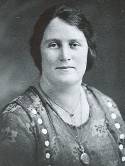
I was born in Grouse Creek, Box Elder County, Utah July 1, 1898, to William Pope Paskett and Annie Louisa Mecham Paskett, in the summer when it was hotter than blazes.
How do I know? I was there. Also, I’ve heard my mother say so, and all kids believe their mothers.
As far back as I can remember we lived in a log house with a dirt roof, and when it rained, it rained inside as well as outside. Some time we kids would get under the table so it wouldn’t rain on us. Mom had tin pans and buckets all over the place. I mean on top of the beds, and wherever the ceiling was dripping mud. But it seemed like we were happy those days. I remember we had such long summers, between May and September. We could hardly wait for school to start again, going back to the house that leaked; we had 3 rooms with a dirt roof. Then Dad built 2 rooms and put shingles on, and we thought there was nothing like that.
Dad had 40 acres of ground, raised hay and grain, and usually had a big garden. There was a few black currant bushes on the place and 20 gooseberry bushes. Picking those things and getting them ready for cooking was a headache, however mother always had the cellar full of bottles of gooseberries, and the jam was out of this world. Dad always had a good garden and sold some of the produce to different people. He could raise the best onions, cabbage, and cauliflower that I’ve ever tasted. We always had enough put away in the cellar for winter use. In those days, Dad bought sugar by the hundred pound sack. And a wagon load of flour to last all winter. As the store was over 50 miles and once a year he would get a load of flour from Tecoma, Nevada or Oakley, Idaho. Grouse Creek was 20 miles from the railroad, and if anyone wanted to go to Ogden, Utah or Salt Lake City, they would ride a wagon or buggy to Lucin, 20 miles away, and get on the train there. The train went across the Great Salt Lake, over Lucin
cutoff.
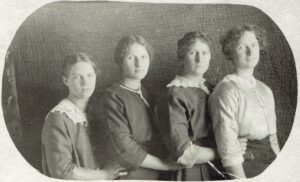
Charlotte. Rhoda, Hattie, Mary Jane Paskett
Years ago when we kids were small, mother used to go out in the field and work just as hard as Dad did. She could pitch hay and grain just as well as anyone. And when I was a teenager I could do that too. And help unload a load of hay using a Jackson Fork to get it to the stack.
There were 10 kids in my mom’s family, 6 boys and 4 girls. Stephen Henry Paskett born April 7, 1892, Frederick William born January 29, 1894, David Mecham Paskett born January 14, 1896, Melvin Oscar born October 25, 1903, Harold Andrew born December 5, 1906, and John M. born October 6, 1908. The girls were Mary Jane born December 17, 1890, Hattie Lovina born July 1, 1898, Rhoda Annie born December 22, 1899, and Charlotte born November 1, 1901. However, Jane was the oldest and I didn’t write them in order, which should have done.
Now I’ll go back to when my grandparents lived in Tetbury, England; James Pope and Charlotte Buckingham Paskett. They had Mormon missionaries living with them.
Grandma made Grandpa’s suits and clothing for her family. Grandpa was a shoemaker and also a good gardener. Grandma did the washing and ironing for the missionaries, and cooking also.
When the family was teenagers, they decided to come to America. They had 3 boys and 5 girls. They settled in Henefer, Utah. Grandfather still made shoes for the town’s people and Grandmother did sewing. She also made yeast by the 5 gallons, and the wives would come get a start of it to make their bread. All Grandmother got in return was a cup full of sugar or flour.
I think Dad was only 17 or 18 when they came to Henefer. He was married in a few years to Sara Hennefer. They had one daughter when he with 3 or 4 more men decided to go to Grouse Creek, Utah to make their homes as they had heard that the grass was greener on the other side of the fence. In the year, Dad, his brother Phillip, his sister Sarah and husband William C. Betteridge, James Simpson, Albert Francis Richins, and their families, each having one or two children, traveled to settle in Grouse Creek, Utah.
They had some hard times. Some of them had a horse or two, and a cow or two, got some plows and harrows somehow, worked the soil, had sickness, death, sad times, and good times. Dad could sing tenor beautiful and so could Uncle Phil. Dad could play the organ and used to play for dances. After a few years, Dad had 6 children to feed; how they all grew up to adults was something. As they grew old enough to go work for someone else and earn their own living they did so.
They all learned from each other what little bit they could about church and school. When they were able they made better houses. They were made of logs and a dirt roof and of course it leaked when it rained. So pans were everywhere it dripped but at that some of the bedding got wet several times.
As years went by more babies came along. Dad had 5 girls and 1 boy. Sarah Patience, Penelope Ann, William James, Louisa Emiline, Cora Mae, and Lillian. Penelope was born in a dug-out a mile or so south of where Dad built his last home. Dad was carpenter. He also mended shoes and was called a cobbler. Sadness came to the home when the 6th child (Lillian) was born on November 22. Her mother Sarah passed away in December. Dad was left alone to raise the family. However, Aunt Sarah Betteridge took Lillian and raised her as their own child.
In another family, there was a young lady by the name of Annie Louisa Mecham, whose father, Lorenzo Dow Mecham came from Pennsylvania and Mary Ann Clark who came from England. Grandpa Mecham help the pioneers along the trail from Nauvoo to Salt Lake City, Utah. Grandma Mary Anne Clark crossed the plains with the hand cart company.
Lorenzo Dow Mecham and Mary Anne Clark met somehow and were married. To them were born 7 children; my mother Annie Louisa being one of them. This family came from Toole, Utah to Grouse Creek, Utah and had a real rough time. I’ve heard mother say that for 2 weeks they had no food. Nothing to eat but pig weed greens and no shoes to wear.
However, when Sarah Ann (Dad’s first wife) died, Annie Louisa Mecham came to keep house for Dad. In a few months Dad and Annie were married. To them were born 10 children; 6 boys and 4 girls. Of which 9 are still living at this time. Mary Jane Paskett Ballingham, Stephen Henry Paskett, Fredrick William Paskett, David Mecham Paskett, Hattie Lovina Paskett Richins, Rhoda Annie Pasket Lee, Charlotte Paskett Weeks, Melvin Oscar Paskett, Harold Andrew Paskett, and John M. Paskett.
This is where I come in. I was born July 1, 1898 at Grouse Creek, Box Elder County, Utah, 5th child of William Pope and Annie Louisa Mecham Paskett. The weather was hotter than Blazes, how do I know? I was there wasn’t I? The earliest I can remember, I think I was 4 or 5 years old. I can see Dad and the family riding away from the church house and left me standing there bawling. I was afraid to walk alone as far as where the team was tied to the hitching pole. I think it was Billy, our older brother who ran back and got me. Dad had the wagon so full of kids anyway, that they hadn’t even missed me.
We lived in a log house with a dirt roof, and every time it rained, the house would leak. And mom put pans and buckets all around to catch the mud. We also had a bucket outside to catch the rain water so we could wash our hair in soft water. In the winter time, we melted snow to do the same thing. Mother had melted gallons of snow to do the washing of clothes.
I went to school and liked it very much until I got in the 5th grade then the teacher said that a boy, David Cooke, and I should be in the 6th grade, and he did not have a sixth 6th grade, only we two. And he put us in the 7th grade. I’ve been more than dumb ever since. I can’t even remember what I did learn. I have always hated that teacher ever since. I can remember songs real well, but as for grammar, arithmetic and geography, it’s all Greek to me.
I can remember the old log church house, and it seems as if it had a dirt roof too, and then another one was built which was dusty and we had to keep the fires going in the winter. There were several coal oil lamps fastened to the walls in little rack like things that hung on nails. We had to fill the lamps with oil and clean the chimney of each one. Sometimes the chimney which was glass would get broken and we would have to replace it of course. I’ve forgotten whether Mother got pay for working at that or not. If she did I never did know how much but I just imagine that she did.
Times were hard in those days. We kids went bare foot a lot at home so we could have shoes for Sunday. We usually all went to church unless someone was sick. We lived a mile from the church and walked when the weather was good and sometimes when it wasn’t so good. When the snow was on the ground Dad would take the team and bob sleigh and all the neighborhood within the mile would run out and catch a ride with us. The sleigh would be full of people all standing up by the time we reached the church. And that was the case to Mutual and to dances. We had our Sunday school at 10 am, Sacrament meeting at 2 pm and Mutual each Sunday night a 7:30 pm. Relief Society at 2 pm on Tuesday, Primary on Thursday at 2 pm, always choir practice at 7 or 7:30 pm every Wednesday night.
Usually, every Friday night would be a dance, and everybody went to the dance; kids and all. The mothers didn’t have babysitters in those days. All babies who were too small to walk around were put to bed on benches. The spaces for beds were benches put together so the kids wouldn’t fall off, and they slept while the fathers and mothers danced.
We used to have basket lunches at the dances too. The ladies would fix a fancy box trimmed with crepe paper and ribbons and fill with lunch for 2. Of course, the ones who were in a big family had to use a dish pan or larger box. When eating time came the men would draw ladies name from a hat, whoever the ladies name was, the man would eat with her. Often times, a young squirt would have to eat with a big family, but everyone seemed to enjoy those dances better than any other.
One time when mother was going to have a baby, it must have been Harold I think because it was winter and freezing time. Anyway, Mother had a clothesline full of lovely white diapers as she always washed them before using them. As they were hanging all frozen stiff, I got a sharp stick that was close by and I hit several diapers splitting them down the middle. I had a mad mother I’ll tell you. I never changed a baby’s diaper since without thinking of that. Course mother had to go to the trouble to mend them. She should have blistered me good, but I think she only gave me a good talking to.
Another time at school, I think I was 13 or 14 years old, another girl (Leona Wakefield) and I wanted to play hooky, which we did, and told the teacher we were sick. So, we went to the Wakefield home which wasn’t far away. Leona told her mother we were sick and couldn’t go any more that day. You know what her mother did? She made us get undressed and go to bed, in different rooms mind you. Gave us some castor oil, and kept us there until school was out in the afternoon. I’ll tell you, I never did let Mrs. Wakefield know when I was playing sick anymore.
Once when I was 11 or 12 years old, I guess, Dad and Mother had gone somewhere and left us kids home. We girls had never been allowed to dress up like boys. Anyway, this day I got some of my brother’s clothes and was the man of the family. Course I was going to be dressed as I should be by the time they got home but they came too soon. Brother, what a crime I had committed. I had 2 long black braids of hair and I had it all tucked up under a cap. Dad made me think he was going to cut my hair off and oh how I bawled. I promised not to wear men’s clothes anymore. Our grandparents would turn over in their graves if they could see the younger generation now days.
Seems like years ago people used to visit each other more than we do now days. I know especially on Thanksgiving Day, Christmas and New Years, several families would have dinner together. I always liked to go to our Grandma’s house for dinner. Aunt Ruth’s family, Aunt Polly’s family (mother’s sisters) they all had a bunch of kids, guess that’s why we always liked to get together. Aunt Polly lived in Etna west of Grouse Creek. There was a small hill not far from the house and in winter we would sleigh ride down the hill or sit on a scoop shovel or dish pan and go down the track.
We used to have lots of snow in Grouse Creek. Months at a time and drifts over the fences. Dad has driven the team and sleigh up over them time and time again; seemed like they would use the sleigh 4 months and sometimes longer. Dad had 2 bay horses called Cub and Brownie. Fred would take them on the sleigh and fill the sleigh with young couples. We’d have quilts and blankets to keep warm. We would sing and sleigh ride half the night. I have often said if I had a dollar for every mile that old Cub and Brownie traveled, I could buy me a coat. No one else in town seemed to have any horses, driver, or sleigh. Anyway, we had good times.
Through the winter months we would stage plays. I wasn’t in so many of them, but my brothers and sisters were. Midas Wakefield, Wilford Richins, Bill Betteridge, Frank Paskett were the main push and they put on some good plays. They traveled over to Oakley, Idaho and to Declo, Idaho with some of their plays and I think they didn’t have automobiles then either. They used horses and wagons.
The first auto that came to Grouse Creek was a one-seater and had a bar across in front of the driver instead of a steering wheel. Dave Toyn was the one who owned it and of course, everyone wanted to ride in it. However, soon a few fords came to town only they called them Jitneys. That is when I learned to drive a car. Frank and Ed Lee, our cousins, had a car and they let me learn on that. I was about 17 or 18 years old then I guess.
(Conclusion by one of Hattie’s sons; DeVerl Richins)
Unfortunately for us all, Mom wasn’t able to write anymore of her history, but I’d like to
reminisce for a page or so about some of the things I remember about her.
As a young boy I can remember our family not having too much as far as worldly things, but I don’t ever recall Mom complaining about it. We never had carpet or drapes, but she made the best of what she had. I can recall in the summertime how worried she would get when the water came in the canal and irrigation ditches for fear some of us would drown. She couldn’t swim and I guess that’s why she was worried.
I can also remember when she would spray for flies the summer. The stuff was so strong we couldn’t go in the house for half-a-day and when we could there would be thousands of dead flies all over the house. But I guess that was a common occurrence in every house those days.
Mom had a knack for tending kids. Whether she liked it or not I don’t know but it seemed to me she always had someone’s kids to tend besides her own. A good portion of her life was spent caring for someone. Before she got married she spent several years caring for member of the Betteridge family and as she mentioned in her writing of this history that she was caring for some lady in Burley while she was writing her history.
After we children were gone from home, Mom spent several years working at night at the potato mills in Burley. She made barely enough money to make a car payment.
I can remember when Dad bought the General Electric stove and refrigerator. She was so used to cooking on the old wood/coal stove that it took her years to really get so she could cook without burning things on the new one. She cooked hundreds of meals for farm workers that Dad would have hired for helping in the fields. Nothing fancy just beans, potatoes, meat, and then in the summer we’d have fresh vegetables.
Mom enjoyed wherever she was. She made herself at home any place and made people feel at ease when she was around.
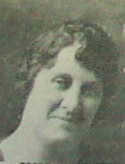 On February 7, 1969, Mom and Dad drove to Burley to do some shopping and then afterward drove over to Gayle and Bonnie’s place to visit for a few minutes. When they went home they took Gayle’s daughter Janette with them. At the intersection about four miles west of their home (it was called Marchant’s corner) they had a collision with a pickup truck and Dad was killed instantly. Mom was driving and was injured severely and passed away four days later, February 11, 1969. They were both buried in the Declo cemetery on February 12, 1969. Janette was injured somewhat and still has some scares as a result. They are buried in the Declo, ID Cemetery.
After Mom and Dad were gone, the family had a council and decided to rent the farm for a year or two. Eventually, it was sold and now as we return to Declo to visit we drive past the farm and remember how it was when we lived there. Whether the memories were good or bad they are part of our lives and will become part of our history as we write it.
(Typed by Curtis Gayle Richins—grandson of Hattie Lovina Paskett Richins and Wilford Francis Richins, Curtis Gayle Richins is the son of Wallace Dean Richins and Priscilla Marie Allred Richins)